Getting Lost in Ocala National Forest (And Why You Should)
Forget the theme parks. Florida's oldest national forest is a tangled, sandy, spring-fed reminder of what the state used to be.
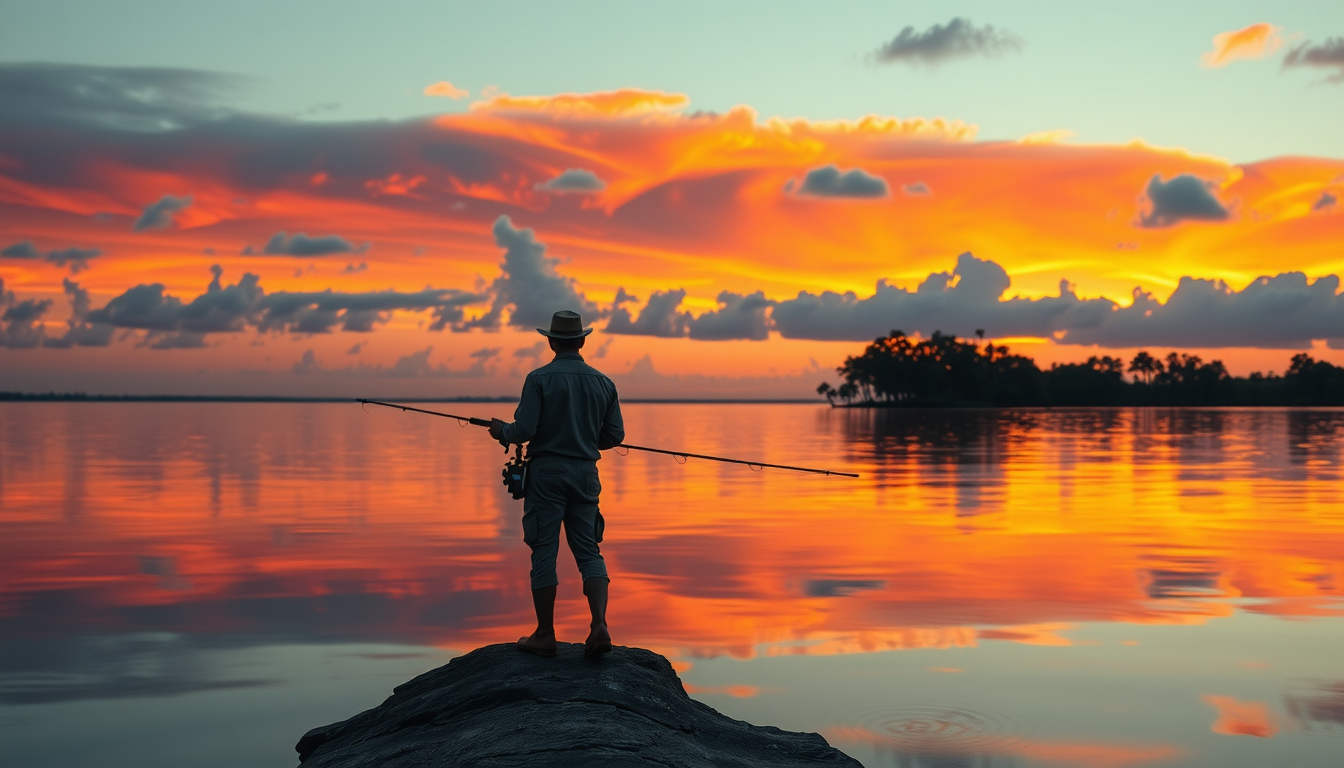
“lone fisherman casting line into glassy Lake George at sunset, mirror-like water reflecting sky
There is a specific kind of quiet you only find when you're standing ankle-deep in seventy-two-degree spring water,
surrounded by ancient sand pines, wondering if you've somehow driven off the edge of the map.
The Ocala National Forest doesn't care about your itinerary. It doesn't have a fast pass, and the only lines you'll find are the ones cast by hopeful fishermen into the glassy surface of Lake George.
It's a place where cell service goes to die, and your sense of wonder is forcibly resurrected.
Ancient Expanse
There is a place in the heart of Florida where the conventional, postcard-perfect image of the state—endless white-sand beaches,
sprawling, humid wetlands, and manicured theme parks—fades away entirely.
In its place rises an ancient, sun-scorched wilderness that feels utterly otherworldly, a landscape that defies the lush, tropical expectations of the peninsula.
This is the Big Scrub of the Ocala National Forest. Covering hundreds of thousands of acres, it stands as the largest contiguous block of sand pine scrub remaining anywhere in the world.
It is a breathtaking, harsh, and undeniably beautiful environment, a profound testament to the resilience of nature in the face of relentless heat, nutrient-poor soils, and extreme conditions.
To step into the Big Scrub is to step back in geological time, entering a unique and captivating ecosystem that demands both respect and awe from anyone who dares to traverse its sandy, sun-drenched depths.
An Ecosystem Born of Fire and Sand
To truly understand the Big Scrub, one must look back millions of years to the Pleistocene (often called the Ice Age) epoch, a time when global sea levels were drastically higher than they are today.
During this era, the central ridge of Florida was not a continuous landmass, but rather a chain of isolated islands surrounded by a shallow, prehistoric sea.
As the oceans eventually receded, they left behind massive deposits of marine sand, creating the rolling dunes that define the Ocala National Forest today.
This ancient, well-drained sand is incredibly poor in nutrients and holds almost no water, creating a desert-like environment in a state otherwise known for its abundant rainfall.
Yet, it is not just the sand that shaped this land; it is fire. The Big Scrub is a fire-maintained ecosystem,
born of and dependent upon the lightning strikes that accompany Florida’s violent summer thunderstorms.
Without periodic, high-intensity wildfires, the scrub would eventually be overtaken by hardwood forests, and its unique flora and fauna would vanish.
The plants here have not merely adapted to survive fire; they actively rely on it for their reproduction and continued existence.
creating a cycle of destruction and rebirth that has played out across these dunes for millennia.
The Sentinels of the Scrub: The Resilient Sand Pine
As you stand at the edge of this vast expanse, the first thing that strikes you is the sheer scale and character of the towering sand pine trees (Pinus clausa).
These are not the perfectly straight, uniform pines of a commercial timber plantation; rather, they are rugged, battle-scarred survivors.
Their gnarled trunks and twisting branches tell a silent story of decades spent battling the elements—the fierce winds of passing hurricanes,
The blistering summer heat and the constant struggle for limited nutrients.
They stand as silent sentinels across the landscape, their deep green needles providing a stark, vibrant contrast against the brilliant, unyielding blue of the Florida sky.
On most days, only a few wispy, cirrus clouds dare to interrupt this, offering little reprieve from the intense, beating sun.
The sand pines lean and curve, shaped by the prevailing winds and their desperate, competitive search for sunlight. This creates a chaotic yet harmonious canopy that filters the harsh, direct light into a dappled, golden glow on the forest floor.
Interestingly, the Ocala variety of the sand pine possesses serotinous cones—cones that remain tightly sealed shut by natural resins until the intense heat of a wildfire melts the resin,
releasing a shower of seeds onto the freshly cleared, nutrient-rich ash below, ensuring the next generation of the forest.
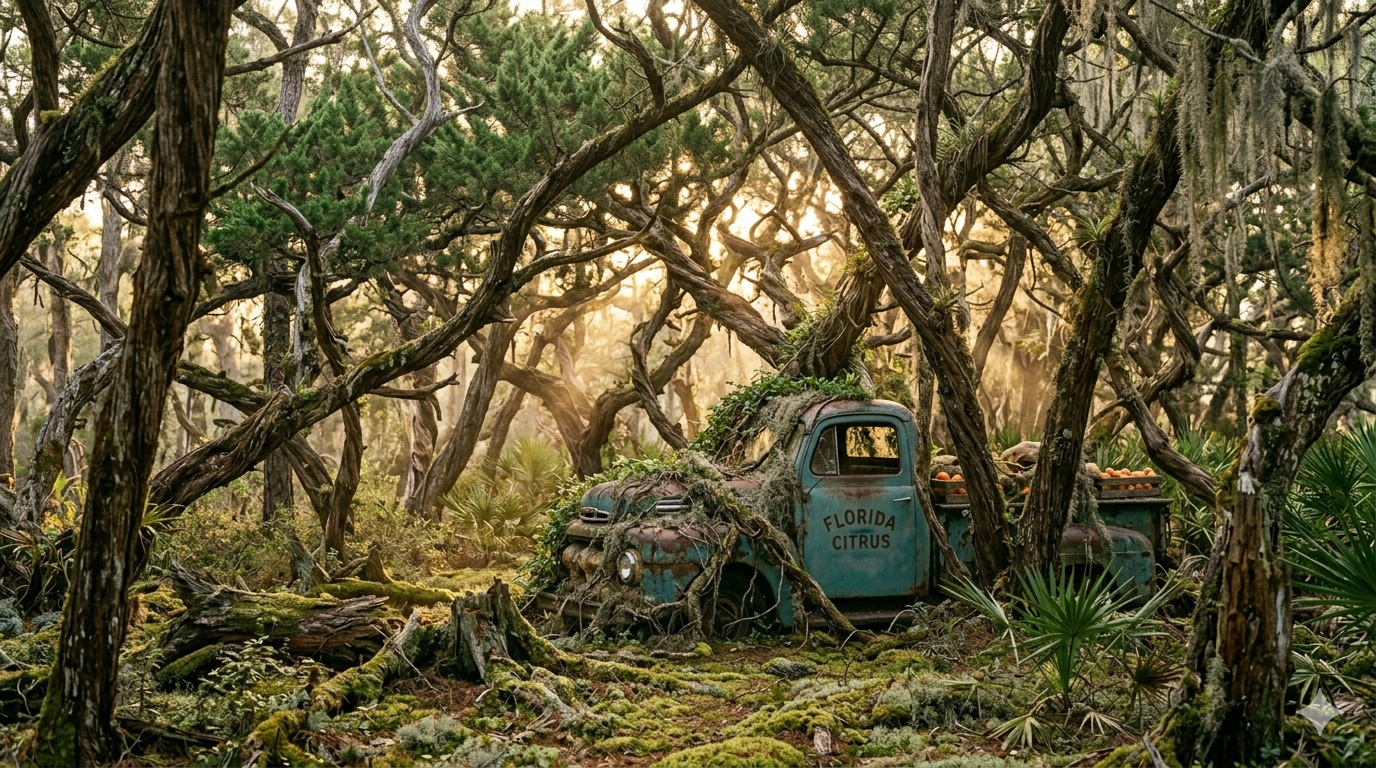
surreal landscape of a sand pine forest, where the twisted, gnarled trunks of these wind-sculpted trees stretch towards the sky
A Labyrinth of Life: The Dense Understory
Beneath this rugged, twisting canopy lies a dense, almost impenetrable sea of understory vegetation.
To the untrained eye, it might look like a simple brushland, but it is a highly specialized community of plants. The scrub oaks—including the myrtle oak,
sand live oak, and Chapman's oak—dominate this lower tier. With their thick, leathery,
and often curled leaves designed specifically to minimize water loss and reflect the harsh sunlight,
they form a tangled labyrinth that provides crucial shade and habitat for the forest's elusive wildlife.
Interspersed among the oaks are the iconic saw palmettos, their fan-like, serrated fronds sprawling outward like defensive shields across the sand.
The palmettos thrive in this harsh environment, their thick, creeping, fire-resistant root systems (rhizomes) remaining safely buried beneath the soil,
allowing them to rapidly resprout in the days and weeks following a blaze.
Weaving through it all is the delicate, thread-like wiregrass. This subtle but vital component of the landscape sways gently in the dry breeze, adding a soft, kinetic texture to an otherwise rigid and rugged terrain.
Together, these plants form a dense thicket that is as beautiful as it is formidable.
The Shifting Sands: Navigating the Ancient Dunes
The terrain of the Big Scrub is a marvel of geological history and a physical challenge to explore.
It undulates with gentle hills and rolling sandy dunes, the very same dunes that once formed the beaches of Florida's prehistoric islands.
The sand here is incredibly fine, often referred to as "sugar sand," and it is blindingly white in patches where it is exposed to the direct sun without the cover of pine needles or oak leaves.
It has been worn smooth by millennia of relentless Florida sun and wind, creating a landscape that feels both deeply permanent and constantly, subtly shifting.
Walking through these dunes requires genuine physical effort.
The soft, yielding sand gives way beneath your boots with every stride, making every step a deliberate, energy-consuming act.
The heat radiates upward from the white earth, baking the air and creating shimmering mirages that blur the line between the ground and the horizon.
Yet, there is a profound grounding effect in this physical exertion.
The resistance of the sand forces you to slow down, to match the unhurried pace of the ancient ecosystem around you, forging a deep, tactile connection between the hiker and the earth.
A Symphony of the Wild: The Sights and Sounds of Isolation
The atmosphere of the Big Scrub is not merely visual; it is a deeply immersive sensory experience.
The air is thick and heavy with the sharp, resinous scent of pine needles baking in the midday sun, mingled with the earthy,
slightly sweet aroma of dry palmetto fronds and sunbaked sand. It is a clean, wild, and intoxicating scent that clears the lungs and sharpens the mind,
entirely distinct from the humid, organic smell of Florida's swamps.
The silence of the forest is profound, yet it is never truly quiet. The air vibrates with the gentle, rhythmic rustle of oak leaves and pine needles catching the wind.
If you are patient and still, the scrub reveals its inhabitants. In the distance,
The call of a Florida scrub-jay—a rare, highly intelligent, and fiercely territorial bird endemic only to this specific habitat—echoes through the trees.
It’s harsh. SOUND serves as the unmistakable voice of the scrub.
You might also hear the sudden, dry rustle of a six-lined racerunner darting across the hot sand, the slow,
scraping of a gopher tortoise navigating through the wiregrass, or the heavy,
deliberate crashing of a white-tailed deer retreating into the safety of the dense underbrush.
The Distant Giants: A Contrast of Ecosystems
As you cast your gaze outward from the crest of a high dune, the horizon offers a striking visual dichotomy that highlights the unique geography of the region.
In the distance, where the elevation dips slightly, and the soil transitions to hold more moisture,
The silhouettes of majestic bald cypress and sprawling live oak trees rise like dark, brooding sentinels against the sky.
These distant giants, often draped in ghostly, trailing Spanish moss, stand in stark contrast to the warm, golden, and olive tones of the immediate sand pine forest.
They serve as a powerful visual reminder of the diverse micro-ecosystems that exist within the boundaries of the Ocala National Forest.
It is a sudden, dramatic transition from the arid, desert-like scrub to the lush, humid swamps, spring runs, and flatwoods that Florida is more commonly known for.
This proximity highlights the isolated nature of the Big Scrub—it is quite literally an island of dry, ancient sand marooned in a sea of subtropical humidity.
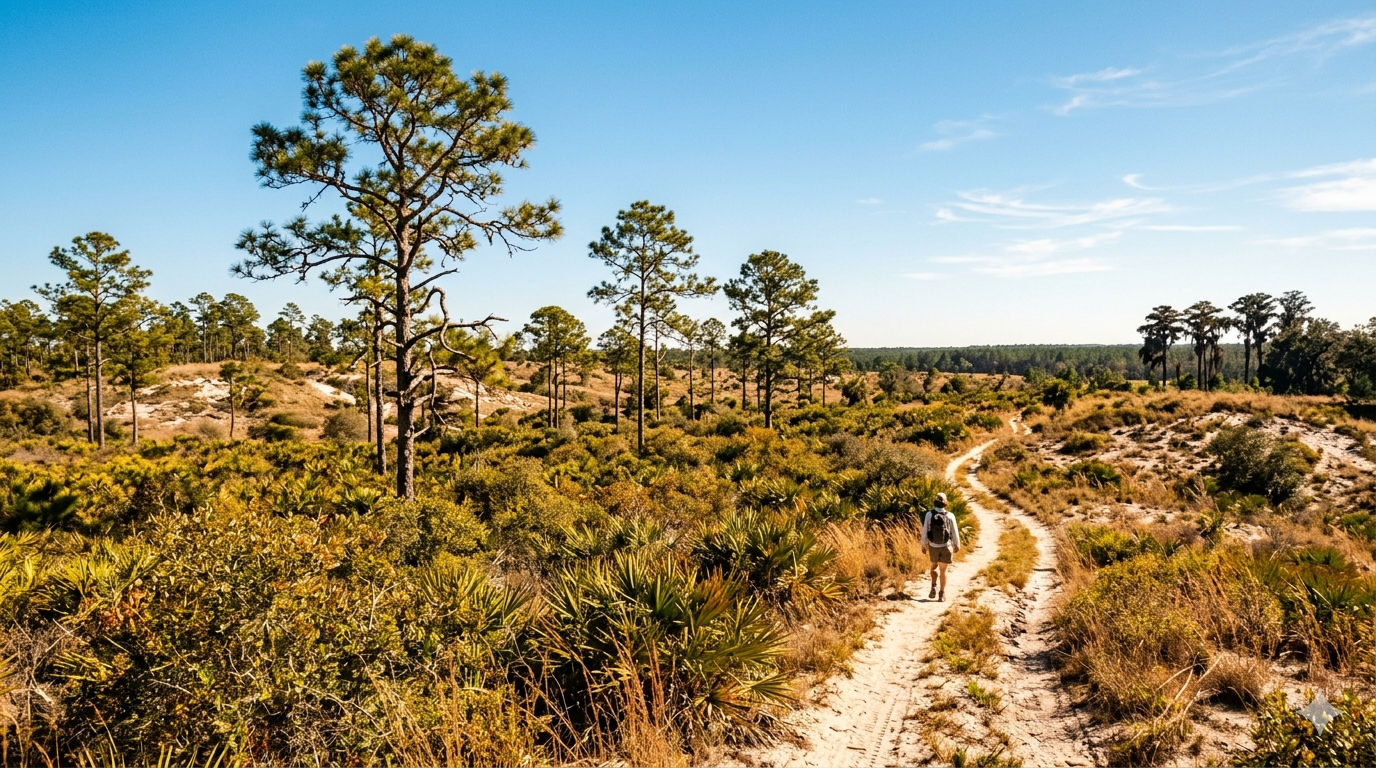
Ocala National Forest
The Lone Hiker's Pilgrimage: Solitude in the Sun
For the lone hiker, navigating this landscape is an exercise in profound solitude and introspection.
There is a deep, almost overwhelming sense of isolation to be found here, a feeling of being wonderfully lost in a vast, untamed expanse that cares little for human presence.
As you walk, the only immediate sound is the soft, rhythmic crunch of sandy soil beneath your feet, a metronome marking your passage through the wilderness.
It is an environment that strips away the noise and distractions of the modern world, forcing you to be entirely present.
You begin to pay attention to the subtle, intricate details that you might otherwise overlook: the complex, puzzle-like patterns of bark on an old sand pine,
The delicate, perfectly preserved tracks of a bobcat or a tortoise in the soft sand, the sudden,
Brilliant flash of a swallowtail butterfly's wings against the muted greens and browns of the scrub oaks.
The solitude here is not lonely; rather, it is expansive, offering a rare opportunity to connect with a landscape that has remained largely unchanged for thousands of years.
The Enduring Legacy of Florida's Desert
The Big Scrub is not a gentle, forgiving landscape. It does not offer easy comfort, shaded, manicured paths, or the lush, overflowing abundance of a rainforest.
It is raw, wild, and unapologetically harsh.
Yet, it is precisely this harshness that makes it so deeply captivating and ecologically vital.
It is a place where life clings on with fierce determination, adapting to extremes of heat, drought, and fire in brilliant and beautiful ways.
The gnarled sand pines, the resilient scrub oaks, and the ancient, rolling dunes all speak to a deep, enduring strength.
To stand in the heart of the Ocala National Forest's Big Scrub is to witness the raw power and beauty of the natural world in its most unvarnished state.
It is to feel the heat of the sun on your skin, the grit of the ancient sand in your boots, and the slow, steady pulse of an ecosystem that has survived and thrived against all odds.
As the sun begins to dip lower in the western sky, casting long,
dramatic shadows across the dunes and painting the few wispy clouds in breathtaking hues of fiery orange, deep magenta, and bruised purple,
the true magic of the scrub reveals itself. It is a landscape of stark contrasts and subtle, hidden harmonies, a sun-scorched masterpiece that leaves an indelible,
lasting mark on the soul of anyone lucky enough to experience its vast and captivating expanse.
If the stories made you smile, learn something new, or remember old Florida, you can support the project with a small coffee.
Every cup helps keep the stories coming.
End of the Trail (For Now) Thanks for joining our first Friday expedition! Florida Unwritten is a labor of love dedicated to the places the brochures forget.
Earl lee
Florida Unwritten
