Lost in the Sawgrass: The Poetry of the Airboat
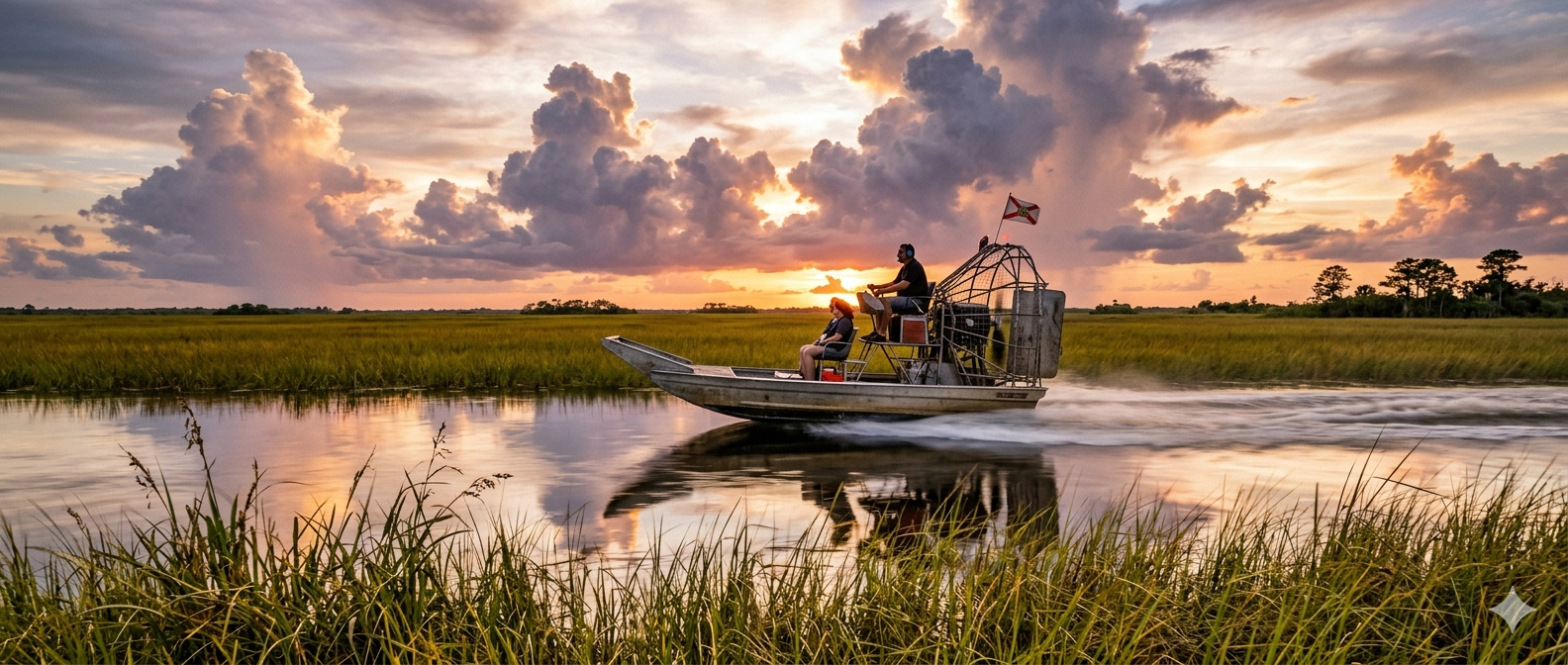
a classic Florida airboat skimming across a golden-green sawgrass prairie at sunset.
The first thing they don’t tell you about the Everglades is that it doesn’t smell like a swamp.
It smells like crushed stalks of green grass and ancient, sun-baked secrets.
The second thing they don’t tell you is that if you want to see the real Florida—the one that existed before the mouse ears,
and the neon—you have to be willing to get a little bit deaf for a while. Standing on the edge of a canal,
Looking at an airboat, you aren’t looking at a vessel; you’re looking at a giant fan strapped to a metal baking sheet.
It looks like it shouldn't work. But then the engine turns over, a roar shakes the marrow in your bones, and suddenly, you aren’t just moving. You’re flying.
The Great Grass Wall
From the window of a car on I-75, the Everglades looks like a flat, monotonous carpet of green.
It’s a backdrop, a blur you pass on your way to Naples or Miami.
But once you’re perched on that high airboat seat, the perspective shifts. The "River of Grass" isn’t just a poetic nickname;
It’s a literal description of a world where the water is only a foot deep and the horizon is a shimmering mirage of sawgrass.
As we pushed off, the boat didn't sink into the water; it skimmed across the surface like a skipped stone.
The wall of grass that looks solid from the highway parted like the Red Sea, revealing hidden prairies and lily-pad highways.
There’s a strange magic in the realization that you are traversing a landscape that is neither entirely land nor entirely sea, but a secret third thing that belongs only to Florida.
The Symphony of the 454
You don't talk on an airboat. Not unless you want to swallow a dragon-fly or scream yourself hoarse.
Instead, you wear those oversized, foam-padded earmuffs that make everyone look like they’re working ground control at MIA. This creates a beautiful, forced isolation.
With the roar of the Chevy 454 engine drowning out the world,
Your other senses go into overdrive. You feel the vibration in your teeth. You feel the spray of the "black water" (which is actually as clear as gin,
stained by the tannins of the trees) against your skin.
There is a strange poetry in the noise—a mechanical scream that somehow harmonizes with the wind whipping past your ears.
It’s the loudest way to find peace I’ve ever discovered.
Gladesmen: The Keepers of the Compass
Our captain was a man who looked like he was carved out of driftwood and cured in the sun.
He is what we call a "gladesman." To him, this isn't a "wetland"—it’s his backyard. Without a GPS or a single landmark higher than a cypress knee,
he knew exactly which bend in the grass led to a hidden "hammock"—a small island of hardwood trees rising out of the muck.
He cut the engine in the middle of a vast opening, and the silence that followed was heavy and immediate.
In that stillness, he pointed out things you’d never see from the road: a purple gallinule stepping delicately across lily pads,
the prehistoric snout of a gator tucked into the shade, and the way the sawgrass actually has tiny teeth (hence the name).
He spoke about the water levels like an old farmer talks about his crops.
To the gladesmen, the Everglades isn't a wilderness to be conquered; it’s a living, breathing relative that demands respect.
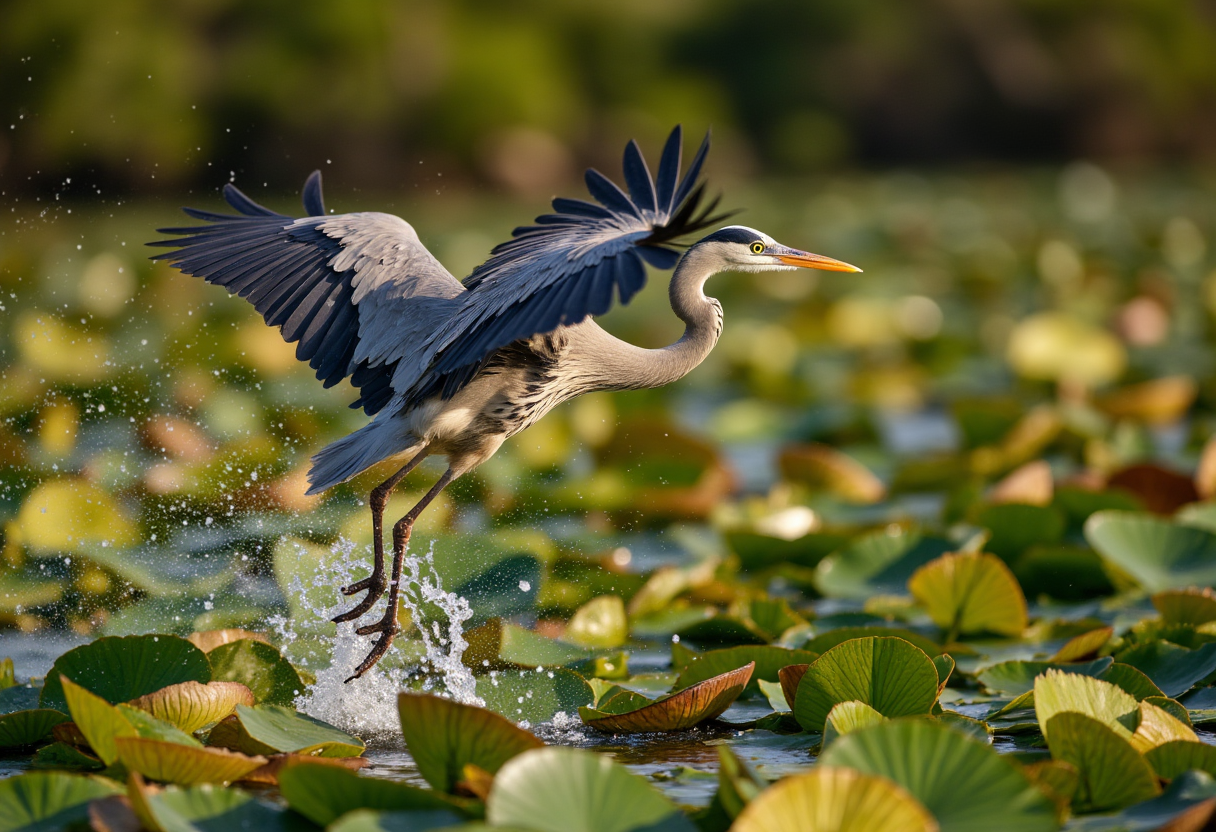
a single Great Blue Heron taking flight from a cluster of vibrant green lily pads
Skimming the Surface of Time
There is a specific nostalgia that hits you when the boat reaches top speed, and you’re gliding over a wet prairie.
It feels like 1950. It feels like the Florida of old postcards and black-and-white photos.
You start to understand why people fell in love with this place before air conditioning made it livable.
There’s a freedom in the airboat—a sense that you can go anywhere the water touches.
We zipped through narrow "trails" carved by generations of gators and boats, the grass brushing against the metal hull with a sound like a thousand whispers.
For those few miles, the strip malls and the traffic jams of "Real Florida" didn’t exist. There was only the sun, the wind, and the endless green.
Finding the Magic in the Muck
Eventually, the boat slowed, the engine gave one last guttural cough, and we drifted back toward the dock.
Stepping off the boat, your legs feel a little heavy, and your ears ring with a faint, ghostly hum. But you look back at that sea of grass with different eyes.
The Everglades isn't just a swamp; it's a cathedral of light and water.
It’s a place where the poetry is written in the ripples of the current and the shadows of the clouds.
If you’re willing to leave the pavement behind and embrace the roar of the fan,
you’ll find a version of Florida that stays with you long after the mud on your shoes has dried.
Earl Lee
Florida Unwritten
