The Swamp Always Wins: My Shortcut Through the Sawgrass
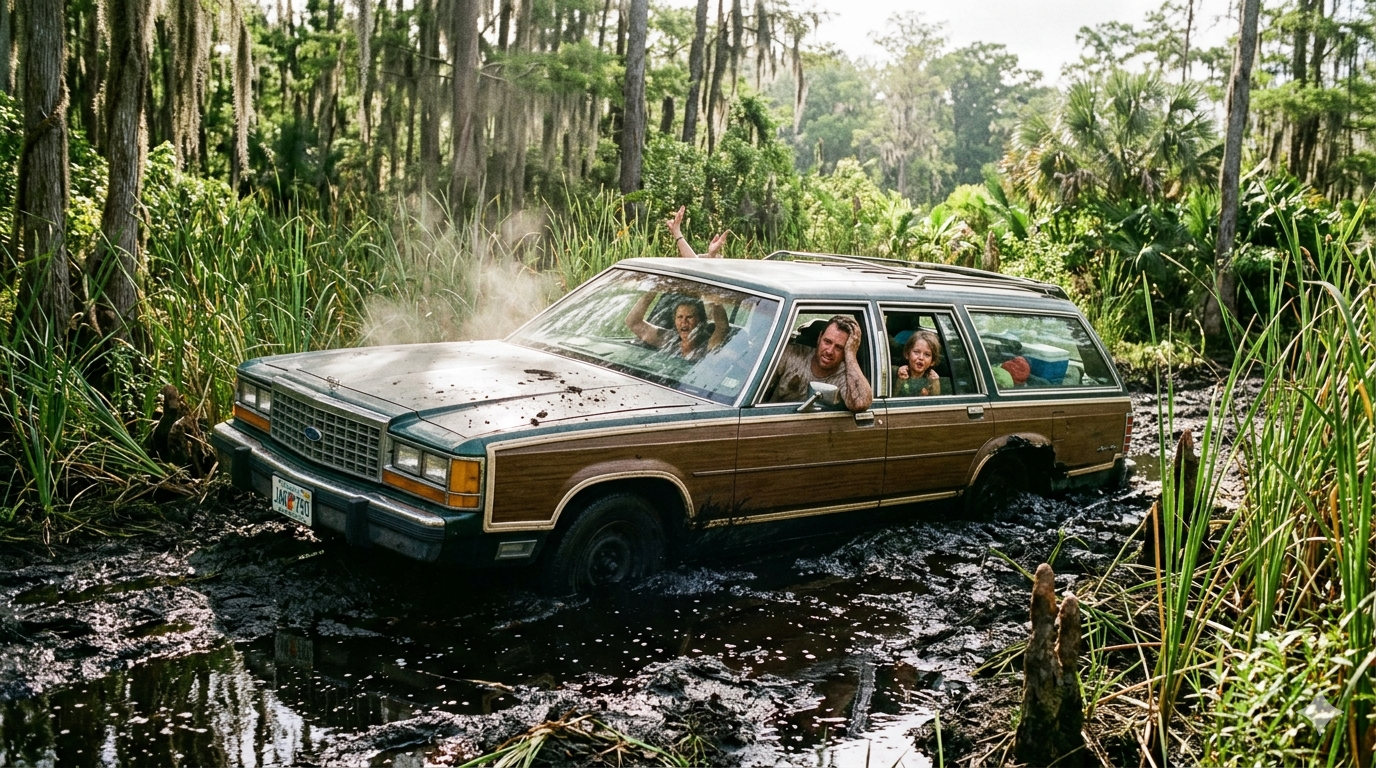
station wagon stuck deep in thick, black Florida swamp mud
If you’ve lived in Florida long enough, you develop a relationship with the heat.
It’s not just weather; it’s a living entity, like a damp, invisible relative that shows up every year and never leaves the couch.
My grandfather, a native Floridian who measured time by hurricanes and orange harvests, used to say,
“Never argue with the heat, and never, ever try to outsmart the swamp.”
In his day, “outsmarting the swamp” meant trying to drain a piece of sawgrass with a shovel.
In my generation, it apparently meant believing a GPS over a local. This is the true story of how I learned, with significant itching, that in the match between Man and the Greenery,
the sawgrass always has the home-field advantage.
The Flawless Plan (On Paper)
It was one of those perfect, sticky, early summer mornings.
My cousins were visiting from Ohio, smelling faintly of sunscreen and Midwestern hope. The agenda was simple: introduce them to the real,
"unwritten" Florida—the vast, ancient mystery of the Everglades.
Specifically, we were headed for an airboat tour near Everglades City,
a small town that feels less like a city and more like a collection of polite suggestions that it might be connected to the rest of the world.
Looking at the map, my father—a man who prides himself on optimization and "local knowledge" (gained largely from reading brochures)—proposed a shortcut.
He pointed to a thin white line on the map that circumvented the main entrance of the national park,
promising a scenic drive that would shave fifteen minutes off our time. “It’s a dirt road, maybe,” he said with a confident wave, “but it’s a classic Florida route.
More authentically swampy.” We should have listened to the ominous hum of the distant insects.
Instead, we cheered. We wanted authentic.
A perfect morning, before the mosquitoes discovered us.
When the Dirt Became Mud
For the first ten minutes, the shortcut was exactly as promised.
The dirt road was framed by sawgrass that rose nearly to the windows of our station wagon (the 1993 model, a beast built of faux-wood paneling and air-conditioning prayers).
The light was that hazy, golden-green you only get in South Florida before noon.
I was busy narrating a National Geographic documentary in my head when the road quality abruptly downgraded.
It didn't just get bumpy; it got soft. The "shortcut" decided it was done pretending to be a road and wanted to return to its original form:
a marsh. With a wet slurp, the station wagon’s engine sputtered and died. We were stuck.
Not just "pull over and wait for help" stuck, but "the wheels are invisible, and we are sinking" stuck.
The silence that followed was massive.
It wasn't an empty silence, but a vibrating one, filled with the buzzing,
clicking, and chirping of a hundred million tiny life forms that knew we weren't going anywhere.
We rolled down the windows, hoping for a breeze.
There was no breeze. Only the swamp’s thick, humid breath, carrying the scent of damp earth and something distinctly unpleasant.
This is the moment optimization meets its match.
“We specialize in the Florida you won't find on a postcard. Keeping these stories 'unwritten'—but not forgotten—takes plenty of caffeine and even more bug spray. If you loved today's tale, you can buy me a brew to help keep the lights on. I'm glad you're here for the
Ride.
The Ten-Second Truce
“Well,” my dad sighed, the optimization coach leaving his eyes. “Everyone, grab your boots.”
We stepped out onto the "road," which was now a soupy mess of mud and sawgrass. My Ohio cousins, who were wearing pristine sneakers,
just stared at the ground. This is where we learned our next lesson.
For exactly ten glorious seconds, we stood in awe. A Great Egret, as white as milk,
landed silently thirty feet away. We could hear the gentle rustling of the sawgrass, a sound like dry paper rattling.
It was breathtakingly beautiful, a scene untouched by the highway. We felt, briefly, like explorers.
Then, they found us.
It started as a single, annoying zzzzzt. Within thirty seconds, we were at the buffet.
The mosquitoes weren't the tiny, polite pests we were used to. These were Florida mosquitoes—large, determined,
and apparently hungry for Midwest travelers and their hopeful guides.
We were a human SWAT team, desperately trying to protect every exposed inch of skin.
We used our hats, our maps (now useless, ironically), and our hands in a flailing, desperate dance.
Finding Our Way Out (The Hard Way)
In a rare moment of clarity between slaps, my father spotted a small sign hidden behind the grass, maybe fifty feet down the marsh.
It wasn’t a road sign; it was a property marker. And where there’s a marker, there’s usually… something.
Leaving the station wagon to its muddy fate, we began to wade. This was the "metaphorical" part of being lost in the sawgrass.
We weren’t physically separated from civilization; we were just deep in its reality.
We had to trust that walking toward a different point of mud was better than staying still.
For twenty agonizing minutes, we waded. The mud sucked at our boots, making every step a victory.
The sawgrass occasionally scraped our skin (it’s called saw-grass for a reason, you know). We were a sweaty, muddy, itching procession of defeat.
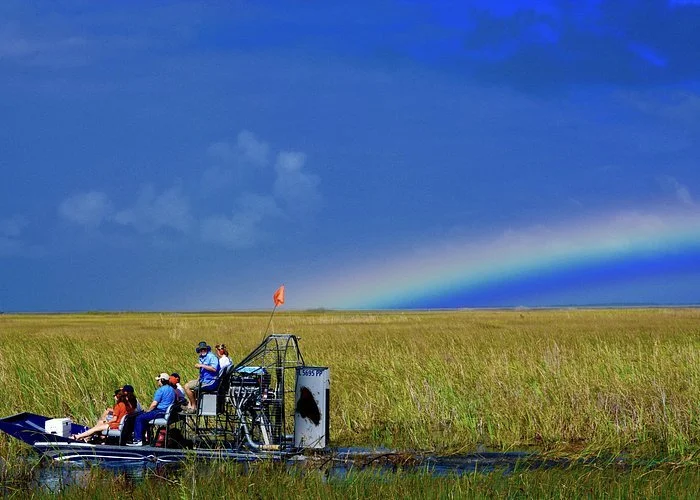
Air Boat ride in river of grass
We eventually reached a small, slightly elevated gravel path that led back to a state highway.
A very nice local rancher, who seemed to have anticipated our arrival, was already pulling up in a truck large enough to have its own weather system.
He looked at us—covered in mud, slapping our faces, eyes wide—and didn't even say a word.
He just hooked a massive chain to our station wagon and hauled it, with a giant, wet pop, back to solid ground.
A local hero, ready for his standard rescue mission.
A Warm, Itchy Remembrance
We never made it to the airboat tour that day.
We spent the afternoon at a roadside diner, nursing lukewarm Cokes and the profound regret of that "optimizing" moment.
Our skin was striped with sawgrass scratches and polka-dotted with a hundred mosquito bites.
We didn't look like explorers; we looked like we’d lost a fight with a salad bar and a cloud of aggressive dust.
But you know what?
We still laugh about it. That muddy "shortcut" gave us a story far more authentic than any brochure promised.
It taught my Ohio cousins that Florida is not just theme parks and beaches—it is a wild, resilient,
beautiful force that demands respect. We might have gotten lost in the sawgrass, but we found a memory that will stick with us, itchy or not.
The swamp always wins. And that’s exactly how it should be.
Have you ever taken a Florida "shortcut" that became an adventure? What’s your own True Story of the Greenery? We’d love to read your itchy, muddy, and warm memories in the comments below, or send us your unwritten tale.
Florida Unwritten is a weekly letter about the quieter side of the state.
Springs that stay cold in July, towns the highway forgot, and the kind of places you only find by slowing down.
Every Friday morning, one good Florida story.
Earl Lee
Florida Unwritten
