Kings and Queens of the Fifty-Yard Kingdom: The Magic of Spoil Island Camping
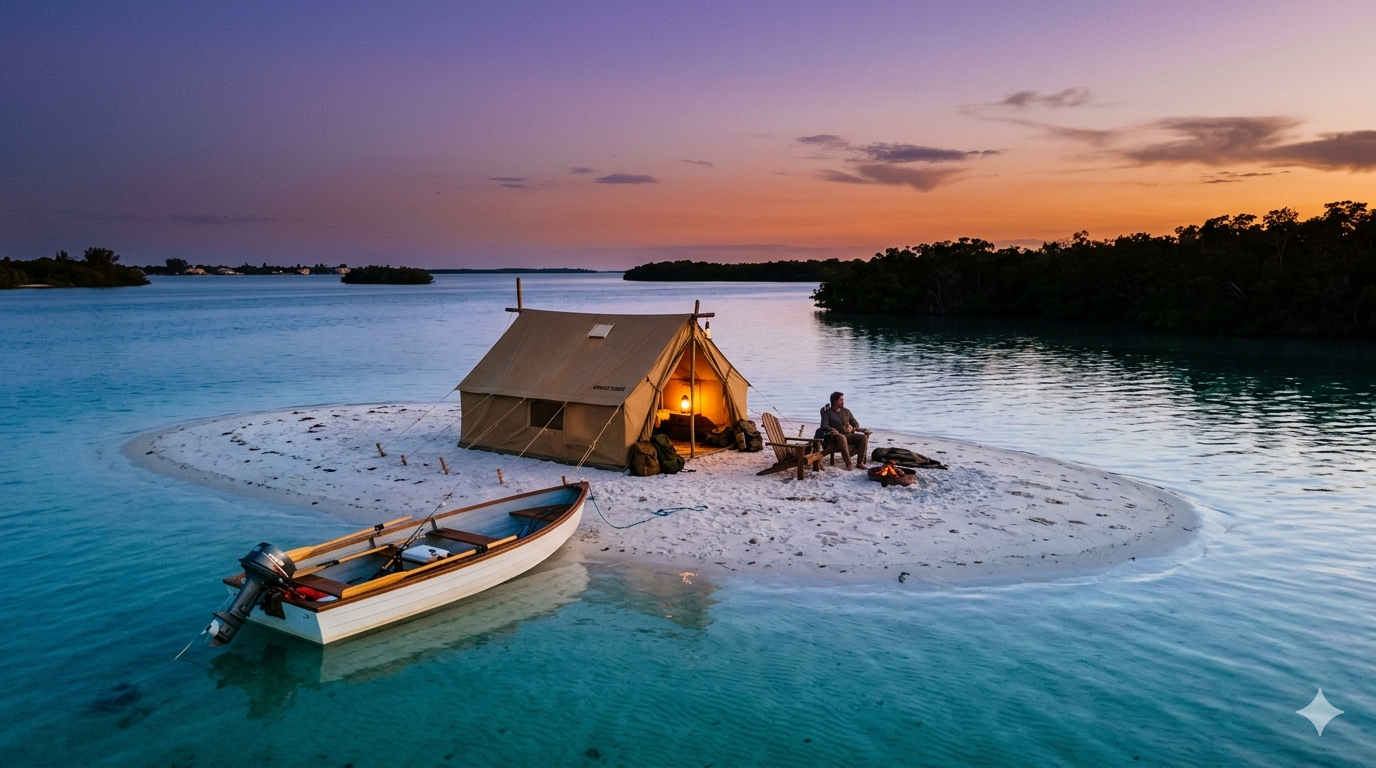
a lone vintage-style canvas tent pitched on a tiny, white sandbar
Florida’s coast is a Masterclass in fleeting ownership.
Every few hours, the Gulf negotiates a new border.
We, as humans, desperately try to ignore this. We plant our colorful umbrellas like conquering flags,
spread our towels, and declare, “This six feet of sugary sand is mine! For the next four hours!”
But there is a specific, delightful, and uniquely Florida species of temporary King available to the truly curious traveler: boat-in camping on the spoil islands.
Spoil islands are, functionally, a glorious mistake.
They are the accidentally beautiful stepchildren of the Army Corps of Engineers, built decades ago from the muck,
sand, and dredged shell displaced to create the Intracoastal Waterway.
But time and the Florida sun have a magical way of reclaiming infrastructure.
Over the years, these mounds of ‘spoil’—the ICW’s byproduct—have anchored mangroves, invited sea oats,
and built themselves into a sprawling chain of unclaimed, wild retreats.
For the inexperienced, island camping is not for the faint of heart, nor for those who require an electrical outlet to feel secure.
It demands a vessel—a skiff, a pontoon,
perhaps even a kayak if your back is strong and your packing is light—and a specific type of optimistic spirit.
This is the place for the camper who looks at a mosquito coil not as a smelly nuisance, but as a fragrant declaration of war.
The experience of spoil island camping is defined by one relentless, predictable, and magical rhythm: the tide.
You arrive when the day is in full bloom. It’s early afternoon on a humid Saturday, and the spoil island is humming with life.
The sandbar—the shallow, shifting spine of the island—is busy.
There are families in center consoles blasting classic rock, children screaming with the terrifying joy that only freezing ocean water can provide,
and the inevitable golden retriever who has declared itself the lifeguard, chasing invisible seagulls and shaking saltwater onto everyone's sandwich.
You find your spot—usually on the slightly higher, scrubbier center of the island,
safe from high tide—and begin the curious ritual of boat-in logistics.
Every piece of gear, from the cooler (which weighs slightly less than a small child) to the dry bag of tents,
must make the perilous trip from bow to beach, often while balanced precariously on a moving sandbar or wading through knee-deep water.
You learn, quickly, the comedic tragedy of the "wet gear toss."
For the next four hours, you are simply a camper among day-trippers. You set up your tent (naturally, on the sandiest patch possible,
accepting your fate immediately). You watch the chaos. You might even feel a little superior,
because you know something the others don't. You know the secret that is about to unfold.
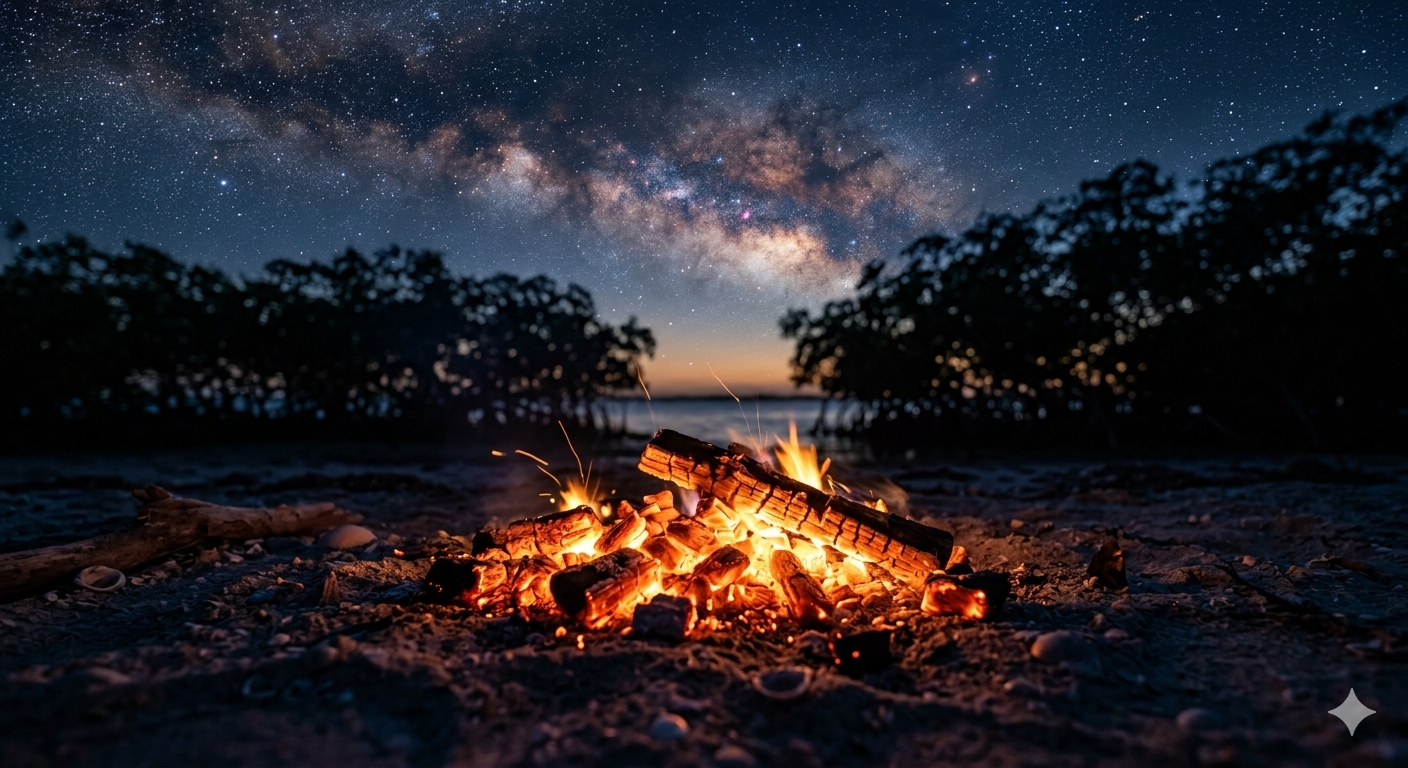
A small campfire crackling on a sandy Florida beach at night. I
And then, it begins.
It’s about 4:30 in the afternoon. The first boat pulls anchor. A dad yells for a kid. A mom deflates a giant, plastic flamingo. The exodus is slow, then total.
The retreating roar of 200-horsepower engines signals the end of the public day.
This is the magic hour. This is the handoff.
As the sun begins its long, gold-and-orange fade over the mangrove canopy of the real mainland, the sandbar transforms.
The chatter of people is replaced by the profound, sudden silence of the natural world reclaimed.
The rhythmic, slightly judgmental call of the Osprey takes over. Small, prehistoric blue crabs emerge from their burrows,
inspecting the area for stray potato chip crumbs.
And you realize: the tide is coming in.
It doesn’t happen all at once. It’s a slow, stealthy creep. That six feet of sandy border where you parked your chairs is gone.
The shallow flat where the kids were splashing?
Now a foot deep. Your skiff, anchored twenty yards away, is suddenly forty yards away and floating significantly higher.
You rush to secure the perimeter. Tents are checked. Coolers are dragged to higher ground
It is, undeniably, a moment of high-stakes logistics. There’s a frantic, breathless,
and gently humorous minute of "Why did we decide this was a good idea?
The tide is gaining on us! Are my pajamas waterproof?"
But the tide, having asserted its dominance, stops. It leaves you just enough kingdom.
This is the moment you truly become the monarch.
You stand on the high point of the spoil island—now perhaps only fifty yards wide by twenty yards deep—and you are, unquestionably, the temporary king or queen.
There are no other lights in your kingdom. No other voices. To the east, the vast, dark Gulf of America.
To the west, the slow-blinking navigational lights of the Intracoastal. In the distance,
the faint, golden halo of the mainland’s civilization—restaurants, cars, ice-makers—all feeling like part of a different universe.
Night on the spoil island is a full sensory immersion.
You don't just see the darkness; you smell it—the deep, rich funk of the mudflats mixed with the dry, grassy scent of the palmettos.
You don't just hear the silence; you hear the volume of the water—the persistent,
liquid slap of the tide and traffic passing far away, creating gentle waves that kiss your sand-bar border.
The entire world seems centered on your tiny, fifty-yard oasis.
The campfire, built with salvaged, salt-soaked driftwood and carefully guarded from the humidity,
becomes the focal point of the kingdom. This is where you trade stories. Not grandiose, mythical ghost stories,
but simpler, warmer ones. Nostalgic stories of childhood camping trips (always involving 10% sand, 90% grit),
debates about the true nature of the Skunk Ape (we’re all 80% convinced), and the profound realization of how few people get to see the stars this clearly.
Without the light pollution of the mainland, the Milky Way isn't just a faint smudge; it’s a detailed, dusty lane.
You can actually see the edge of the galactic center. Your kingdom is small, but its ceiling is boundless.
Inevitably, the curiosity that brought you here is piqued. You must go to the edge of the kingdom. You must walk to the water’s edge.
This is where the most profound moment of Spoil Island happens.
You walk to the waterline, now a hundred yards from your original starting point. Your tent,
lit only by a faint, warm lantern, is a small, safe ember.
Your skiff, now bobbing fifty feet away, is a shadow.
You look across the channel. The lights of the mainland, once welcoming, now look... noisy.
They look busy, cluttered, and intense. You feel an almost physical relief that you are not there.
For that temporary moment, you are safe from the hustle. You are not just on a sandbar;
You are a world away from "the grid." This fifty-yard kingdom, built of accidental sand and accidental mangroves,
is, for one night, the most important place on earth.
And you think, gently smiling as you trace the Milky Way, Yeah. We can live with the sand in the sleeping bag for this.
Enjoying Florida Unwritten?
If the stories made you smile, learn something new, or remember old Florida, you can support the project with a small coffee.
Every cup helps keep the stories coming.
Earl Lee
Florida Unwritten
