The Living Heart of the Heartland: Exploring Rural Florida Wildlife
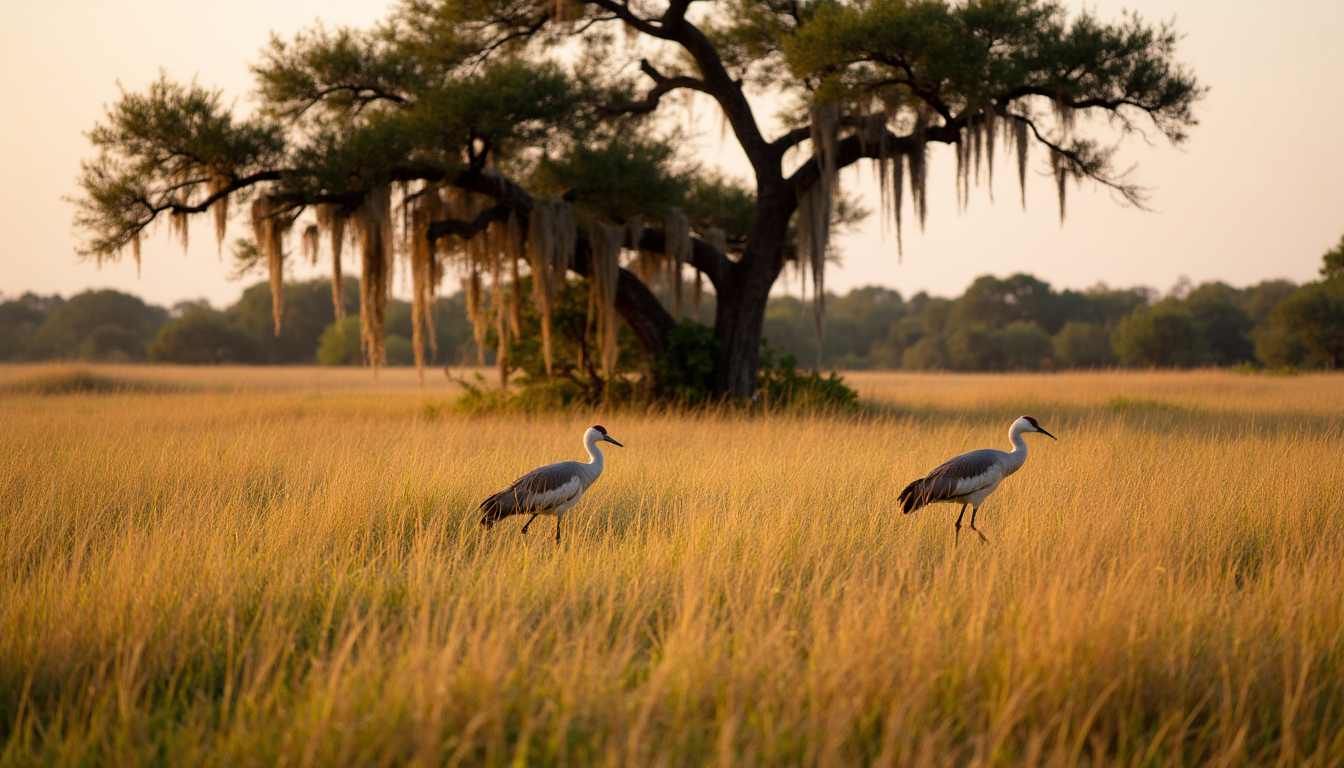
a pair of majestic sandhill cranes
When most people think of Florida, their minds drift toward the neon lights of South Beach or the manicured perfection of theme park resorts.
But for those who venture past the suburban sprawl and the strip malls, there is another Florida—a place of cypress domes,
pine flatwoods, and sprawling wet prairies. This is Rural Florida, a landscape that remains one of the most biodiverse regions in North America.
In these quiet stretches of the state, the soundtrack isn’t traffic; it’s the prehistoric rattle of a crane,
the splash of an alligator, and the distant, haunting cry of a panther. To understand Florida is to understand its wild residents.
The Sentinels of the Prairie: Sandhill Cranes
If rural Florida has a spokesperson, it is the Sandhill crane (Antigone canadensis). Standing nearly four feet tall with a wingspan that can reach six feet,
these birds are impossible to miss. They are defined by their slate-gray plumage, long, elegant necks,
and a striking patch of bald, red skin on their foreheads that pulses with color when they are excited or territorial.
There are actually two types of Sandhill cranes you’ll encounter in the Florida countryside.
The Florida Sandhill crane is a year-round resident, a non-migratory subspecies that calls the state's marshes and pine savannahs home year-round. In the winter,
they are joined by their northern cousins, the Greater Sandhill cranes, who migrate from the Great Lakes region to bask in the Florida sun.
A Dance as Old as Time
Perhaps the most enchanting aspect of these birds is their behavior. Sandhill cranes mate for life,
and their bonds are reinforced through elaborate courtship dances.
These aren't just simple hops; they are full-scale performances involving synchronized bowing, wing-stretching, and leaping into the air while tossing sticks or tufts of grass.
Their vocalizations are equally legendary. Thanks to an elongated, coiled trachea, their calls are deep, rattling "trumpets" that can be heard from miles away.
In the stillness of a rural morning, the sound is evocative of a time when dinosaurs roamed the earth—fitting, given that crane fossils in Florida date back over two million years.
Coexisting with "Modern" Florida
Despite their ancient lineage, cranes face modern challenges. As rural lands are subdivided,
cranes have begun to frequent cattle pastures and even suburban lawns. While they appear friendly, Florida law strictly prohibits feeding them.
Handouts make them lose their fear of humans, leading them to cross dangerous roads or peck at reflective windows and car bumpers,
which they mistake for rival cranes. In the wild heart of the state, however, they remain the graceful, watchful guardians of the wetlands.
The Ghosts of the Hammock: The Florida Panther
Deep within the rural south of the state, specifically within the Big Cypress National Preserve and the surrounding ranch lands,
lives the "ghost of the swamp": the Florida panther. As the only cougar population remaining in the Eastern United States,
these big cats are a symbol of Florida's wild resilience.
Panthers are masters of stealth.
A male can weigh up to 160 pounds and requires a massive home range—sometimes over 100 square miles—to hunt white-tailed deer and feral hogs.
Because they are solitary and territorial,
the fragmentation of rural land is their greatest threat.
Every new road cut through a forest is a potential death trap; vehicle collisions remain the leading cause of panther mortality.
Seeing a panther in the wild is a rare gift, a "once-in-a-lifetime" moment for most rural residents.
Their presence is a litmus test for the health of the ecosystem: if the land is wild enough for a panther, it is wild enough for everything else.
The Ancient Architects: American Alligators
No discussion of Florida wildlife is complete without the American alligator.
Found in every one of Florida's 67 counties, they are the undisputed kings of the rural waterways.
In the dry season, alligators perform a vital service for other wildlife by digging "gator holes."
Using their snouts and tails, they clear out depressions in the marsh that retain water when the surrounding land dries up.
These holes become life-saving oases for fish, turtles, and wading birds until the rains return.
While they are apex predators capable of impressive bursts of speed (up to 20 mph in short spurts), alligators are generally wary of humans unless they have been illegally fed.
In rural Florida, the "live and let live" philosophy is essential—give them their space, and they will continue their role as the ancient architects of the swamp.
The Shadow Travelers: Florida Black Bears
While many think of bears as mountain animals, the Florida black bear is perfectly at home in the scrub and palmetto flatwoods of the flat Florida landscape.
They are the state’s largest land mammal, and their diet is surprisingly "green"—about 80% of what they eat consists of plants, berries, and nuts (though they won’t turn down an insect or a small animal if the opportunity arises).
In rural areas near the Ocala National Forest or the Panhandle, bears are a common sight.
They are wide-ranging travelers, often moving through "wildlife corridors" that connect different patches of forest. Like the Sandhill crane,
the bear’s biggest challenge is the "lure of the easy meal."
Unsecured trash cans in rural homesteads can lead to "nuisance" behavior, but with proper bear-proof containers, humans and bears can—and do—coexist peacefully.
The Sky in Bloom: Wading Birds
Beyond the cranes, rural Florida’s wetlands are a theater for some of the most spectacular birds in the world.
The Roseate Spoonbill: Often mistaken for a flamingo, these birds have neon-pink feathers and a unique, spatula-shaped bill used to sift for shrimp in shallow water.
The Wood Stork: A "tactile" feeder that snaps its beak shut in just 25 milliseconds when it feels a fish, the Wood Stork is a prehistoric-looking bird that nests in high cypress canopies.
The Great Blue Heron: A patient hunter, often seen standing perfectly still in a roadside ditch, waiting for a frog or fish to swim within striking distance.
“We specialize in the Florida you won't find on a postcard.
Keeping these stories 'unwritten'—but not forgotten—takes plenty of caffeine and even more bug spray.
If you loved today's tale, you can buy me a brewto help keep the lights on. I'm glad you're here for the
Ride.
The Importance of the Rural Fringe
The wildlife of rural Florida is currently at a crossroads.
As Florida’s human population continues to grow, the "buffer zones"—the ranches, timberlands, and family farms—are becoming increasingly vital.
These working lands often serve as unofficial wildlife preserves,
providing the space that panthers, bears, and cranes need to survive.
To witness a flock of Sandhill cranes landing in a golden cow pasture at sunset is to see the true Florida.
It is a reminder that the state is more than just a destination; it is a complex, breathing wilderness that requires our respect and protection.
The next time you find yourself on a quiet backroad in the Sunshine State, roll down your window.
Listen for that prehistoric crane rattle or scan the tree line for a soaring hawk.
You aren't just in the "middle of nowhere"—you are in the middle of one of the most vibrant biological treasure troves on the planet.
Earl Lee
Florida Unwritten
