The Everglades: How Florida Accidentally Built One of the Strangest Places on Earth
Natural Wonders Through Time
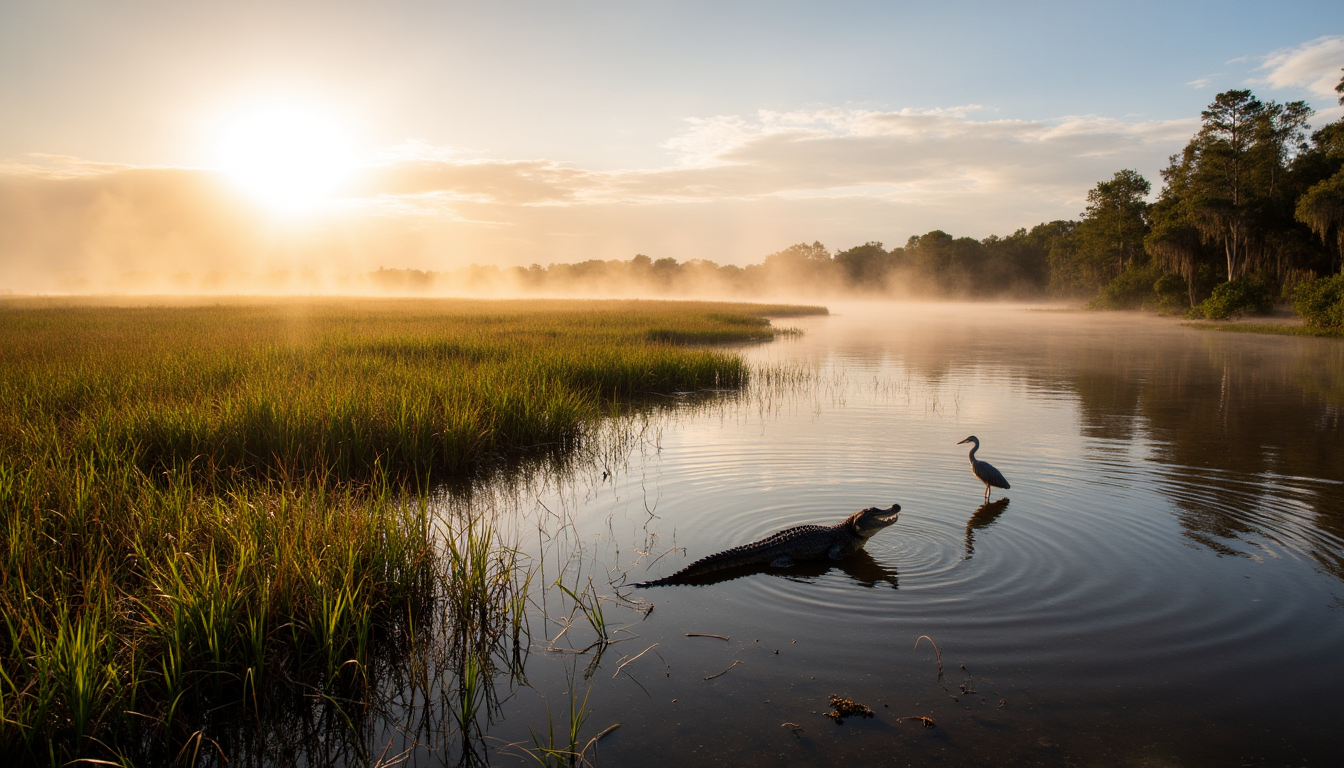
Tree islaEverglades landscape at sunrise, endless sawgrassnd in the Everglades
Or how a state famous for bad drivers, giant mosquitoes, and questionable real estate decisions somehow created a masterpiece.
Florida didn't set out to build the Everglades. There wasn't some grand planning session millions of years ago where Mother Nature unrolled blueprints and said, "Let's create the world's most confusing ecosystem."
Instead, it happened through patience, persistence, and a remarkable refusal to behave like normal land.
No mountains.
No cliffs.
No dramatic rivers carving canyons for postcards.
Just water moving very slowly over a very long time.
That's Florida's greatest trick. The state wasn't built overnight. It was assembled one patient drop at a time.
What eventually emerged wasn't exactly a swamp, a marsh, a lake, or even a river in the traditional sense. Scientists spent decades arguing about what to call it before finally settling on something wonderfully unhelpful: a river of grass.
Which is a bit like calling a sandwich "bread with ambition."
Yet somehow, it's exactly right.
Because the Everglades refuses to fit neatly into categories, and honestly, that's been Florida's personality from the very beginning.
Before Florida Was Florida
Long before highways, retirement communities, and people deciding to move here after surviving one perfect vacation week, southern Florida looked very different.
Thousands of years ago, much of the region was a shallow inland sea. Rain fell across central Florida, collected around Lake Okeechobee, and slowly began drifting south.
And when we say slowly, we mean slowly enough to make a sloth seem impatient.
The water moved at roughly half a mile a day. There was no urgency. No rushing toward an ocean finish line. Just a giant sheet of water spreading itself across the landscape.
Over thousands of years, sawgrass learned to thrive in ankle-deep water. Peat accumulated beneath the surface. Tree islands rose like punctuation marks in a long green sentence. Birds arrived. Fish adapted. Alligators moved in and immediately started acting like they owned the place.
The Everglades quietly assembled itself without blueprints, permits, or ribbon-cutting ceremonies.
This wasn't wilderness as drama.
It was wilderness as persistence.
The River That Refused to Behave Like a River
Most rivers are easy to understand. They have banks, channels, and a direction you can point to.
The Everglades looked at those rules and politely ignored every single one.
Instead of flowing deep, it flows wide. Instead of racing, it drifts. Instead of carving through rock, it spreads itself across the landscape like a giant moving filter.
That slow movement became its superpower.
Because slow water is productive water.
Over time, entire ecosystems stacked themselves together like chapters in a book. Open marshes became feeding grounds for wading birds. Sloughs sheltered fish, turtles, and alligators. Hardwood hammocks rose just high enough to stay dry during wet seasons.
Out here, a single foot of elevation changes everything.
One extra foot of ground can create an entirely different world.
Florida is surprisingly dramatic that way.
It just whispers instead of shouting.
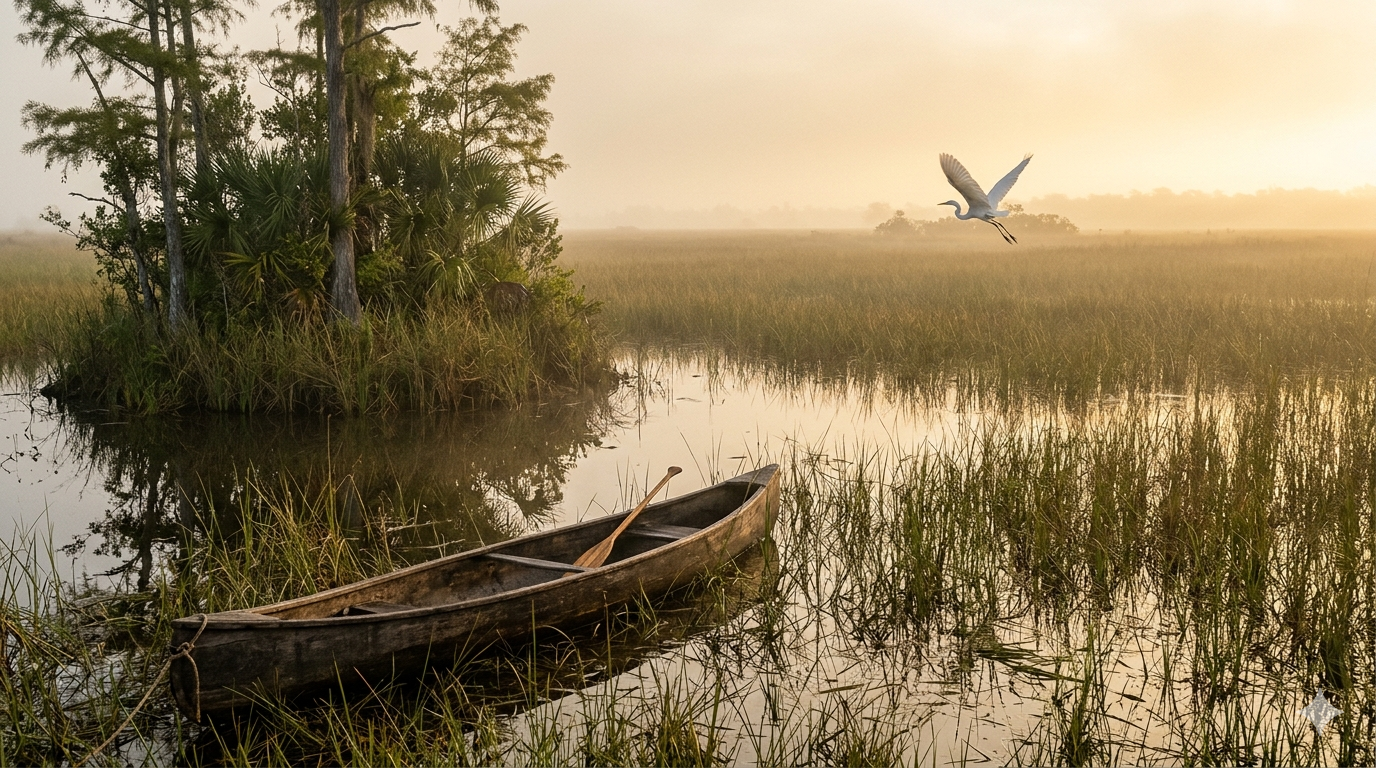
Everglades during early morning fog
Humans Meet a Wetland With Opinions
Eventually, humans arrived carrying one of history's most dangerous ideas.
"We can improve this."
Early settlers looked at the Everglades and saw a problem to solve. Too wet. Too buggy. Too unpredictable.
So canals were dug. Water was redirected. Drainage projects expanded across South Florida. The goal was simple.
Make the land behave.
Florida, however, has always had a rebellious streak.
The Everglades began shrinking. Some areas dried out while others flooded unexpectedly. Wildlife populations shifted, and water quality suffered.
Scientists eventually realized something important.
What everyone thought was chaos had actually been balance all along.
The Everglades wasn't broken.
We were interrupting it.
It's a bit like showing up to your grandmother's kitchen, changing all her recipes, and then wondering why dinner tastes different.
Nature has long memories.
Florida especially.
The Springs That Time Forgot
While the Everglades slowly drifted south, another Florida miracle was happening underground.
Florida's springs were quietly bubbling upward.
More than 700 freshwater springs flow throughout the state, making Florida home to the largest concentration of freshwater springs on Earth.
Every day, millions of gallons rise through ancient limestone aquifers at a constant 72 degrees.
In July, it feels like air conditioning.
In January, it feels like a heated swimming pool.
Long before roads existed, Indigenous people gathered around these springs. Animals returned season after season. Entire communities formed around these dependable sources of fresh water.
Springs were Florida's original gathering places.
Long before coffee shops, there was a spring.
Many remain hidden beneath giant cypress trees and Spanish moss canopies. Others have become beloved parks where families float lazily downstream while pretending they aren't secretly checking their phones.
But every spring tells the same story.
Florida's history doesn't only run across the surface.
It rises from underground.
Ecosystems That Rewrite the Rules
Florida has never been interested in simple labels.
Its wetlands are seasonal, adaptive, and occasionally stubborn.
Fire and flood both belong here.
That sounds contradictory until you realize Florida thrives on contradictions.
Dry seasons invite natural burns that renew the landscape. Wet seasons erase boundaries all over again.
This endless dance between land and water shaped species that sometimes feel almost mythical.
Alligators dig water holes that dozens of other animals depend upon for survival. Birds migrate thousands of miles every year just to raise their young here. Plants evolved expecting instability instead of fearing it.
Nothing assumes permanence.
Everything adapts.
Perhaps Florida's greatest lesson has always been resilience.
It just happens to teach that lesson with mosquitoes.
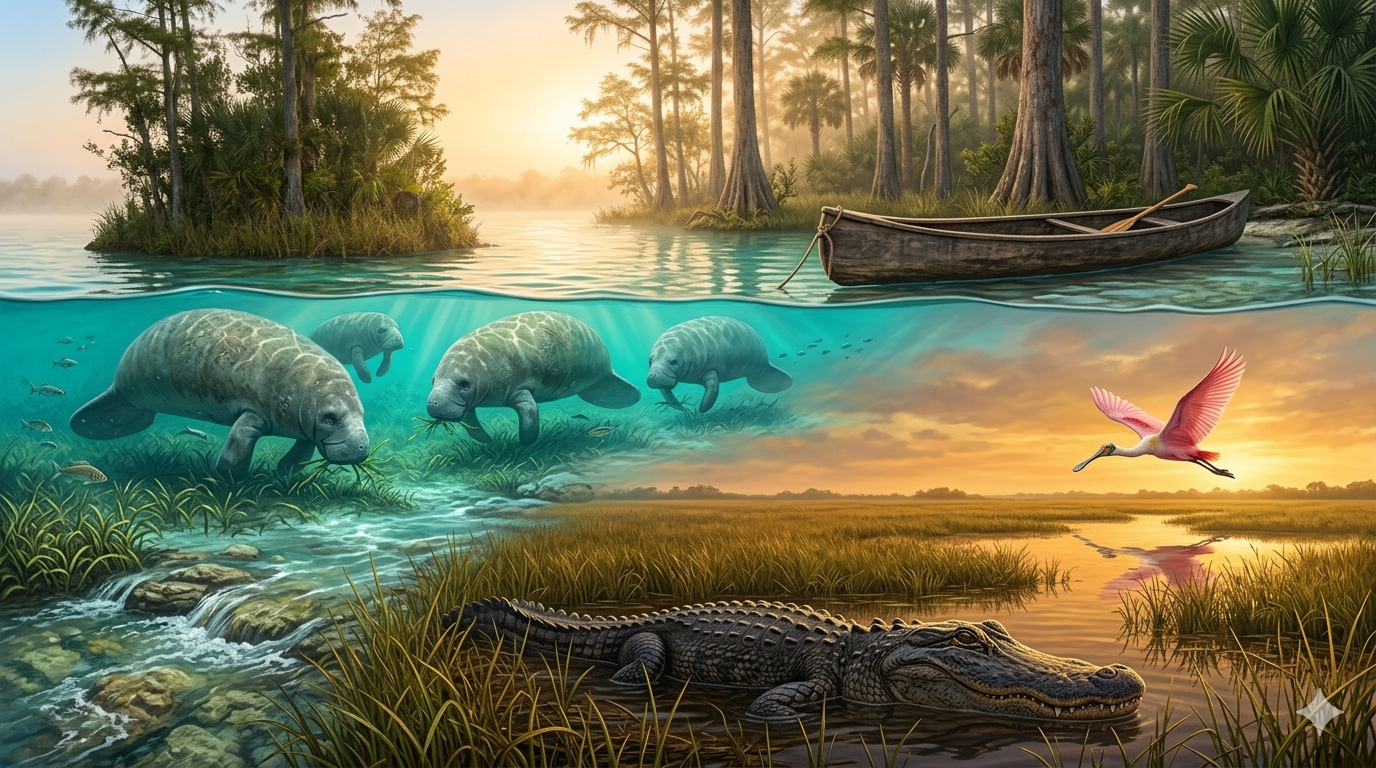
split-scene realistic illustration showing Florida's two hidden worlds connected together. The upper half features crystal-clear Florida springs beneath giant cypress trees
Why These Places Still Matter
The Everglades and Florida's springs are not leftovers from the past.
They're alive.
They're still writing their own story.
These ecosystems filter drinking water for millions of Floridians. They buffer storms, shelter species found nowhere else on Earth, and quietly perform jobs most of us never think about.
More importantly, they remind us that not everything valuable moves quickly.
In a world obsessed with speed, Florida's greatest natural systems still operate on ancient time.
Maybe that's exactly why we need them.
To lose these places wouldn't simply be an environmental tragedy.
It would be a kind of amnesia.
We would forget how this land learned to exist in the first place.
Walking Through Deep Time
Standing in the Everglades doesn't feel dramatic at first.
There are no mountain peaks waiting for applause.
No giant monuments.
No soundtrack.
Just quiet.
Then, after a while, something changes.
You begin to notice things.
The ripple of water around an alligator's nose.
The distant call of a bird.
The wind bends endless fields of sawgrass.
Eventually, you realize this place doesn't need spectators.
It never did.
It has survived ice ages, rising seas, hurricanes, and more than a century of human impatience.
It will remember us too.
Because that's what ancient landscapes do.
They endure.
Join O ur Circle New Story Every Friday
Closing Thought
Florida's natural wonders were never designed to impress us.
They were built to survive.
Underneath the traffic, tourist brochures, and endless development signs, Florida remains an unfinished story.
Water is still shaping the land one inch at a time.
And if we slow down enough to listen, we might discover Florida was never weird by accident.
It was extraordinary all along.
Thanks for spending part of your day with Florida Unwritten.
👉 More stories live at https://surl.lu/uilyob
Florida Unwritten is a labor of love dedicated to the places the brochures forget.
Earl lee
