The Secret Boils: Searching for Florida’s Offshore Springs
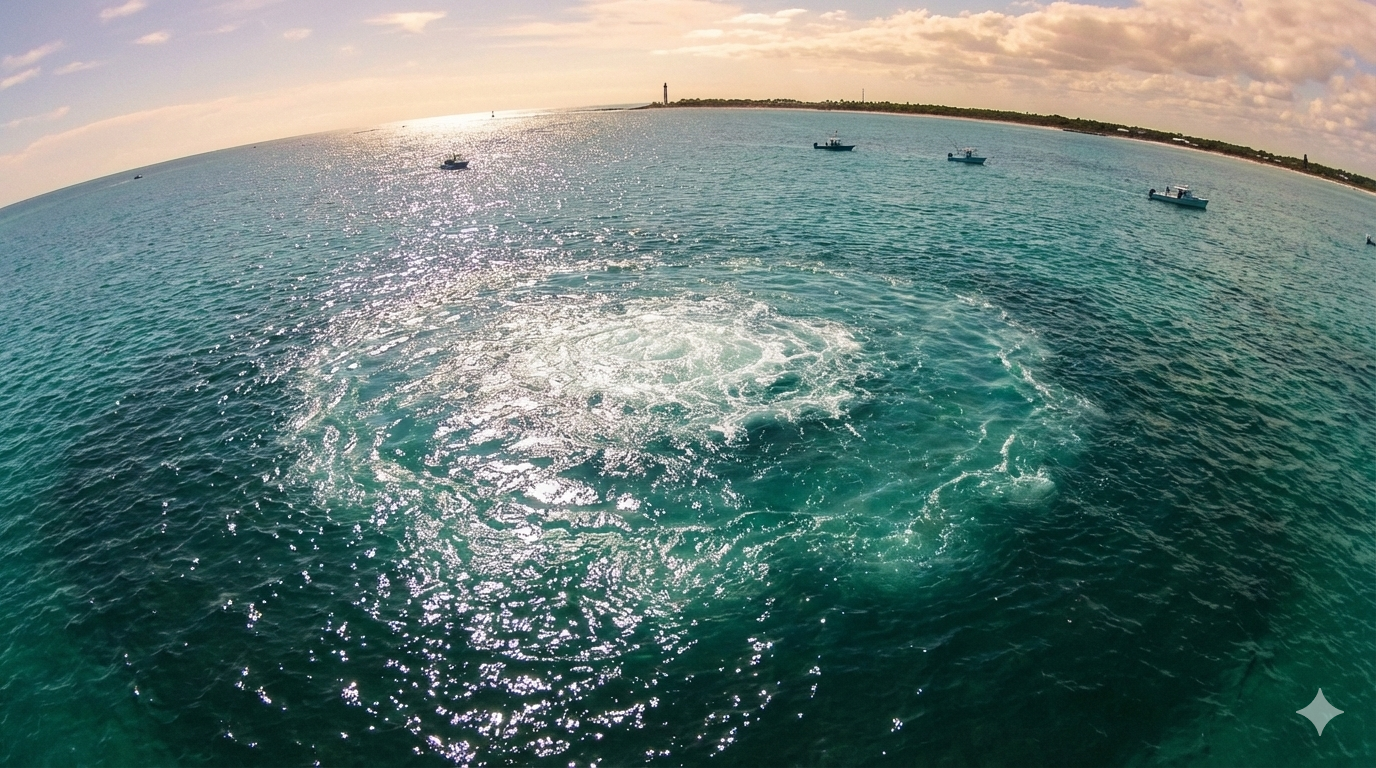
Blue Hole
Pull up a chair and let the ice melt in your tea for a minute, because there is a map of Florida you won’t find in any glovebox or on any glowing smartphone screen.
It’s a map written in the salt-crusted memories of fourth-generation guides and etched into the ancient limestone floor of the Gulf of Mexico.
It’s the story of the "boils"—those strange, shimmering places where the earth’s freshwater pulse pushes right through the heavy brine of the sea.
To an outsider, the Gulf looks like a vast, flat mirror, perhaps a little murky depending on the tide.
But to those who have spent their lives navigating the maze of the Ten Thousand Islands, the surface is a cunning mask.
Beneath it lies a wild, unconquered realm that has survived conquistadors, outlaws, and the relentless march of modern developers.
To find a "boil" is to find a place where the old world is still breathing, a literal fountain of youth bubbling up from the dark.
The Mirage in the Salt
If you venture far enough into the Ten Thousand Islands, past the mangrove silhouettes and out where the horizon starts to blur into the sky, you might see a visual trick.
It looks like a disturbance in the water, a shimmering "sandy light colored hole" about ten to fifteen feet across, stark against the dark, muddy flats that surround it.
These aren't just patches of white sand; they are artesian wells.
In these specific spots, the pressure of the Florida water table is so great that it forces cool, clear freshwater up through the sea floor. You can see the water "boil" on the surface, a rhythmic rippling that tells you the earth is exhaling.
For a sailor or a fisherman who has spent all day under the brutal Florida sun, these spots are more than just geological curiosities—they are sacred ground.
Caxambas: The Map of the Ancients
The history of these springs is written into the very names of our islands, though we often forget the translations.
Take Caxambas Pass on the southern end of Marco Island.
In the language of the Calusa—the "vanished people" who built towering shell mounds and ruled this coast for centuries—"Caxambas" literally means "fresh water."
The Calusa were the original masters of this environment. They didn't just survive here; they thrived, building a civilization atop millions of discarded oyster shells.
They knew exactly where the freshwater overflowed into the middle of the islands. Long before the first tourist arrived or the first skyscraper cast a shadow over the beach, these springs were the lifeblood of the coast.
In the 1700s, Spanish galleons would anchor off the coast of Caxambas.
These were the mightiest ships of the era, yet they were at the mercy of the Florida Reef—some of the most treacherous waters in the world.
Before beginning the long, dry trek back across the Atlantic, sailors would send small boats ashore to fill their heavy wooden casks with the sweet artesian water from these springs.
It was a lifeline in an environment that seemed designed to ruin anyone who didn't respect its rules.
The Loggerhead Sanctuary at 65 Feet
The legends of these boils aren't just about water; they’re about the creatures that call them home.
About eight miles off Cape Romano, there is a legendary spot known as a "Blue Hole." Here, the Gulf floor suddenly drops into a 65-foot abyss.
It is a surreal, almost haunting sight. Giant loggerhead turtles, some of the oldest residents of our coast, congregate in this deep sanctuary.
Fishermen tell stories of watching these massive prehistoric creatures rise from the depths, emerging with remnants of white mud on their backs, surrounded by the "boiling" pressure of the cold spring.
A bit further out—about fifteen miles from Marco Pass—lies the "Creature Hole."
This spot is a magnet for the wilder side of Florida. It’s a sanctuary where the cold artesian water meets the warmth of the Gulf, creating a unique micro-ecosystem.
In the clear water of the boil, you might see ten-foot tiger sharks, cobia, and massive jewfish (goliath grouper) patrolling the edges of the spring.
It’s a reminder that Florida’s reputation as a "quirky" or even "apocalyptic" place isn't just an internet meme; it’s rooted in a landscape where nature still holds the upper hand.
Characters of the Frontier
This wild environment bred a specific kind of person—larger-than-life characters who felt more at home in a mosquito-infested mangrove swamp than a city.
Take, for example, legendary figures like Cap Knight, the barefoot and shirtless restaurant owner of "Old Florida" fame.
Cap was deeply devoted to his community, but he was also a man of the frontier. If a patron didn’t enjoy his food, Cap was known to heave the man right off the dock and into the water.
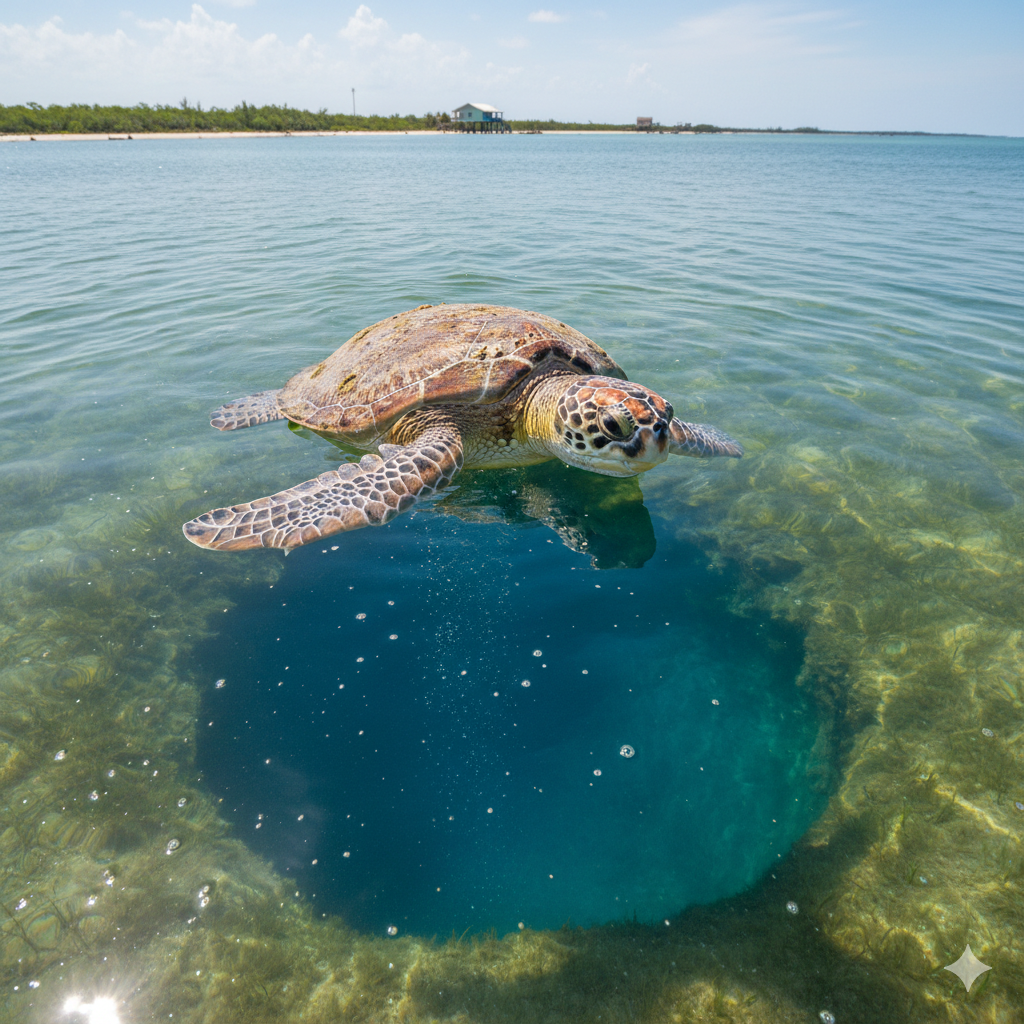
A loggerhead turtle surfacing near a deep artesian spring
This was the spirit of the Ten Thousand Islands before the mid-20th century.
It was a "land’s end" for outlaws, pioneers, and those seeking to escape the "fullness of modernization." During Prohibition, the remote nature of these islands made rum-running a "spectator sport" for locals.
The federal government’s attempts to regulate this wild southern frontier were largely ignored because the landscape itself provided a perfect sanctuary for those who knew the hidden channels and the locations of the freshwater boils.
The Vanishing Boils: A Silent Witness
However, these springs are as fragile as a ghost story. In the mid-20th century, the landscape began to change.
To accommodate a growing population, the state began to "drain the swamp," digging over 1,400 miles of canals to divert the "River of Grass."
The impact was devastating. Back in the day, the Bear Lake Canal and the North and Watson Rivers were famous for groundwater that "boiled" to the surface.
But as the freshwater was siphoned off to feed the thirsty cities on the East Coast, the pressure in the water level began to drop. When the freshwater flow slowed, the boiling stopped.
The disappearance of these boils serves as a silent witness to the environmental transformation of the Everglades.
It’s a reminder that our "hidden gems" are all connected. The health of a spring twenty miles offshore is tied directly to the water flowing through the sawgrass miles away. When we lose the boils, we lose a piece of the state’s soul.
A Legacy Worth Preserving
I send one good Florida story every Friday morning so Ride Along
Today, the coordinates for the "Blue Hole" or the "Spring off Cape Romano" are passed down like family heirlooms.
They are the secrets of the fourth-generation guides who still know how to read the water. These spots remain excellent for fishing and diving, but they are also monuments to a Florida that existed before the hotels and strip malls.
In a state now famous for "Florida Man" headlines and social media memes, it’s easy to forget that our true identity is found in these wild, quiet places.
Florida has always been a "land’s end"—a place to start over, a place to hide, and a place where the environment dictates the rules of survival.
To find a boil is to find a piece of the "unconquered realm" that T.D. Allman and Gilbert Voss wrote about.
It is a reminder that beneath the surface of the modern state, there is still a pulse.
If you ever find yourself on a boat in the Gulf and you see a patch of sand glowing white against the dark mud, don’t just pass it by.
Stop the engine. Listen to the water. You’re standing over a secret that has been bubbling for thousands of years.
We specialize in the Florida you won't find on a postcard. Keeping these stories 'unwritten'—but not forgotten—takes plenty of caffeine and even more bug spray.
Florida Unwritten is a weekly letter about the quieter side of the state.
Springs that stay cold in July, towns the highway forgot, and the kind of places you only find by slowing down.
Every Friday morning, one good Florida story.
Earl Lee
Florida Unwritten
