The Bridge That Was Built Twice
The Seven Mile Bridge, engineering miracles, storms, and the stubbornness of the Keys
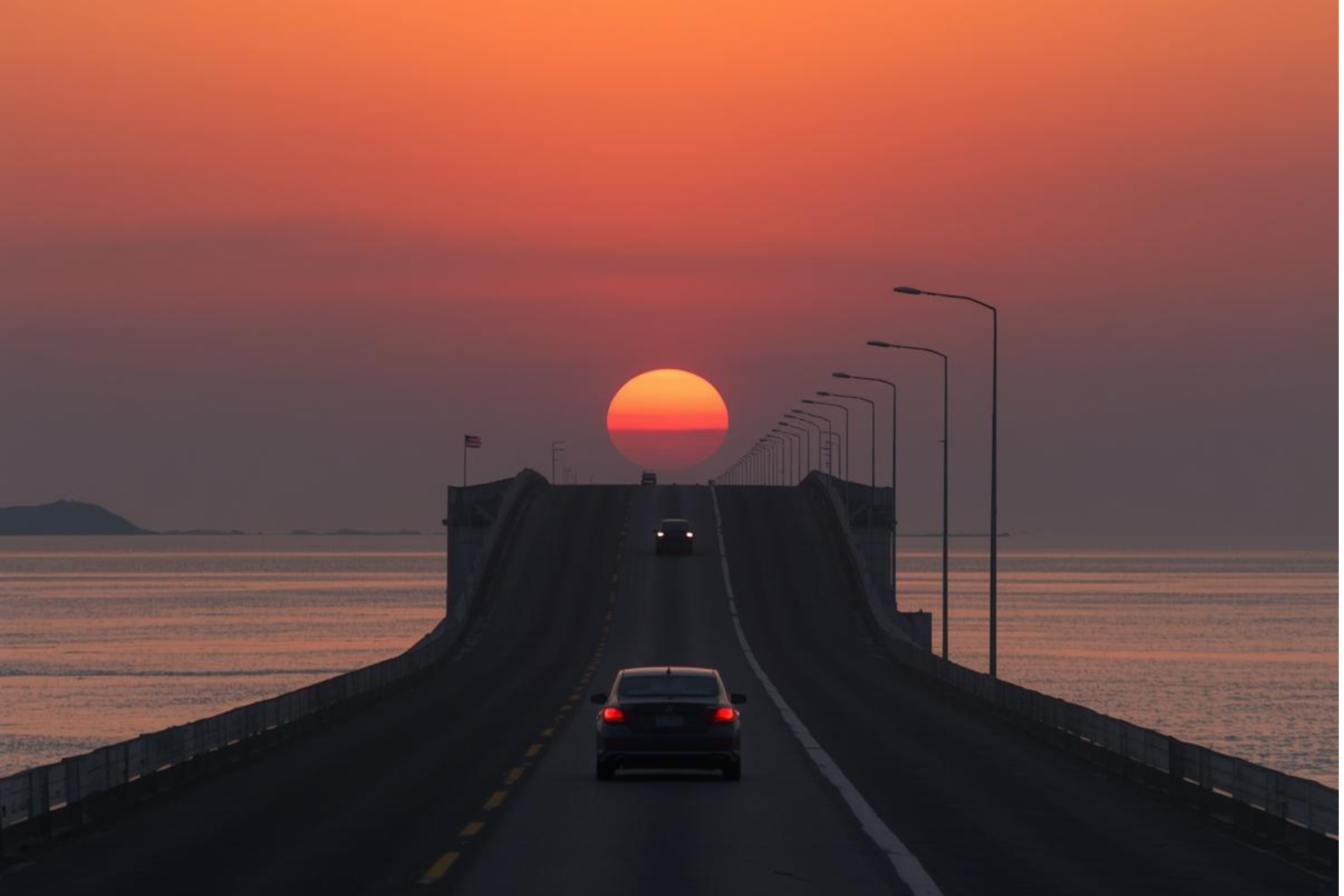
Car driving across the Seven Mile Bridge at sunset
There are places in Florida where the land feels temporary. Where the ground narrows, the horizon widens, and everything you build seems to borrow time from the sea.
The Florida Keys are like that. They never promised stability. And yet, people keep building anyway.
Nowhere is that more visible than on the Seven Mile Bridge, a ribbon of concrete and steel stretched so far across open water it feels less like a road and more like a declaration.
To cross it is to understand something essential about the Keys. Not just their beauty, but their refusal to surrender.
The Seven Mile Bridge was not built once. It was built twice. And both times, it stood as an answer to the same question the ocean keeps asking.
You sure about that?
A Bridge Before Cars Belonged Here
Long before rental cars and GPS voices, the first version of the Seven Mile Bridge was never meant for automobiles at all. It was built for trains.
In the early 1900s, oil tycoon Henry Flagler had already done the impossible once by extending his Florida East Coast Railway down the mainland.
Then he decided the impossible wasn’t finished. He wanted rails all the way to Key West, then the busiest port in Florida, closer to Havana than Miami.
What followed was one of the most ambitious infrastructure projects in American history. Workers battled heat, isolation, disease, and open ocean.
They built trestles across deep channels, anchored piers into coral bedrock, and learned quickly that storms in the Keys were not suggestions.
They were verdicts.
By 1912, the Overseas Railroad was complete. The original Seven Mile Bridge stretched between Knight’s Key and Little Duck Key, a narrow steel-and-concrete spine resting just above the water.
When the first train crossed, it was hailed as the Eighth Wonder of the World.
And for a while, it worked.
The Ocean Keeps Receipts
Then came the storms.
Hurricanes in the Keys don’t simply arrive. They rearrange things.
They take inventory. They remove what wasn’t anchored deeply enough, or perhaps never meant to stay.
In 1935, one of the most powerful hurricanes ever to hit the United States tore through the Keys.
The Labor Day Hurricane killed hundreds, many of them World War I veterans working on infrastructure projects along the railroad. Tracks twisted.
Bridges shattered. Entire sections vanished.
The Overseas Railroad never recovered.
By then, cars were replacing trains, and Florida’s priorities were shifting. The railroad was abandoned,
but its bones remained. Concrete piers stood in long, lonely rows across the water, stubborn as gravestones.
The idea emerged to reuse them.
If the ocean wouldn’t let the bridge disappear, maybe Florida could teach it a new purpose.
Building It Again, This Time for Wheels
Construction on the modern Seven Mile Bridge began in the late 1970s. Engineers studied the remains of the old railroad bridge and made a decision that felt both practical and symbolic.
Build alongside it.
The new bridge would be wider, taller, and stronger. Designed for cars, trucks, evacuations, and the long, exposed reality of Keys living.
It would rise higher above the water to allow boats to pass and waves to roll beneath without slamming directly into its underside.
This time, they knew better than to argue with the ocean. They planned for it.
The bridge opened in 1982. At the time, it was one of the longest segmental bridges in the world, constructed in pieces and assembled over water like a puzzle laid carefully on a moving table.
When it was finished, Florida had its road to the end of the road again.
And the old bridge?
It stayed.
Two Bridges, One Horizon
If you drive the Seven Mile Bridge today, you’ll notice it immediately.
To the south, running parallel like a shadow that refuses to fade, the original bridge stretches across the water, broken in places but still impossibly long.
It feels ghostly. A reminder that even when progress moves forward, the past doesn’t always step aside.
Parts of the old bridge were eventually converted into fishing piers and walking paths.
The most famous section, near Marathon, is now called Old Seven Mile Bridge State Historic Park. People walk it at sunrise and sunset, rods in hand,
pelicans gliding low, water lapping quietly against concrete poured more than a century ago.
It is one of the few places in Florida where you can physically walk on a previous version of the future.
The Stubbornness of the Keys
The Seven Mile Bridge isn’t loved because it’s pretty, though it is. It’s loved because it represents something the Keys understand instinctively.
You build knowing it may be tested.
You rebuild knowing it may be tested again.
The bridge has been closed due to hurricanes. It has been battered by storms, scorched by the sun, and rattled by wind so strong it makes even seasoned locals grip the wheel tighter. And still, it stands.
Every evacuation crossing feels heavier because of it. Every return trip after a storm carries a quiet gratitude. The bridge doesn’t promise safety. It offers access. It gives you a chance.
That’s the deal the Keys have always made with the sea.
A Drive That Changes People
Ask anyone the first time they crossed the Seven Mile Bridge, and they’ll tell you the same thing. Something shifts halfway across.
The land disappears behind you. The Keys ahead look almost imaginary. Water stretches in every direction, shallow turquoise giving way to deeper blues. On clear days, the sky feels oversized, like it wasn’t designed for roads at all.
There’s nowhere to pull over. No shortcut. No alternate route.
You go forward, or you turn back.
That, too, feels intentional.
Built Twice, Still Standing
The Seven Mile Bridge exists because Florida refused to accept that distance meant separation. Because storms, however devastating, were not final answers.
Because the Keys demanded connection even when connection seemed unreasonable.
It was built once with steel and optimism.
It was built again with concrete and experience.
Both versions carry the same message.
This place is worth reaching.
This place is worth rebuilding.
This place does not disappear quietly.
When you cross the Seven Mile Bridge, you’re not just driving over water. You’re moving through time. Past ambition. Past loss. Past the idea that nature always wins outright.
Sometimes, it allows a compromise.
And sometimes, it lets a bridge stand long enough for a second one to rise beside it, just in case the ocean wants to argue again.
“Florida Unwritten runs on stories, sunburn, and caffeine.
If you enjoyed this, you can buy me a coffee. No pressure.”
Earl Lee
Florida Unwritten
