
The Mangrove People: A Field Guide to Florida’s Most Salt-Crusted Subspecies
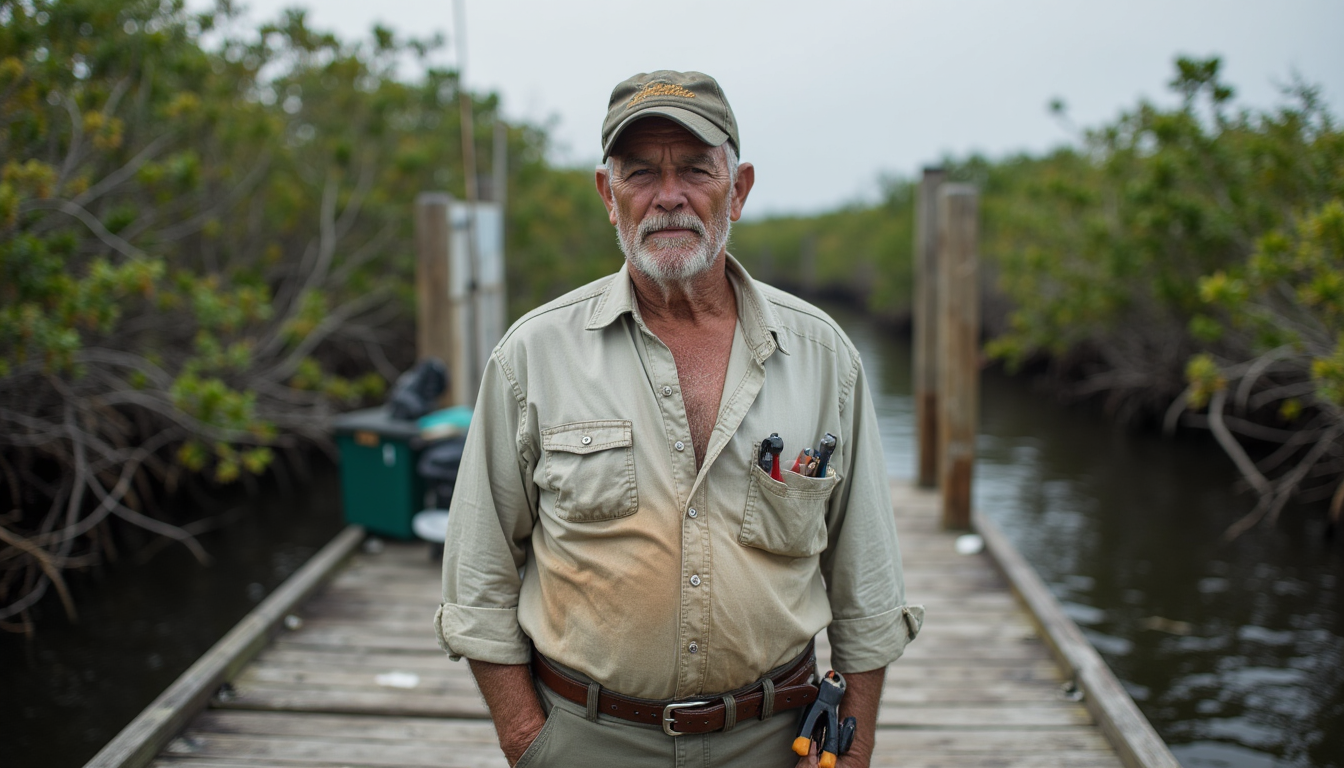
weathered Florida fisherman
If you’ve spent more than forty-eight hours in the Sunshine State, you’ve seen them.
They aren’t the tourists in the "I’m Physics-Defyingly Sunburned" neon shirts,
and they aren’t the high-rise condo dwellers who treat a rainy Tuesday like a biblical apocalypse.
No, I’m talking about the Mangrove People.
These are the human equivalent of a barnacle—hard to remove, slightly sharp to the touch, and perfectly adapted to an environment that would kill a normal person in three hours.
They live in that humid, lime-green fringe where the brackish water meets the bug-infested brush.
They don't just endure the swamp; they’ve found a state of spiritual oneness with it.
Anatomy of a Mangrove Human
You can spot a Mangrove Person by their biological refusal to wear anything that doesn't serve a purpose.
If it doesn’t have a pocket for a pliers set or a loop for a bait knife, they aren't wearing it.
The Skin: It’s not "tan." It’s "cured." It has the texture of an expensive Italian leather briefcase that was left in a pool for a week and then dried with a blowtorch.
The Footwear: White rubber boots (the "Florida Reebok") or flip-flops so worn down they’re basically just two pieces of cardboard held on by a prayer and some fishing line.
The Scent: A complex bouquet of 2-stroke engine oil, SPF 50 (applied once in 1994), and the lingering ghost of a smoked mullet.
The Boat: A Floating Junk Drawer
A true Mangrove Person does not own a "yacht." They own a "skiff," a "jon boat," or a "flats boat" that looks like it was assembled from spare parts found in the back of a 1982 El Camino.
To the untrained eye, their vessel is a chaotic mess of rusted anchors, tangled nets, and empty Gatorade bottles. To the Mangrove Person, it is a precision instrument.
They know exactly which specific rusted screw to kick to make the bilge pump work,
and they can navigate a winding creek at midnight using only the smell of the incoming tide and a general sense of spite.
"If the boat has a name like Seas the Day, they aren't Mangrove People.
If the boat has no name and is held together by a single, load-bearing bungee cord? That’s your person."
The Natural Habitat
While the rest of us are fighting for a parking spot at a Publix, the Mangrove Person is hunkered down in a secret "honey hole" where the mosquitoes are the size of hummingbirds.
They possess a supernatural immunity to the No-See-Um. While you are slapping yourself into a frenzy, looking like you’re performing a violent interpretive dance, the Mangrove Person is standing perfectly still, puffing on a cigar, watching a snook cruise through the roots.
They don’t feel the bites anymore. Their blood has likely reached a salinity level that makes them toxic to most local insects.
Social Hierarchies and Language
The Mangrove People are notoriously tight-lipped. Communication usually consists of a series of nods, grunts, and vague hand gestures toward the horizon.
Phrase
Translation
"They're biting."
I have caught forty fish and will not tell you where.
"Water’s a bit skinny."
My boat is currently scraping the bottom, and I am technically on land.
"Tide’s wrong."
I want you to leave so I can fish in peace.
"Nice rig."
I am judging your $80,000 boat because it has never touched a fish scale.
The Mangrove Philosophy
Why do they do it? Why spend your life in a state of perpetual dampness, battling humidity that feels like being hugged by a warm, wet carpet?
Because the Mangrove Person knows something we don't. They know that the real Florida isn't found in a theme park or a sanitized beach club.
The real Florida is raw, itchy, and smells a bit like decomposing seagrass. It’s the thrill of seeing a bull shark's fin cut through a glassy flat at dawn,
or the silence of a hidden cove where the only sound is the "pop" of a redfish feeding under the branches.
They are the guardians of the weird. They are the ones who know exactly where the 12-foot alligator named "Old George" lives, and they respect him more than they respect their own HOA board.
How to Befriend One (Don't)
If you encounter a Mangrove Person at a boat ramp, the best thing you can do is stay out of the way. Do not offer to help them back their trailer.
They have been doing this since before you were born, and they can do it blindfolded while eating a Cuban sandwich.
If you must speak, keep it brief. Mention something about the barometer dropping or the clarity of the water.
If they offer you a sip of something out of an unlabeled jug, decline politely unless you want to see through time and space.
We specialize in the Florida you won't find on a postcard. Keeping these stories 'unwritten'—but not forgotten—takes plenty of caffeine and even more bug spray. If you loved today's tale, you can buy me a brew
Final Thoughts from the Fringe
As the world gets more paved over and the condos creep closer to the shoreline, the Mangrove People retreat further into the maze of the keys and creeks.
They are a vanishing breed, a living link to a Florida that existed before air conditioning made us soft.
So, the next time you see a salt-stained individual dragging a kayak through a muddy ditch at 5:00 AM, don't pity them.
They aren't lost. They’re the only ones who are actually home.
"If you enjoyed this, look at Florida's forgotten coast, sign up here to never miss a story."
Earl Lee
