Florida’s Hot Potato: How Spain and Britain Kept Dropping a Peninsula
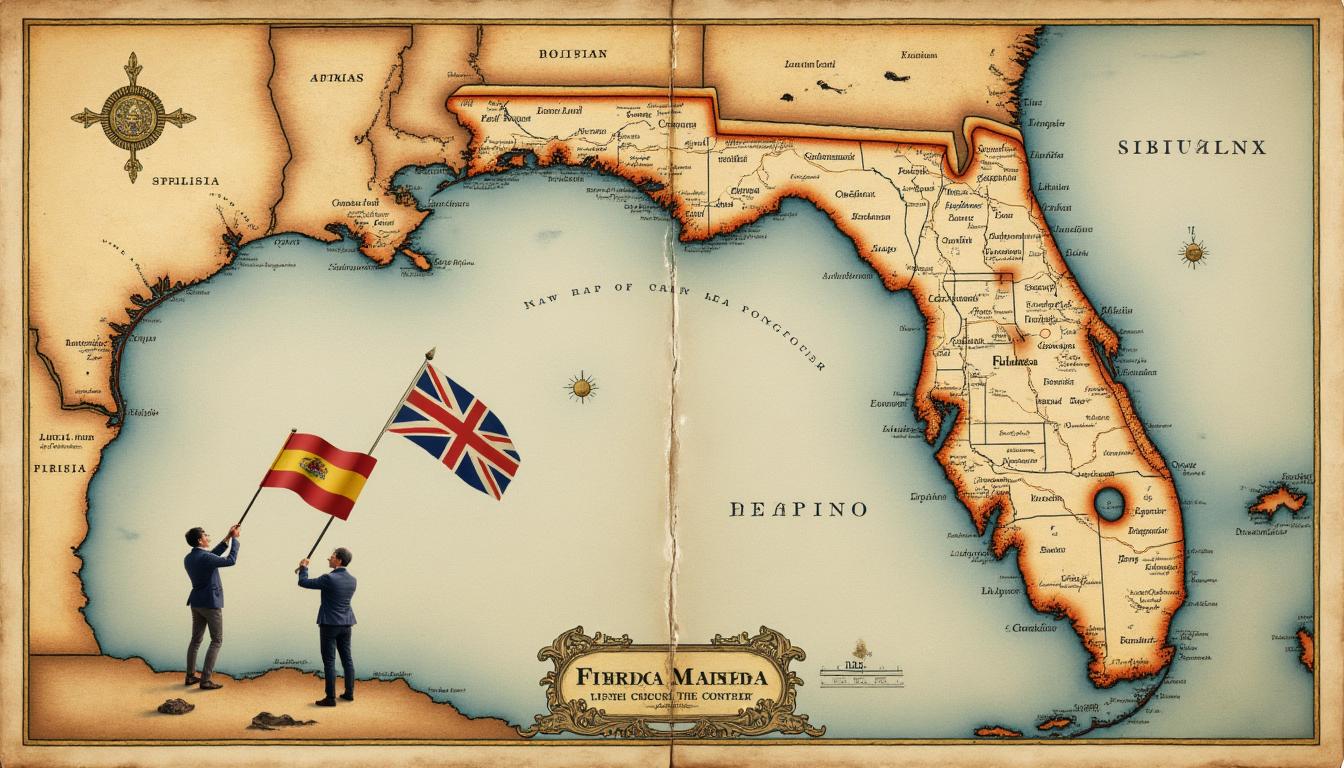
Florida: traded, returned, traded again, and still not impressed.
Introduction: A Peninsula Nobody Meant to Keep
Florida has spent most of its history being passed around like a lukewarm casserole at a family reunion.
Nobody really wanted it.
Nobody wanted to pay for it.
Everyone argued over it anyway.
Long before theme parks, condos, or hurricane evacuation routes, Florida was a geopolitical inconvenience. Spain and Britain spent more than a century trading control of the peninsula, often reluctantly, occasionally strategically, and usually with a sigh.
This is the true story of how Florida became the most awkward colonial possession in the Atlantic world.
Why Florida Mattered (And Why It Mostly Didn’t)
To Spain and Britain, Florida wasn’t prized land. It was positioning.
Spain valued Florida as:
A defensive buffer for its Caribbean holdings
A shield for shipping routes
A place to stop other empires from setting up shop too close
Britain saw Florida as:
A strategic outpost
A way to annoy Spain
A potential retirement zone for loyal subjects
Neither empire saw Florida as profitable. There was no gold rush. No spice trade. No easy agriculture. Just heat, swamps, mosquitoes, and Indigenous nations who were very clear about not being impressed.
Florida was important mostly because someone else might have it.
Spain Arrives First (And Immediately Has Regrets)
Spain claimed Florida in 1513, when Juan Ponce de León landed and decided this place was worth naming, if not settling comfortably.
Spain established:
St. Augustine in 1565, was the oldest permanent European settlement in what is now the United States
A string of forts and missions designed more to block rivals than build wealth
Florida under Spain was expensive, underpopulated, and constantly under threat.
Spain kept Florida the way you keep a broken fence: not because it’s useful, but because you don’t want the neighbor messing with it.
Britain Enters the Picture (Briefly and Politely)
After the Seven Years’ War, Spain traded Florida to Britain in 1763.
Not conquered.
Not seized.
Traded.
Spain gave up Florida to get Havana back, which tells you exactly how Florida ranked on the priority list.
Britain split Florida into:
East Florida (capital: St. Augustine)
West Florida (capital: Pensacola)
This was Britain’s attempt to make Florida manageable, civilized, and profitable.
It did not work.
British Florida: Organized, Ambitious, and Short-Lived
Under British rule, Florida saw:
Planned settlements
Incentives for British colonists
Road building and agriculture experiments
For the first time, Florida looked like it might become something.
But Britain had a timing problem.
The American colonies were getting restless, and Florida was about to become collateral damage in a much larger argument.
The American Revolution Ruins Everything
When the American Revolution broke out, Florida stayed loyal to Britain.
That made it:
A refuge for Loyalists
A base for British operations
A target once Britain lost
After Britain’s defeat, Florida was no longer useful leverage.
In 1783, Britain handed Florida back to Spain.
Again. Quietly. With relief.
Spain Gets Florida Back (And Sighs Deeply)
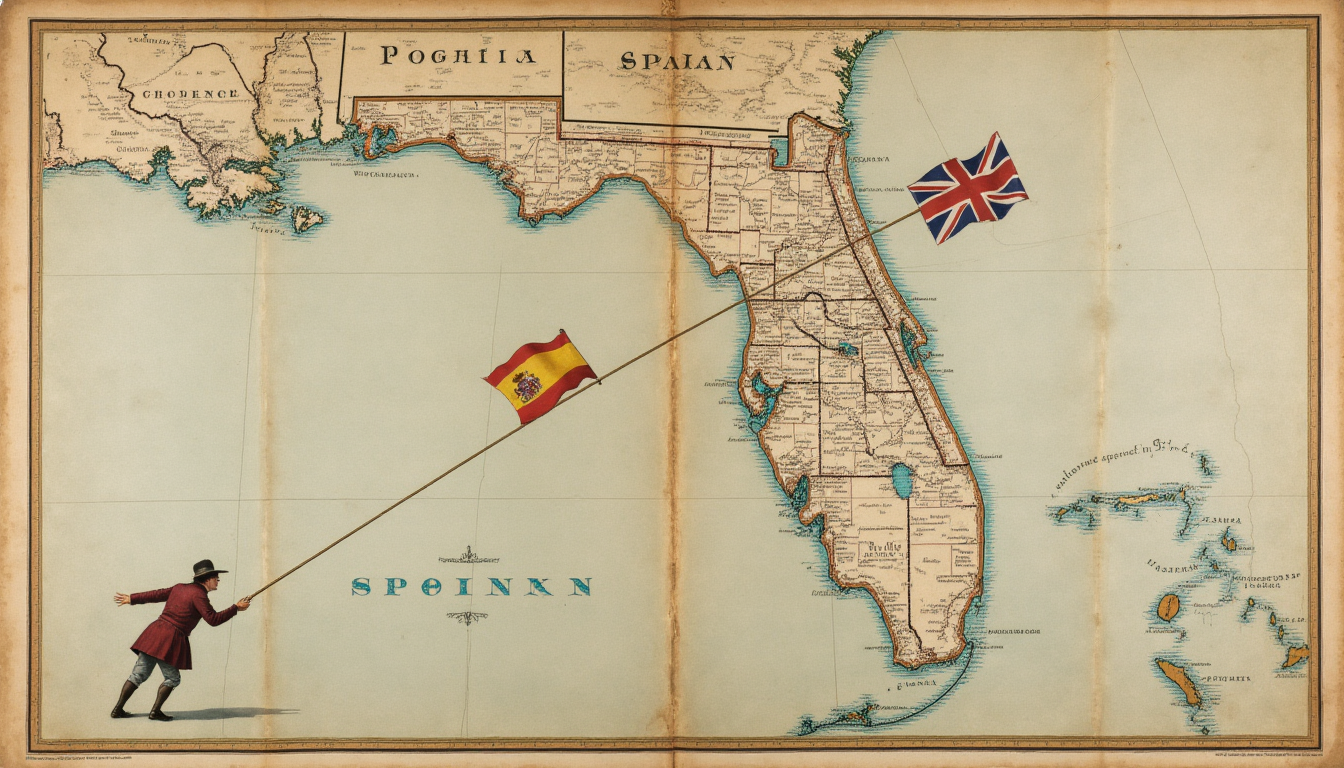
Spain’s second run with Florida was worse than the first.
The peninsula was now:
Surrounded by a growing United States
Home to escaped enslaved people, Seminoles, and refugees
A magnet for smugglers and cross-border chaos
Spain struggled to control Florida, fund it, or defend it.
Florida became less a colony and more an international headache.
The United States Starts Hovering
The young United States looked at Florida and saw:
Strategic coastline
Security risks
A place Spain clearly couldn’t manage
American settlers moved in. Conflicts increased. Andrew Jackson invaded Florida more than once without permission.
Spain protested weakly. Britain watched. Everyone knew where this was going.
The Adams-Onís Treaty: Florida Finally Changes Hands for Good
In 1819, Spain officially ceded Florida to the United States through the Adams-Onís Treaty.
Spain received:
Debt relief
A clear border in the West
The end of a very long responsibility
Florida became a U.S. territory in 1821.
No parade.
No celebration.
Just paperwork and exhaustion.
Why Florida Was Always the Hot Potato
Spain and Britain didn’t fight over Florida because it was amazing.
They fought over it because:
It protected shipping lanes
It prevented rivals from getting too close
Florida was never the prize. It was the positioning.
The irony is that the place nobody wanted eventually became one of the most desirable states in the country.
History has a sense of humor. Florida sharpened it.
Florida’s Identity Was Forged in Uncertainty
Being traded repeatedly shaped Florida’s character:
A mix of cultures
Loose borders
Questionable authority
Deep independence
Florida learned early not to rely on distant powers to understand it.
Which explains a lot.
Conclusion: A Peninsula That Refused to Behave
Florida didn’t become American because it was conquered gloriously or settled easily.
It became American because Spain was tired, Britain was distracted, and the U.S. was persistent.
Florida survived empires, treaties, neglect, and confusion.
And somehow, it turned all that into beach towns, odd laws, and a reputation for doing things its own way.
The hot potato finally landed.
Florida never gave it back.
— Earl Lee
Image Prompt (1 per post)
Prompt:
Wide cinematic illustration of colonial-era Florida map showing Spanish and British flags being swapped over the peninsula, aged parchment texture, muted coastal blues and greens, subtle humor in small figures reluctantly handing off Florida, historical but slightly whimsical tone
Caption:
Florida: traded, returned, traded again, and still not impressed.
Tags
Florida History
Colonial Florida
Spain and Britain
American Expansion
Florida Origins
True Stories
SEO Description
How Spain and Britain repeatedly traded Florida like an unwanted hot potato, and how the peninsula finally became American. A true story of empires, exhaustion, and a place nobody quite wanted.
Optional Further Reading (Internal Linking)
True Stories: Why Florida Homes All Have Porches
True Stories: Florida’s First Air Conditioner
Tall Tales: What Florida Porches Know (And Refuse to Tell You)
If you’d like next:
A Tall Tales companion where Florida intentionally sabotages every empire that claims it
Or a map-driven visual post breaking down the swaps and treaties
Florida has opinions. It always has.
