Grandpa’s Florida Guide to a Simpler Life
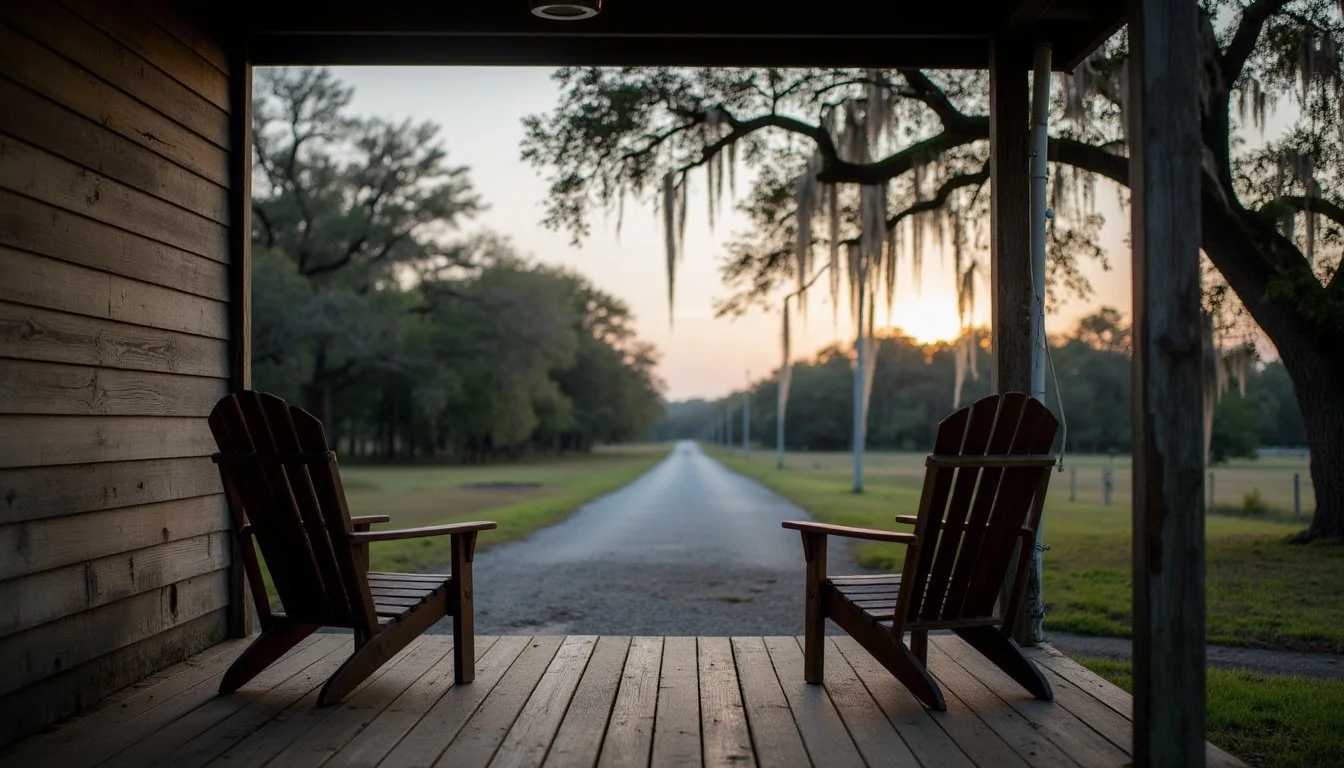
an old Florida wooden porch in the late afternoon, two weathered wooden chairs facing a quiet two-lane rural road
There was a time when I thought having more was the whole point of the exercise. More money in your pocket, more tools resting in the shed, more fish stacked like silver bars in the cooler. More land. More stuff sitting around the house that might, if you held onto it long enough, someday come in handy.
I suspect I wasn't the only one. That’s the way we’re taught to measure a life in this country: bigger house, newer truck, faster boat, more horsepower, and a few hundred extra square feet to hold all the things we haven’t figured out how to use yet.
Grandpa was never particularly impressed by any of it.
He had a porch. That was about it. It wasn’t a fancy porch—no designer furniture, no outdoor television, no ceiling fan spinning lazily above a collection of decorative signs telling us to slow down and enjoy life. It had two weathered wooden chairs, a little table that had seen better decades, and a view of Florida that didn't need decorating.
Grandpa would sit there in the late afternoon with a glass of sweet tea, watching the world go by. Sitting beside him, I eventually began to understand that he’d figured out something that took me considerably longer to learn: You don't need more life. You just need more of the life you've already got.
That porch faced a stretch of two-lane where not much happened, which was precisely why he liked it.
Every now and then, a pickup would roll past, a hand would come up off the steering wheel in a wave, or a dog would wander through the yard with absolutely no apparent destination. Birds carried on with whatever important bird business occupied their afternoons.
Sometimes we talked. Sometimes we didn't.
That was another thing Grandpa understood: silence didn't need fixing. Today, we’re surrounded by noise. Phones buzz, televisions jabber, cars honk, and notifications announce themselves like tiny emergency sirens. But Grandpa could sit for twenty minutes without saying a word and make it feel like twenty minutes well spent.
I used to think he was doing nothing. I eventually realized he was doing something most of us have forgotten how to do—he was paying attention.
He ran the same play with his old pickup. The paint had faded, the bench seat had its share of cracks, and the dashboard contained roughly three times as many mysterious rattles as it did working gauges. But Grandpa knew that truck.
He could identify a problem by the exact frequency of its groan.
"That ain't right," he'd say, staring down the road.
I'd listen, but all I heard was an engine. Grandpa heard information. He kept that truck going long after anyone else would have traded it in—not because he couldn't imagine owning something newer, but because he didn't see the point.
If something worked, he used it. If it broke, he fixed it. If it couldn't be fixed, well, then he'd think about replacing it. He didn't replace things because they were old; he replaced them when they stopped doing their job.
I learned another version of that same lesson out on the water. Grandpa could fish all morning and come home with very little to show for it. When I'd get frustrated and ask what we were going to eat, he’d just look at me and say, "We ate yesterday."
That was usually the end of the discussion. To Grandpa, fishing wasn't a grocery store with a motor attached. It was time. It was the feel of water moving beneath the hull,
the sight of birds working the shoreline, and the cool of the first morning breeze before the brutal Florida heat settled in for the day. The fish were part of the experience, sure, but they weren't the whole point.
When you're young, you count things—fish, dollars, miles, possessions, wins. You want proof that something happened. Grandpa understood that some of the best things in life leave no receipt.
Dinner at his house was built on the same quiet math. There were no extravagant meals, because there didn't need to be. A plate of fried fish, a handful of hush puppies, maybe a bowl of grits, and a glass of tea sweating onto the table could turn an ordinary evening into something worth keeping.
Nobody photographed the food. Nobody cared if it was "Instagram-worthy." We simply ate, talked, and laughed. Sometimes somebody told a story we'd already heard three times, and Grandpa would go ahead and tell it a fourth.
Some memories don't need new material; they just need an excuse to come out and stretch.
I think his greatest trick, though, was the art of leaving room. Leave room on the schedule, room at the table, room in the garage, room in your head. Today, we’re remarkably good at filling every empty square inch. If there's a spare hour, we book it. If there's an empty wall, we hang a picture. If there's a silent moment, we reach for the phone.
Grandpa had no such urge. He understood that empty space wasn't missing something—sometimes the empty space was the thing itself. A quiet porch needs room. A real conversation needs pauses. A life needs room to breathe.
What I once mistook for being old-fashioned now looks an awful lot like wisdom. He wasn't against nice things; he simply refused to let stuff become the scoreboard. His priorities were simple: family, a little work, a little fishing,
a good meal, a decent truck, a comfortable chair, and enough time to sit on the porch. He didn't need a five-year plan for happiness or an app to remind him to slow down. He just slowed down.
I sometimes wonder what he’d think of the world now—the screens, the endless traffic, the parade of advertisements telling us what we're missing and what we're supposed to want next. I imagine he'd sit quietly for a while, look out over the yard, and say, "Looks like everybody's got plenty." Then he'd go right back to watching the road.
Having less isn't losing something. Most of the time, it’s just gaining the space to notice what was already sitting right in front of you: the trees, the water, the people beside you, the sound of an old truck cooling down in the driveway, and the last light slipping across a Florida yard.
Those things don't look like much on paper, but paper has never been very good at measuring a life anyway. More isn't always more. Sometimes it's just more noise, more clutter, and more rushing toward the next thing. The richest life is often the one that finally stops adding long enough to realize it already has enough.
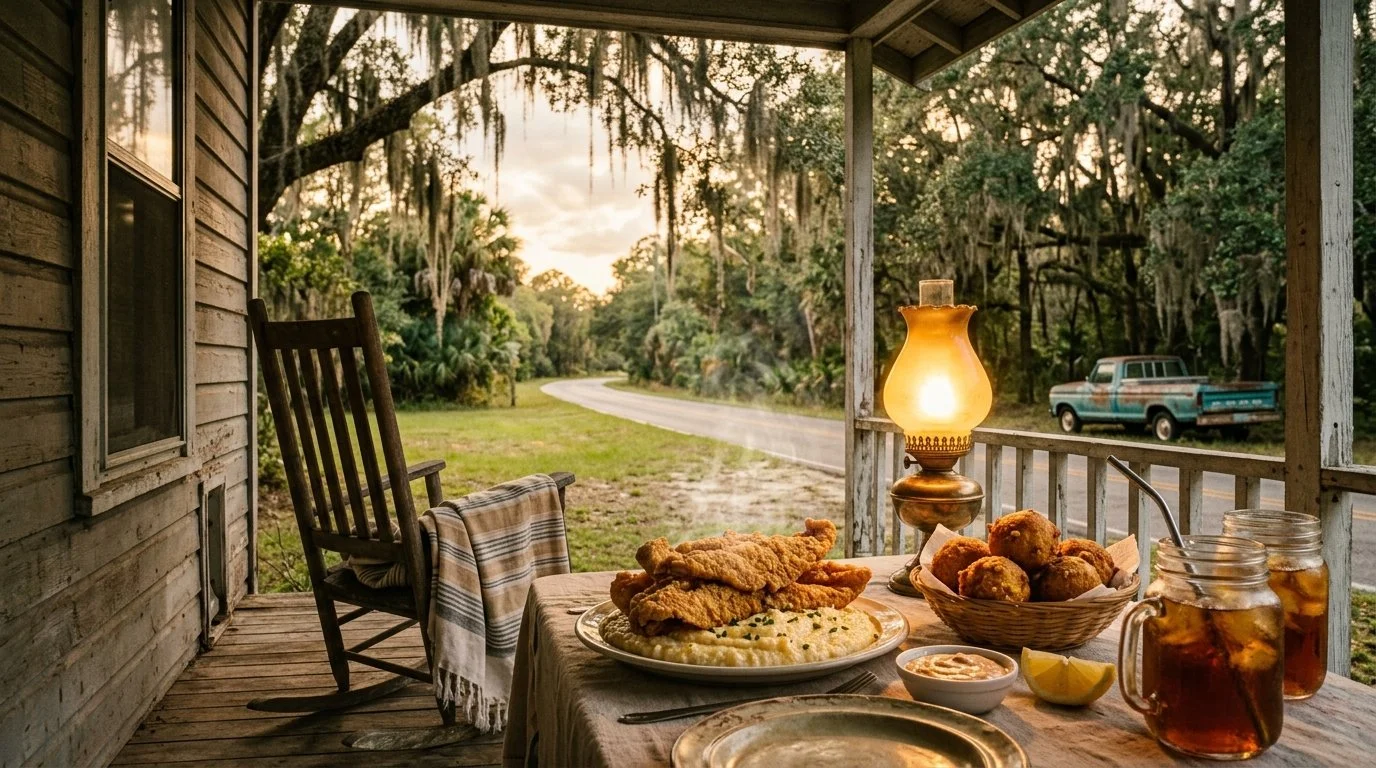
a traditional Southern-style fried fish dinner, set in a cozy, rustic kitchen or dining room. The table is centered with a generous serving of crispy, golden fried catfish, served atop a fluffy mound of creamy grits, infused with a subtle smokiness and a hint of butter. On the side, a trio of golden-brown hush puppies,
Every now and then, when the Florida afternoon gets quiet and the heat begins to loosen its grip, I can almost picture him back out there. Two chairs. One old porch. Nothing fancy. Nothing missing. Just enough—and as it turns out, enough was plenty.
Thanks for spending part of your day with Florida Unwritten.
If this story felt familiar, salty, strange, or a little too Florida to explain at dinner, share it with someone who’d understand.
👉 More stories live at https://surl.lu/uilyob. 📬 Subscribe for weekly Florida stories, coastlines, wildlife, weirdness, and the kind of local moments tourists usually miss.
Florida Unwritten is a labor of love dedicated to the places the brochures forget.
Earl
