“Fishing vs. Catching: A Florida Lesson in Patience, Fog, and Growing Up”
"Volume 1"
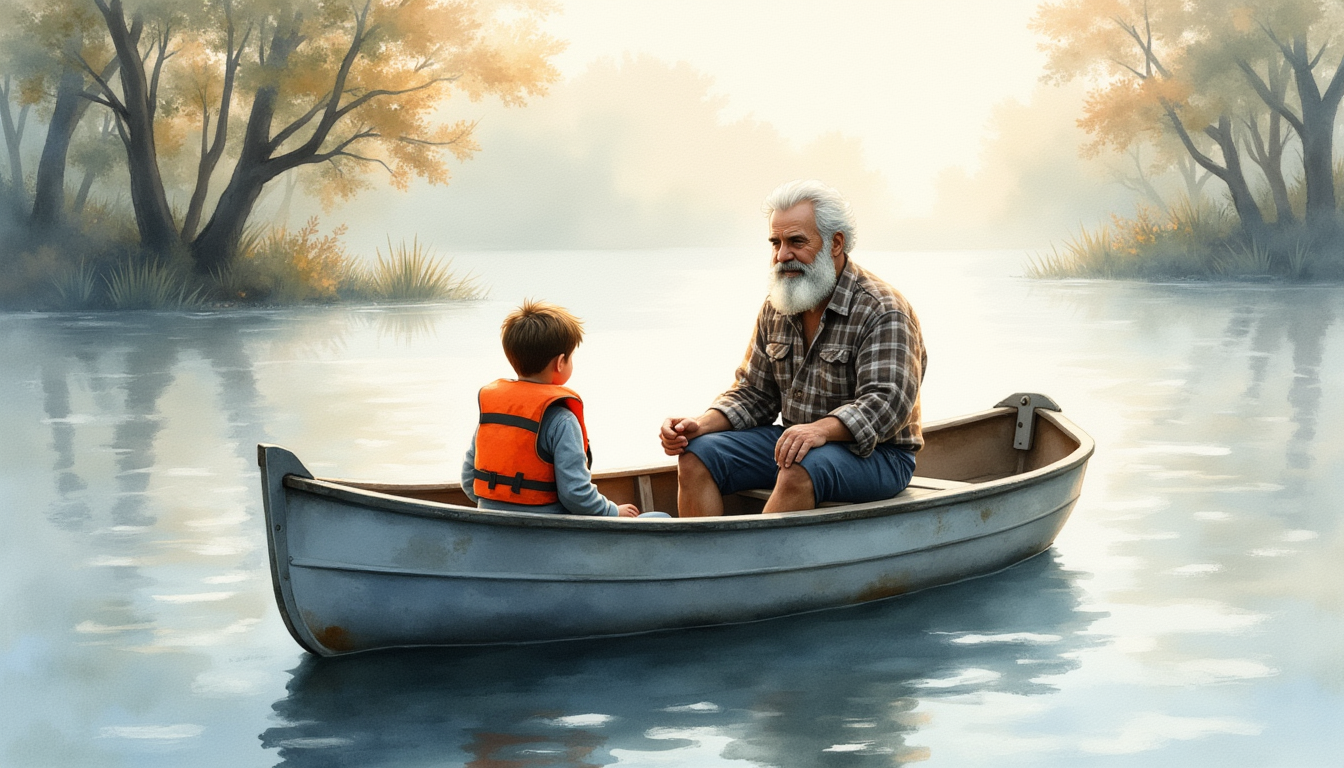
Me and Grandpa on Jon Boat
The world was nothing but a wall of white.
My grandfather called it “sea fog,” a thick, heavy curtain that swallowed the cypress knees and erased the horizon.
We were sitting in the middle of a chain of lakes that could carry a man through three Florida counties, yet I couldn’t even see the shore ten feet away.
It was the first Saturday of summer, just before sunrise, and I was tucked behind him in his dented aluminum jon boat.
We had been out for an hour.
I tried not to think about the prehistoric splashes nearby or the occasional glow of red alligator eyes cutting through the mist.
I watched him pull his third bass over the gunwale.
Meanwhile, I had been casting into the same patch of lily pads until my arms ached, without so much as a nibble.
Defeated, I reeled in, laid my rod down, and crossed my arms in a quiet pout.
He never turned around.
He didn’t have to.
“Earl,” he said, his voice a slow Southern drawl that seemed to hum through the metal floor of the boat.
“What’s wrong?”
I jumped. I hadn’t said a word.
“I’m done,” I muttered. “They aren’t biting for me.”
Without breaking rhythm, he cast again with a smooth precision I would spend years trying to copy.
“Well, Earl,” he said, “that’s why they call it fishing instead of catching.”
At the time, I thought it was just another one of his sayings.
Looking back, that was the morning the education began.
I was raised on stories that didn’t always happen and sayings that didn’t always make sense—but somehow, they taught me everything I needed to know.
Why Southern Tall Tales Carry More Truth Than Facts
In the South, a story isn’t just a recount of events. It’s a kind of currency.
By that measure, my grandfather was a wealthy man.
His stories were filled with fourteen-foot gators that spoke in riddles, storms that rained catfish, and shadows that only appeared to those with something to hide.
I spent years trying to fact-check him.
I’d point out that a gator couldn’t talk.
The lake wasn’t deep enough to hide a sunken Spanish ship.
He would just grin, spit into the water, and say:
“Don’t let the facts get in the way of the truth.”
It took me decades to understand what he meant.
Facts are catching.
The measurable, provable result.
Truth is the fishing.
The patience, the wonder, the feeling a story leaves behind.
He wasn’t trying to fool me.
He was making the world bigger than it looked.

Image of white out ( Fog ) on the Lake
Lessons in the Fog
That morning taught me something about how to move through life.
When the fog is thick enough to erase everything, you stop relying on your eyes. You start trusting your instincts.
My grandfather didn’t navigate those lakes by sight.
He knew them by feel.
“Keep the motor low and watch the ripples,” he’d say.
It sounded like boating advice.
It wasn’t.
It was a lesson in uncertainty.
There will be seasons when you can’t see the shore.
When the goal disappears.
When it feels like you’re floating in nothing.
In those moments, you don’t panic.
You slow down.
You focus on what’s right in front of you.
You trust that the land hasn’t moved just because you can’t see it.
🔜 NEXT
At ten years old, a jon boat and an Australian Shepherd were my ticket to freedom.
The Gospel of Fishing vs. Catching
We live in a world obsessed with catching.
Results. Wins. Proof.
We’re told if we don’t land something—money, success, recognition—then the effort didn’t matter.
My grandfather believed the opposite.
To him, the story of the one that got away carried more weight than anything in the cooler.
The fish you lost became legend.
The fish you kept became dinner.
He taught me that effort has dignity, even when it doesn’t pay off.
That waking up before sunrise matters—even if you come home empty-handed.
Because you saw the light break through the fog.
You heard the world wake up.
And that counts for something.
The Moral of the Make-Believe
As I got older, I realized most of his stories weren’t true.
The giant gator shrank.
The sunken ship never existed.
But the lessons stayed.
He used stories to build something stronger than facts ever could.
He knew a lecture wouldn’t stick.
But a story?
A story roots itself deep.

Image aof a Small Boy
The Fog Lifts
By the time the sun finally burned through the fog, the lake had turned to glass.
He had five fish.
I had none.
But as we headed back to the dock, I didn’t feel defeated anymore.
For the first time that morning, he turned around and smiled.
“Hungry, Earl?”
“Yeah,” I said.
“Good,” he replied. “Stories go down better on a full stomach.”
It took me years to realize he wasn’t just teaching me how to fish.
He was teaching me how to move through life.
He gave me a compass made of stories and a map built from moments that never quite happened—but somehow told the truth anyway.
And now, when the fog rolls into my own life…
When I’m working hard and getting nothing back…
I still hear that voice.
I remember that the value is in the fishing.
That the shore is still there.
Even when I can’t see it.
☀ Every Friday, another piece of old Florida drifts out of the fog—
backroads, quiet places, and stories you won’t find on a billboard.
Pull up a chair. We’ll save you a spot. https://surli.cc/dvcmdh
This story is part of the “Raised on Stories” series—lessons learned in the fog of Florida’s lakes.
🌊 SHARE THIS
Enjoying Florida Unwritten?
Forward this to a friend or share it—
That’s how these stories keep moving.
Florida Unwritten.com
Florida Unwritten.com
