Front Porch Wisdom About Reputation and Character
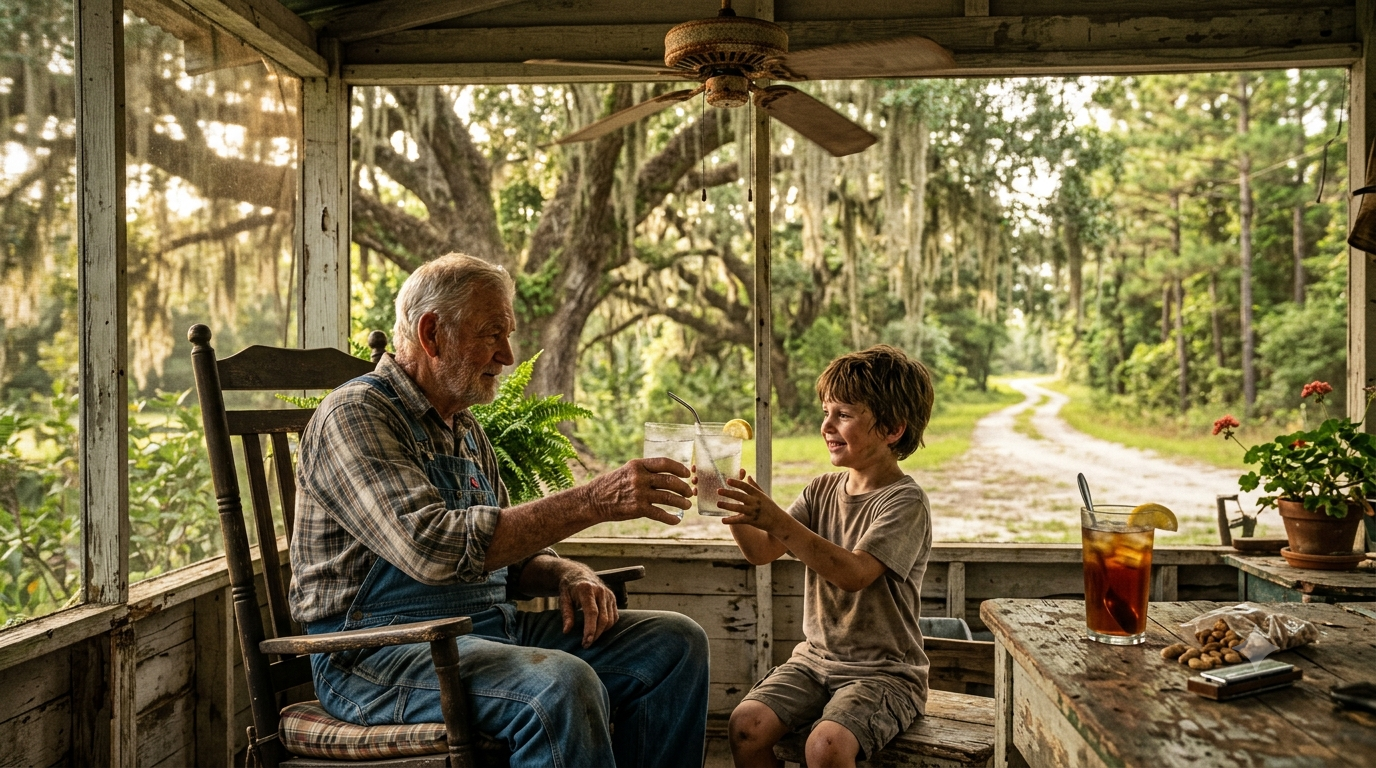
Southern porch during a sweltering July afternoon in rural North Florida. An elderly grandfather
There’s a specific kind of heavy, suffocating heat that only exists on a screened-in Southern porch in the dead of July.
It’s the sort of humidity that makes the sweet tea sweat faster than you do, transforming the air into something thick enough to chew. On those afternoons, the rhythmic,
metallic creak-whine of a rusted ceiling fan acts as the steady bassline for a deafening chorus of cicadas hiding out in the nearby pine trees.
It was on just such a porch, while I was lazily swatting at a rogue mosquito that had somehow breached the rusted wire perimeter, that my granddaddy handed me a condensation-soaked glass of ice water.
He didn't say anything at first; he just watched the dust motes dancing in the slanting afternoon sun. Finally, he nodded toward the gravel road winding past the property line and offered a piece of advice that took me nearly twenty years to truly appreciate.
"Out here, hoss," he said, his voice gravelly from a lifetime of early mornings and unfiltered wisdom, "you can lose your house to a fire, your truck to the bank, and your crop to the weather. But if you lose your name, you’re just a ghost walking around saving chairs.
A man with no word is just a shadow taking up space." In the South, your name isn't merely a collection of letters on a birth certificate, nor is it just what your mama yells out the back door when supper is getting cold on the table. It is a walking resume, a community credit score, and a legally binding contract all wrapped into one unspoken package.
Growing up on that weathered wooden porch taught me everything I need to know about the fragile anatomy of a reputation—and why keeping your word is the only true currency that never devalues.
The Heritage of the Family Name (More Than Just a Monogram).
When you grow up in a small Southern town, you quickly realize that you don't just belong to your immediate parents; you are public property belonging to an entire lineage.
If you decide to act a fool in the grocery store aisle or drive a little too fast down a clay road, the local store clerk or passing neighbor doesn't ask to see your driver's license. Instead, they drop their sunglasses,
squint at the bridge of your nose, and deliver that classic, loaded question: "Now, who are your people?"
That single phrase carries the weight of an anvil. A Southern name is a living inheritance, a fragile hand-me-down passed from generation to generation.
When someone asks who your people are, they are mentally cross-referencing your face with the grandmothers who baked the funeral casseroles during hard times, the uncles who fixed broken plumbing for free, and the grandfathers who pulled a neighbor’s tractor out of a muddy ditch during the historic floods of '93.
When you inherit a name, you inherit a legacy built on decades of quiet handshakes and kept promises. Carrying that name out into the world means realizing that your personal actions do not exist in a vacuum.
Your choices ripple backward through generations of ancestors who worked tirelessly to keep that name clean, and they stretch forward to the children who will one day have to wear it themselves.
A monogram on a towel is cute, but the character behind the initials is what actually holds the fabric together.
The Golden Rule of the Screened-In Porch: Your Word is Your Bond.
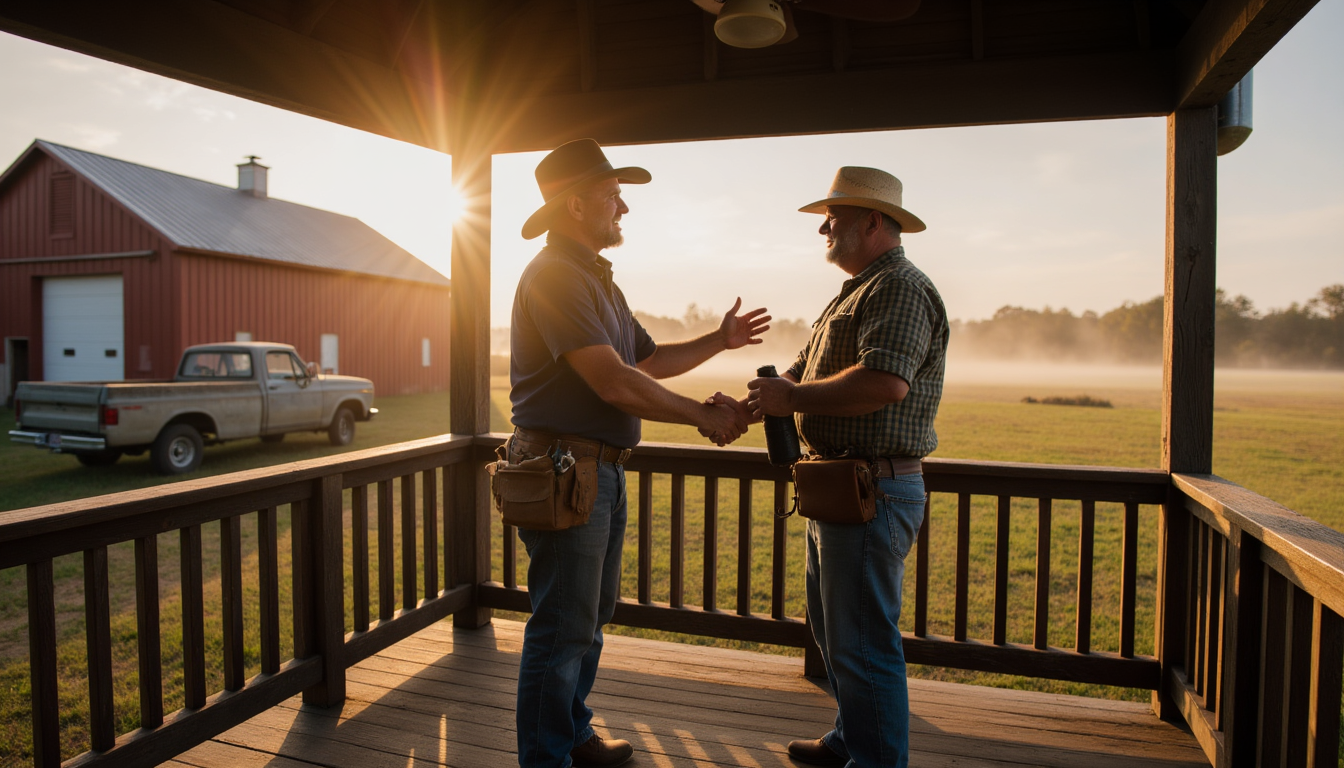
Two weathered farmers sealing an agreement with a firm handshake on a screened porch at sunrise.
Long before society became entirely dependent on digital contracts, multi-page terms of service agreements, and expensive legal teams, there was the undisputed sanctity of the porch handshake.
It was an elegant, simple system. If a neighbor looked you in the eye and told you they’d help you roof the hay barn on Saturday morning, you didn't need to send a calendar invite or a confirmation text.
You simply knew that at 6:00 AM sharp, their truck would rumble up your driveway, and they’d step out with a tool belt around their waist and a steaming thermos of black coffee in hand. The Southern Standard:
A man or woman who breaks their word is viewed with far more disdain than a common thief. A thief only steals your material possessions; a liar steals your peace of mind and your ability to trust.
If someone backed out of a promise without a life-or-death excuse, that was considered a total social bankruptcy. There was no Chapter 11 filing for a broken promise. The news would quietly travel from the hardware store to the morning diner booths, and suddenly, that person's handshake was worth about as much as a counterfeit dollar bill.
In a modern world that is completely obsessed with finding loopholes, escaping liabilities, and hiding behind the fine print, there is something deeply grounding—almost holy—about a culture where a simple "I'll be there" or "I'll take care of it" means exactly what it says.
It is an unwritten contract written directly on the heart. If your word isn't good, it doesn't matter how big your bank account is or how shiny your tractor looks in the driveway; you are fundamentally broke.
☀This story is part of the “Lessons From the Porch series—
The Day the Lake Swallowed the Sun: A Lesson at Eleven
A Florida Lesson in Patience, Fog, and Growing Up
The Only Currency That Doesn’t Devalue:
Economic markets crash without warning. Interest rates skyrocket overnight. The local co-op prices for feed, seed, and fuel fluctuate constantly based on global events that are completely out of our hands.
But the value of a solid, bulletproof reputation?
It is entirely recession-proof, inflation-proof, and immune to the whims of Wall Street. Think about the specific people in your own community whom you respect the most.
If you take a step back and analyze it, it’s rarely the folks with the flashiest dual-axle trucks, the biggest brick houses on the hill,
or the most manicured lawns. It’s the local mechanic who looks at your rattling engine, tells you that a loose bolt was the only issue, tightens it up, and sends you on your way with a smile and a zero-dollar invoice.
It’s the quiet neighbor who notices your grass is getting a bit high while you're recovering from surgery and unassumingly drives their mower over to handle it without being asked.
It’s the family friend who drops off a warm peach cobbler or a pot of chicken and dumplings simply because they heard through the grapevine that you’ve had a heavy, exhausting week.
That kind of consistent integrity and genuine kindness builds up an immense reserve of social capital that money simply cannot buy.
When the storms of life inevitably hit—and they hit everyone sooner or later—the individual who has invested heavily in their character will find a community ready to shield them. A good name is a shield that gold can never forge.

Click on Image for new story every Friday
Sweeter Than Sweet Tea:
The Slow Work of Rebuilding a Tarnished Name. Of course, we have to be realistic:
We are all human, and humans are notoriously prone to tripping over their own feet. Mistakes happen. Maybe a promise was inadvertently broken due to poor judgment,
a business venture fell apart awkwardly, or a momentary lapse in character gave the local town gossips plenty of ammunition to wag their tongues over at the beauty shop or the Sunday morning pews.
In the South, gossip travels faster than a grease fire in a small kitchen, and a bad rumor can circle the county twice before the truth can even get its boots on.
But the beautiful thing about a tight-knit community is that while gossip travels fast, grace has a remarkably long memory.
Rebuilding a damaged reputation out here doesn't happen by hiring a public relations firm, launching a defensive social media campaign, or posting a heavily rehearsed, dramatic apology video online.
Instead, a name is restored through quiet, consistent, everyday action. It’s the slow,
intentional process of showing up when you say you will, doing the right thing when you think absolutely nobody is watching, and letting the quiet volume of your daily character eventually drown out the loud, temporary noise of past mistakes.
It is a very slow pour, much like brewing a proper pitcher of sweet tea from scratch. You can’t rush the process; it takes immense patience, genuine warmth, and plenty of time for the sugar to completely dissolve the bitterness.
But if you stay the course, the final result is something sweet, enduring, and deeply valued.
A Warm Farewell from the Rocking Chair. As the evening sun finally begins to dip below the jagged line of loblolly pines, casting a long, amber-orange glow across the weathered floorboards of the porch,
it is worth taking a quiet moment to stock up on what we are actually chasing in this fast-paced life.
Wealth, status, and material possessions can all vanish in the span of a single, catastrophic afternoon. But a good name? That stays firmly anchored right where you left it, serving as a monument to who you were when the world was watching, and more importantly,
when it wasn't. So, the next time you find yourself extending your hand to seal a deal, or giving someone your solemn word across a kitchen table or a boardroom desk, hold onto that promise with everything you've got.
Treat it like gold, because at the end of the day, it’s the most valuable asset you will ever own.
Thanks for spending part of your day with Florida Unwritten.
If this story felt familiar, salty, strange, or a little too Florida to explain at dinner, share it with someone who’d understand.
👉 More stories live at https://surl.lu/uilyob
📬 Subscribe for weekly Florida stories, coastlines, wildlife, weirdness, and the kind of local moments tourists usually miss.
Florida Unwritten is a labor of love dedicated to the places the brochures forget.
Earl lee
Florida Unwritten
