Before Google: How Storytelling Built Florida's Identity
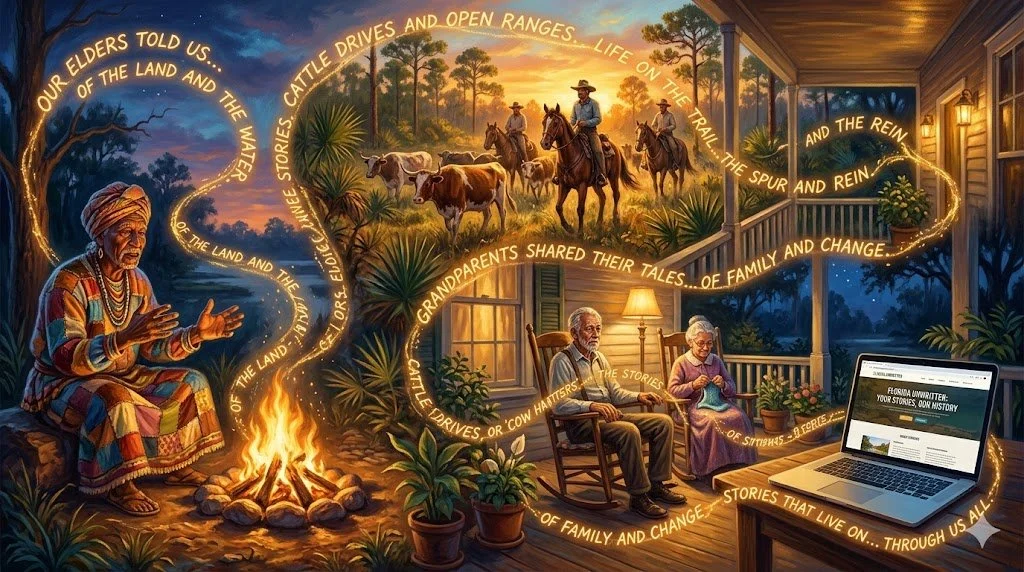
symbolic image showing stories flowing through generations, Seminole campfire transitioning into Florida cowboys, then grandparents on a porch,
Introduction: Sitting in the Nook of a Story
You know that particular kind of Florida quiet, the one where the only thing cutting through the thick humidity is the rhythmic creak of a porch swing.
Long before we could pull an answer out of our pockets at the speed of light, we lived in the "B.G." (Before Google) era. It was a time when the world's greatest intelligence was found in the shade of a live oak rather than a classroom,
an intelligence that can never be learned from a textbook.
Back then, I’d sit tucked under my grandfather’s right arm while the aroma of black coffee clung to the air, demanding to be known
He didn't just tell stories to pass the time; he gave them to us as a survival kit.
We learned our history from the mouths of our elders, people who had lived in our skin and embodied the blood of our stories, ensuring that the parts of us that shouldn't be forgotten weren't lost to the sawgrass.
Storytelling is as ancient as humankind, existing long before writing as a way to pass down traditions, values, and the very glue that holds a culture together. When we stop to listen, we aren't just hearing words; we are participating in a timeless ritual that anchors us to the earth.
--------------------------------------------------------------------------------
New Story Every Friday
https://surl.li/liobbk
The Succession of Language (Our Florida Roots)
Down here, we’re usually "fixin' to" do something, but we rarely stop to think about the "succession of language" that got us here.
The Native Hawaiians have a beautiful word for this: moʻolelo.
It comes from mo’o, meaning succession, and olelo, meaning language.
Because all their stories were oral, a story was quite literally the way language succeeded from one heart to the next.
Florida has its own deep succession. Long before the first orange groves were planted, the Seminole and Miccosukee people were gathered around campfires, retelling legends of the mischievous Rabbit and the Corn Lady.
Their stories weren't just for fun; they were a pedagogical tool used to teach children how to live in harmony with the Everglades.
They tell of a Creator who placed all living things in a large shell atop the "backbone of the earth"—the high mountains—and waited for the Wind to help them emerge.
This created a clan system—Panther, Wind, Bird—that still dictates tribal life today.
Then came the Crackers, a subculture of Scots-Irish and English pioneers who arrived around 1763 and learned to flourish in a land of mosquitoes and alligators before air conditioning was even a dream.
While some say the name "Cracker" comes from the Elizabethan word for a braggart, we like the version where it’s the sharp "crack" of the rawhide whips used by cowmen to herd cattle through the scrub.
Men like Jacob Summerlin, the "King of the Crackers," were self-sufficient spirits who helped name towns like Orlando and Bartow, proving that a well-told story (and a bit of clout) could build a state from the muck up.
Stepping Into Someone Else’s Boots
One of the most profound gifts a story gives us is the ability to step out of our own sun-dazed lives and into someone else's worn-out boots. Storytelling cultivates empathy and understanding, allowing us to appreciate the complexities of the human condition through a broader lens.
Zora Neale Hurston, a daughter of Eatonville, understood this better than anyone.
She called her anthropological training a "spy-glass" that allowed her to look at the "garment" of her own culture from the outside.
She traveled through the citrus camps and turpentine woods of Florida, recording the "big old lies" and work songs of Black laborers. She knew that these stories weren't "primitive"—they were sacred records of a people’s resilience and identity.
Similarly, Marjorie Kinnan Rawlings moved to Cross Creek in 1928 and found her muse in the "cracker" folks of the Big Scrub.
She immersed herself in their lives, even taking a two-week boat trip down the St. Johns River to truly connect with the land.
She famously wrote that we are merely "tenants and not possessors" of the earth, which belongs ultimately to the wind and the rain.
By sharing the lives of her neighbors in books like The Yearling, she bridged the gap between the remote Florida backcountry and the rest of the world, fostering a connection to a land most people knew nothing about.
--------------------------------------------------------------------------------
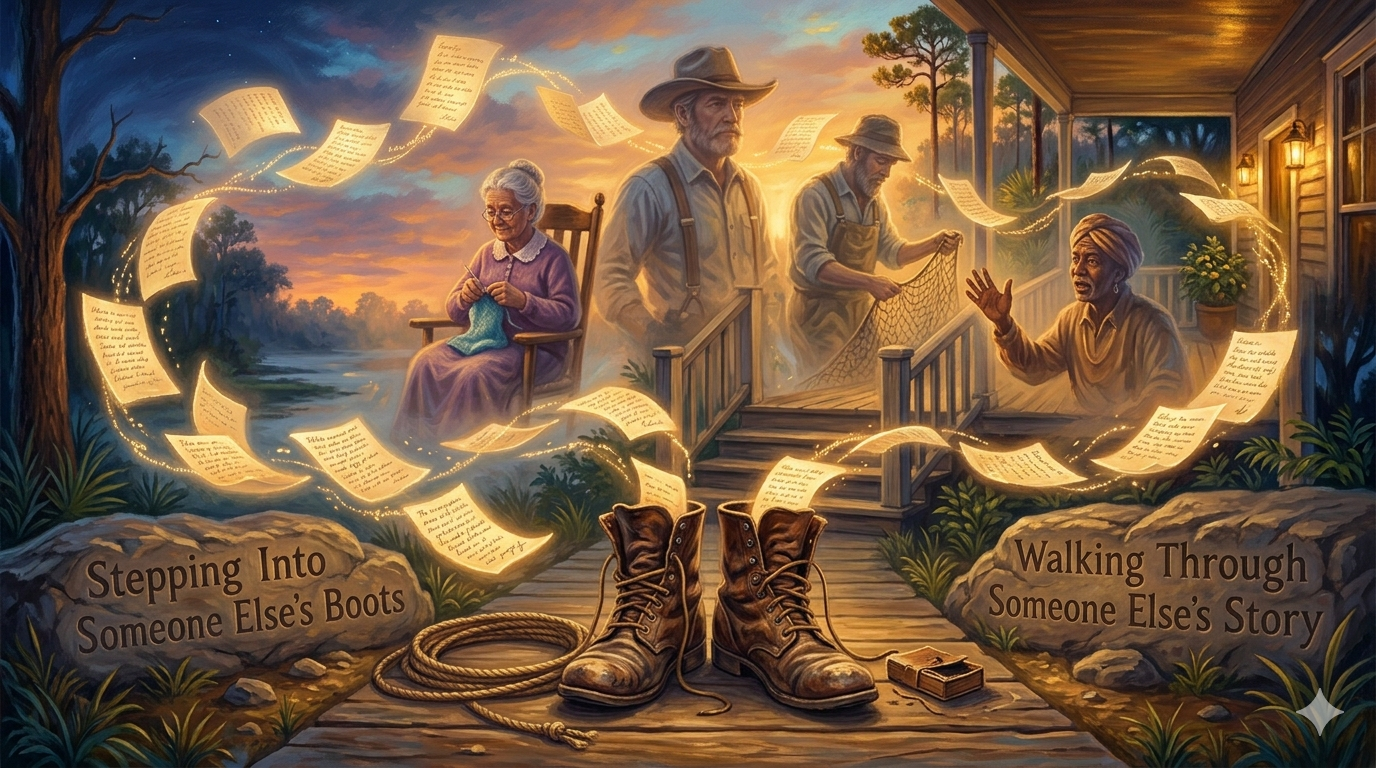
boots sitting beside a weathered porch while ghostlike silhouettes of different generations overlap one another, grandparents, pioneers, fishermen, storytellers,
The Folklore of Our Faith
In the "B.G." days, storytelling was a form of prayer.
The attention we give to a storyteller is the same kind of engagement we give when we position ourselves to pray.
Our faith is strengthened through the knowledge and obligation passed down in these tales, even the "bone-chilling" ones.
Take the legend of La Llorona, the "crying woman" of the creeks.
My grandfather would tell her story while slurping his coffee, making us wonder if her tireless search for her drowned children was a kind of purgatory or a testament to a mother’s undying faith.
These legends remind us that our faith is what "springs before us" to cushion our fall when life gets hard.
And then there are the yarns of Bone Mizell, the "rangeland raconteur" with a hawklike nose and a "quick and cutting wit".
One of the best stories tells of Bone passing out and being left in a graveyard as a prank. When he woke up groggily, he looked around and announced,
"Well, by God! Here it is Judgment Day, and I'm the first one up".
It’s a bit of gentle, self-aware humor that reminds us that even in death, a good Floridian keeps his sense of timing.
These tales ensure our history resisted being erased by people who never lived in our skin.
--------------------------------------------------------------------------------
☀This story is part of the “Lessons From the Porch series—
Healing Over a Basket of Fried Catfish
There is a unique kind of healing that happens around a dinner table when the meals are communal, and the stories are plentiful.
Whether we’re passing around homemade tortillas or eating cantaloupe filled with vanilla ice cream, we are participating in a "church" of sorts.
Sharing personal experiences—both the joyful and the painful—is a powerful tool for catharsis, transforming trauma into resilience.
Modern science actually backs this up. Researchers have found that nostalgia—that bittersweet "sentimental longing for a past that no longer exists"—actually infuses our lives with meaning (MIL).
It’s a serial process: nostalgia fosters social connectedness, which heightens self-continuity (the sense that you are the same person across time), which finally strengthens your sense of purpose.
When we reflect on the musty smell of a grandparent's attic or the sound of a song from our youth, we aren't just daydreaming. We are symbolically reigniting bonds with the people who helped us become who we are today.
This "social repair" buffers us against loneliness and gives us the efficacy to face whatever "frog-strangler" of a storm is coming our way.
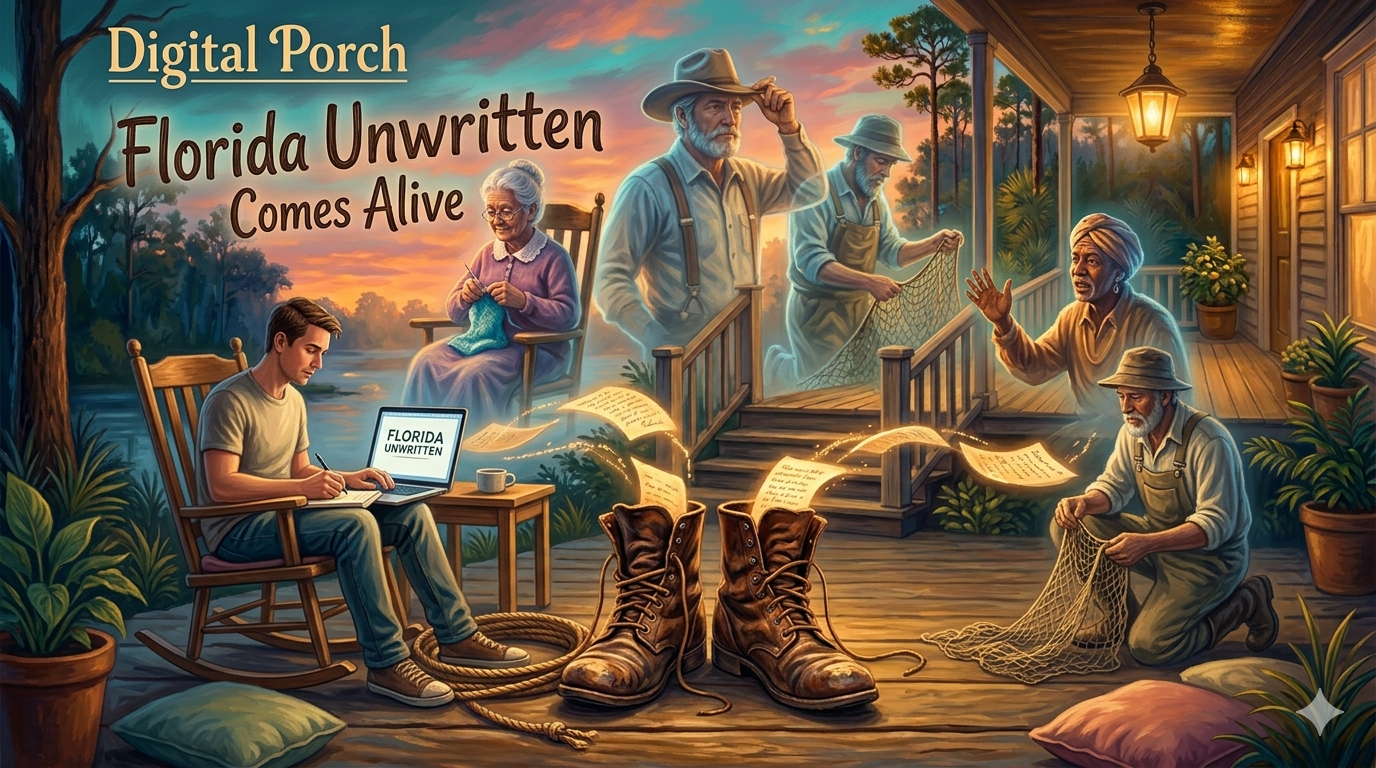
Modern person sitting at a laptop on a front porch at sunset while ghostlike images of old Florida storytellers
Digital Porches & Future Whispers
We might live in a high-tech world, but storytelling remains a "low-tech art".
It helps us build communication skills and the confidence to structure our narratives and captivate an audience.
I created Florida Unwritten to be a digital porch where we can still "sit a spell" and listen, even if we’re hundreds of miles apart.
By using these modern tools to tell "B.G." stories, we are helping to preserve old cultures while building new ones.
We are making sure that the voices of turpentine workers, "He-coon" leaders, and pioneer teachers aren't lost to the digital tide.
It’s about taking that "oratorical aesthetic" of the South—where speech is an art form—and ensuring it has a place in the future.
--------------------------------------------------------------------------------
Conclusion: Grabbing Hold of the Backpack
There is a unique trust, much like faith, that happens during the transaction of storytelling.
Once you receive a story, it becomes your own, a part of your personal "history book".
We are "lost at the ends of sentences" when our histories are not honored, but when we tell them, we ensure our people are never forgotten.
It is an honor to carry these stories on our backs. My hope is that you—and your children—will grab hold of the backpacks of those who came before you.
Fill them with your own "unwritten" gems, keep the old ones polished, and keep carrying them forward.
Because as long as we keep the stories alive,
we can continue to brave life with a little more heart, a little more humor, and a whole lot of faith.
Thanks for spending part of your day with Florida Unwritten.
If this story felt familiar, salty, strange, or a little too Florida to explain at dinner, share it with someone who’d understand.
👉 More stories live at https://surl.lu/uilyob
📬 Subscribe for weekly Florida stories, coastlines, wildlife, weirdness, and the kind of local moments tourists usually miss.
Florida Unwritten is a labor of love dedicated to the places the brochures forget.
Earl lee
Florida Unwritten
