Every Rusted Sword Has a Story
"Volume 3"
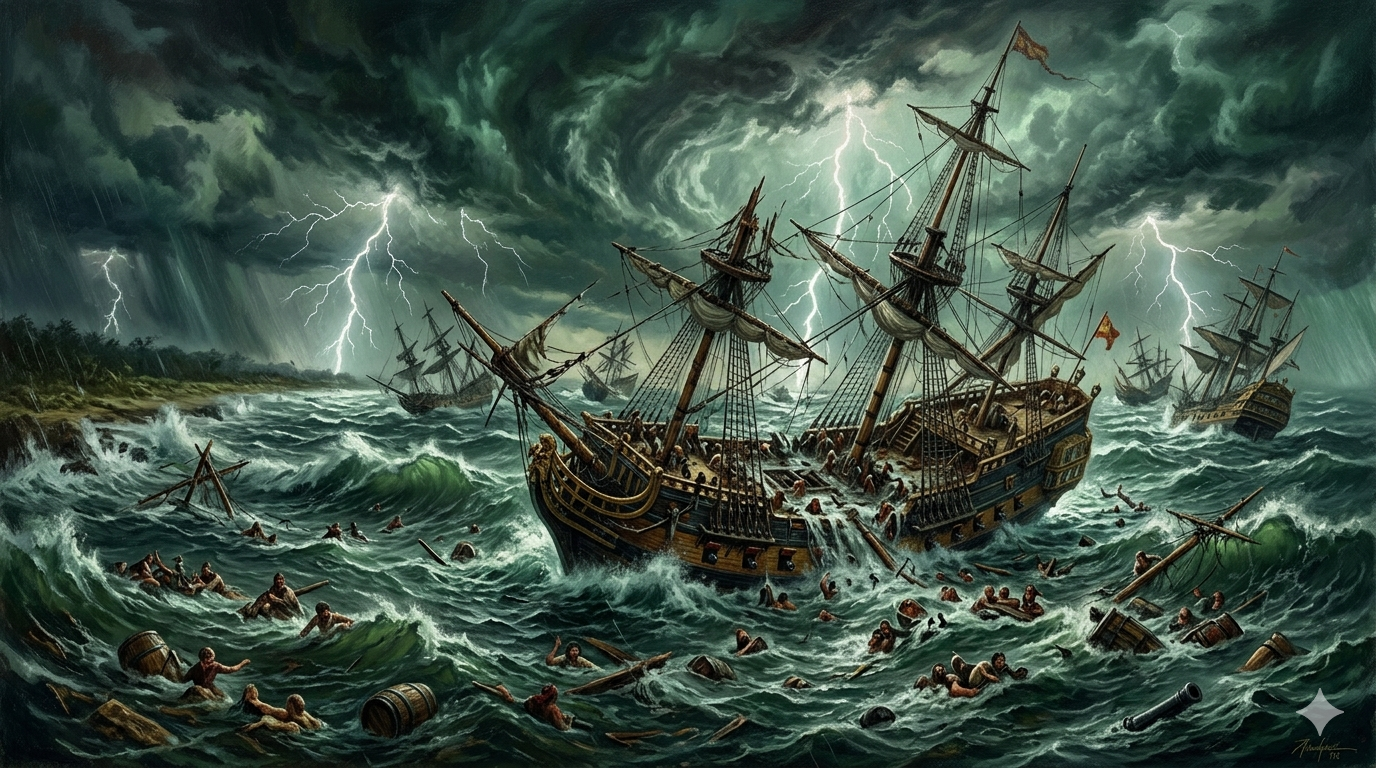
The 1715 Shipwreck
Spanish treasure galleons being destroyed by a violent hurricane off the Florida coast
You know that specific feeling when you’re cleaning out a space that hasn’t seen a broom since the Reagan administration?
That was me last Saturday, armed with a lukewarm Cuban coffee and enough cobweb-dodging skills to audition for an action movie.
I was digging through the back corner of my grandfather’s old, weathered barn—a place where Florida humidity and cedar planks have been locked in a slow-motion wrestling match for forty years.
In our family, the barn wasn't just storage; it was a "cathedral of stuff," a dusty museum where every rusted wrench and discarded outboard part had a story attached to it.
As I moved a moth-eaten horse blanket, expecting to find another prehistoric palmetto bug or a petrified lizard skin, I saw a glint of metal that didn't look like a rusted tractor part.
When I pulled it from the shadows, the weight of it nearly took me by surprise.
It wasn’t scrap. It was a sword—or at least, the salt-crusted, brine-eaten remains of one. In that moment, the air in the barn felt a little heavier,
like a piece of a puzzle I hadn’t known I was solving. It was a reminder that in this state, history is under our floorboards, waiting for a Saturday cleaning session to bring it back to life.
The Discovery Beneath the Dust
The object in my hand was a tangible piece of "Old Florida" mystery.
The hilt was a tarnished basket weave, and the blade, while shorter than a standard cavalry saber, was thick and pitted by centuries of neglect.
As I wiped away the layers of barn dust, I realized this wasn't something you found in a Sears catalog or a Disney gift shop. This was a weapon that had seen the underside of the Atlantic.
I dragged my find out into the blinding Florida sunshine, my Australian Shepherd, Red, trailing a half-step behind me with his ears perked, sensing my excitement.
We headed straight for the porch, the sacred ground where all "Old Dirt" mysteries were eventually decoded.
My grandfather was in his usual spot, the rhythmic creak-thump of his rocking chair keeping time with the local cicadas. I laid the rusted blade on the small table between us,
right next to his sweating glass of sweet tea. He didn't jump. He didn't even look surprised.
He just peered over his spectacles, poked the hilt with a calloused finger, and whispered, “So, she finally decided to show herself, did she?”.
New Story Every Friday
The Night the Sky Turned Green
That was the start of a "Grandpa Tail," the kind of story that begins with a long silence and ends with you looking at the Florida coast in a completely different way. According to him, that sword belonged to the "Ghost of 1715".
He began to describe a legendary Spanish treasure fleet that met its end during a hurricane so fierce it turned the sky an eerie shade of bruised purple and green.
“The waves weren’t just water that night,” he said, leaning in until I could smell the cedar on his clothes. “They were walls of iron”. The fleet, laden with silver and private spoils, was ripped apart on the jagged reefs just a few hundred yards off our very own stretch of coastline.
He claimed his own father—a man who understood the "Old Dirt" long before the asphalt arrived—had found that sword partially buried in the dunes after a particularly nasty Nor'easter back in the 1940s. For decades, it had sat in the rafters of the barn, a silent witness to the changing times.
The Shipwreck Trail and the Ocean's Memory
What I realized as I cleaned the blade—treating it with more reverence than I usually give my kitchen knives—was that I was holding a piece of the Florida Shipwreck Trail.
We often forget that we live in a graveyard of history.
The sand beneath our toes isn't just silicon and crushed shells; it might be hiding "pieces of eight" or the personal sidearm of a Spanish sailor who was trying to get home three hundred years ago.
Grandpa taught me that the ocean is the ultimate bookkeeper—it eventually "spits back what it swallowed".
He viewed our backyard not as grass and sand, but as a map of ancient secrets.
To a man with a sixth-grade education, this wasn't "archaeology" found in a textbook; it was stewardship. He believed that finding these things was a responsibility to remember the people who were here before the "New Money" tried to pave over the memories.
👉 More stories live at https://surl.lu/uilyob
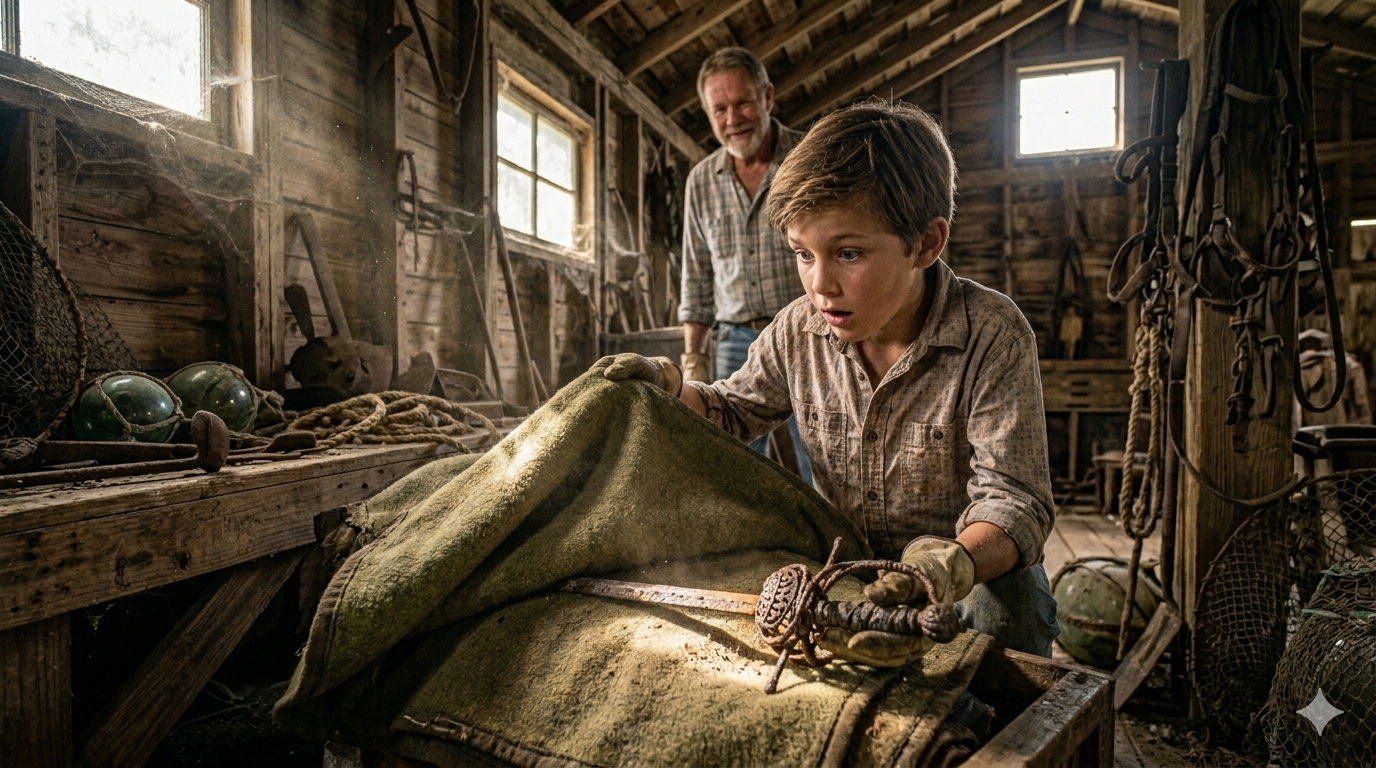
a Boy discovering a salt-crusted Spanish sword beneath an old horse blanket, cinematic realism
Truth vs. Facts: The Legend Lives On
Now, I’m sure if I took this sword to a museum, they might give me a list of "facts"—the exact carbon content of the steel or the specific forge in Spain where it was hammered out.
But as Grandpa always told me, “Don’t let the facts get in the way of the truth”.
The "facts" are the catching; the "truth" is the fishing.
The truth of that sword isn't just in its metallurgy; it’s in the way it makes me feel when I walk past it in my hallway. It sits there now, looking slightly out of place next to a modern coat rack and a bowl of car keys,
but it serves as my North Star.
It reminds me that even when the world outside our porch becomes unrecognizable—swallowed by neon signs and the "magic" of the coming Kingdom—there are things beneath the surface that don't change.
Grandpa’s story might have been 10% history and 90% "Old Florida" imagination, but in this state, the line between legend and reality is often as thin as a fishing line.
He was the navigator who used these stories to keep us anchored to the land, ensuring I never went so far that I forgot whose dock I belonged to.
A Map Made of Memories
Finding that rusted blade was a reminder that our heritage isn't just inherited; it’s earned through the curiosity to look under the "floorboards" of our lives.
It taught me that Florida is a place where the past isn't gone—it's just waiting for a storm or a shovel to bring it back to the light.
Every time I see that sword, I can almost hear the roar of the 1715 gale and see the whitecaps breaking over a doomed wooden hull. I realize now that Grandpa wasn't just telling me a ghost story; he was showing me how to read the ripples of tide.
Thanks for spending part of your day with Florida Unwritten.
If this story felt familiar, salty, strange, or a little too Florida to explain at dinner, share it with someone who’d understand.
👉 More stories live at https://surl.lu/uilyob
📬 Subscribe for weekly Florida stories, coastlines, wildlife, weirdness, and the kind of local moments tourists usually miss.
Florida Unwritten is a labor of love dedicated to the places the brochures forget.
Earl lee
