The Entry Fee: Why Heritage Isn’t Inherited, It’s Earned
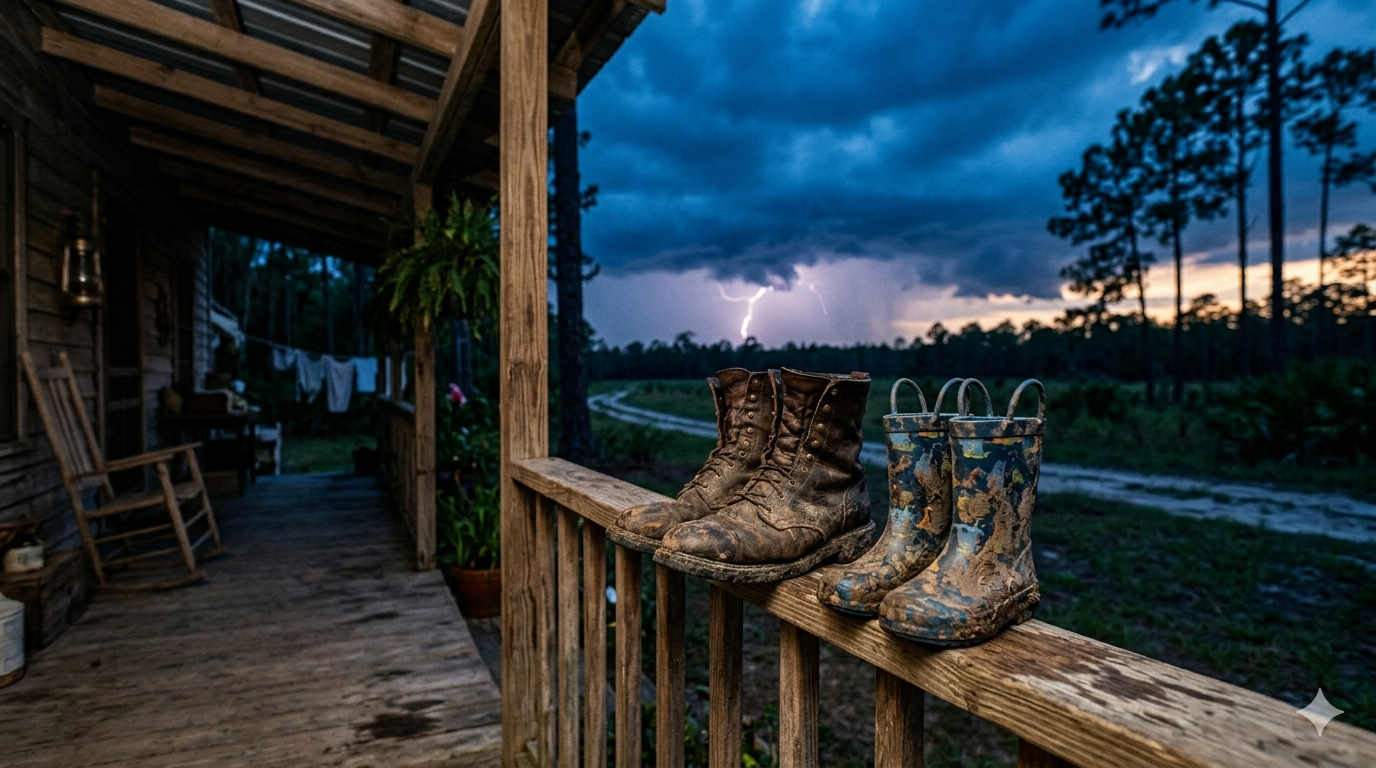
Two pairs of muddy boots resting on a wooden porch railing at dusk,
"Volume 2"
The yellow school bus didn’t just drop me off; it exhaled me onto the dirt road in a cloud of dust and diesel fumes.
For a ten-year-old in the early 70s, that puff of black smoke was the finish line of the modern world and the starting gun for the one that actually mattered.
Waiting for me at the exact line where the asphalt died, and our life began was Red, my Australian Shepherd.
I often wondered how that dog could tell time, but there he was, ears perked, ready to lead me around the last towering longleaf pine toward the house.
And there, like a permanent fixture of the Florida landscape, was Grandpa.
He’d be sitting in his rocking chair, the rhythmic creak-thump keeping time with the cicadas. Before I could even drop my bag, the question would drift across the yard: "Got any homework?".
"Not today," I’d say, a wide grin breaking across my face.
He’d smile back, that familiar twinkle in his eyes suggesting he knew exactly what was coming next. "Good," he’d say. "Change your clothes and come see me".
In our house, that wasn't a suggestion. It was the polite translation for: It’s time for chores. It was the first step in paying what he called the "entry fee" for the evening.
--------------------------------------------------------------------------------
The Sacred Geometry of the Feed Bucket
To an outsider, the next two hours looked like manual labor. To Grandpa—a man with a sixth-grade education and the smartest mind I’ve ever known—it was "sacred geometry". Every afternoon followed the same rigorous pattern: feeding, fixing, hauling, and sweating.
There was a specific rhythm to the chores. You didn't just throw grain at the chickens; you checked the fencing for where the foxes had been testing the wire.
You didn't just pump water; you listened to the "breath" of the pump to see if the leather seals were wearing thin. This was the "Old Dirt" education.
The Florida heat during those years felt like a wet wool blanket draped over your shoulders. As I hauled buckets of feed or dragged cedar planks to the barn, the sweat didn't just run; it soaked.
But in Grandpa’s world,
Sweat was the only currency that didn't devalue. He believed that if you didn't put your hands into the earth, you had no right to sit on the porch and talk about it.
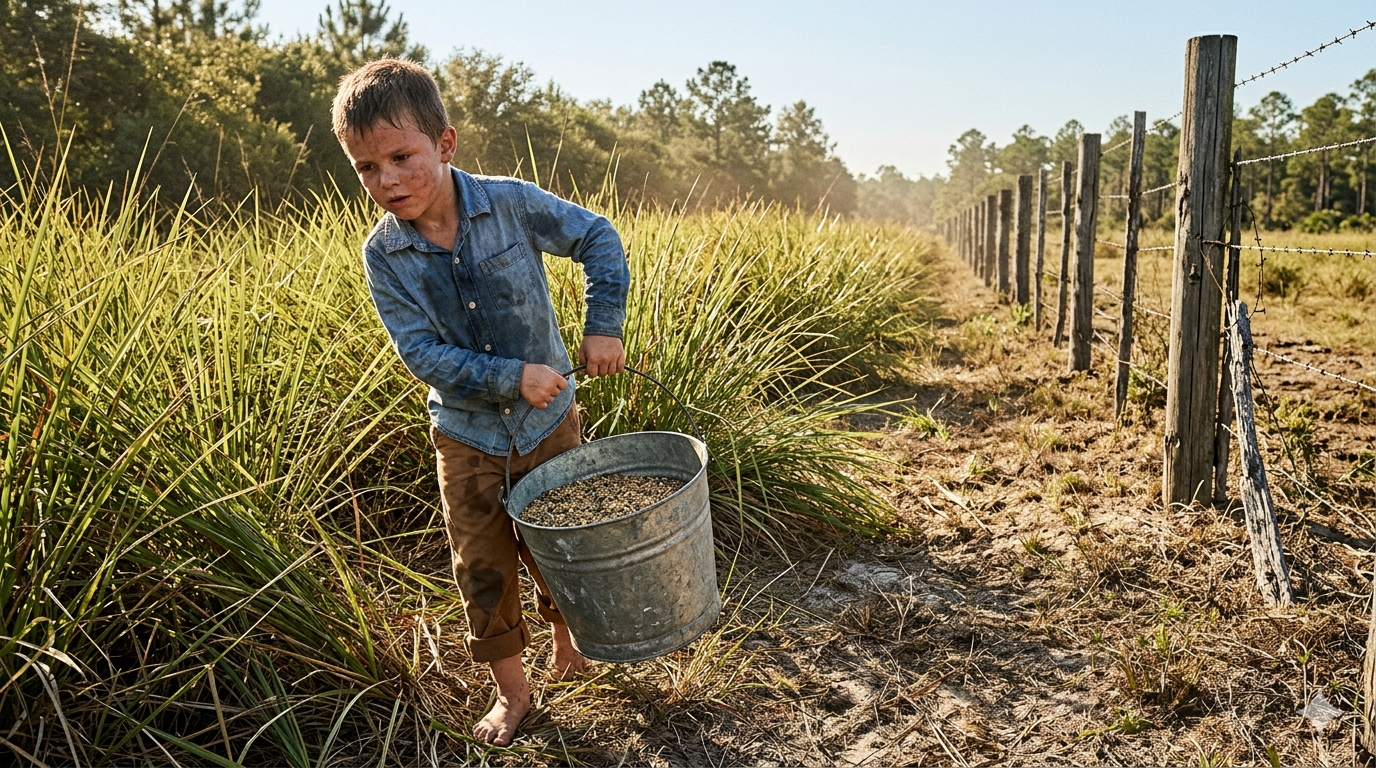
The Entry Fee: Paying for the Porch
We live in a world today obsessed with "catching"—the results, the wins, the measurable proof of success.
But Grandpa believed the value was always in the fishing—the effort, the patience, and the dignity of the work itself. He viewed the porch as a sanctum, a place where the labor of the day was distilled into the wisdom of a lifetime.
"Earl," he’d say, watching me lean against a fence post to catch my breath, "most people love the leaving. But the man is the one who remembers the way home".
He was teaching me that heritage isn't something you're born with; it's something you earn through stewardship.
You couldn't just inherit the "Old Dirt"; you had to prove you were worthy of it by tending to it when the sun was hot, and the dragonflies stayed low.
To him, the land wasn’t an asset to be sold for "new money"; it was an identity. Every fence I fixed was a stitch in the fabric of who we were.
If I tried to take a "short way" or skip a step, he’d just chuckle and reach for his glass. He knew that the "Short Way" was a mistake—a stage-play version of life that didn't have to answer to the seasons.
--------------------------------------------------------------------------------
Distilling Labor into Legend
By the time the sun began to bleed into the horizon and the indigo Florida blue took over the sky, the chores were done. This was the moment the "entry fee" was processed. I’d wash the grit from my hands, change back into a clean shirt, and finally—finally—take my seat.
The porch was where the "Grandpa-isms" lived—those cryptic, rhythmic sayings that never gave a straight answer but always kept you wondering.
Because I had done the work, I was allowed into the conversation.
I had earned the right to hear about the "Ghost of 1715" and the Spanish galleons that met their end when the sky turned a bruised purple and green.
When he spoke of the rusted sword found in the dunes or the 14-foot gators that spoke in riddles, I didn't care if the facts were 90% imagination.
I understood the Truth behind them. The truth was that the world was bigger and more mysterious than any textbook could hold, and that the only way to navigate it was to "watch the ripples" and trust your instincts.
👉 Florida always has another story

New Story Every Friday
No spam. Just Good Stories
The Religion of the Tin Roof
As we sat there, the air heavy with the scent of orange blossoms and damp earth, I realized that this was my "religion." It wasn't found in a building, but under the rhythmic roar of a tin roof during a summer storm.
Grandpa taught me that the rain always won, and that the most honest sound in the world was the sky meeting the earth.
He stayed on that porch until the very end, a navigator who refused to let the "New Money" or the coming "Kingdom" of the Mouse dictate his life.
He saw the "Changing Times" coming—the asphalt, the neon signs, and the end of the "Unwritten" Florida. He knew that once you sell the "Old Dirt," you can never buy it back.
By making me pay the "entry fee" of chores, he wasn't being a taskmaster.
He was giving me a compass made of stories and a map built from the sweat of my own brow. He was ensuring that when the world eventually became unrecognizable, I would still know whose dock I belonged to.
👉 More stories live at https://surl.lu/uilyob
The Long Version of the Truth
Now, when I look back at those seven years from 1970 to 1977, I don't remember the exhaustion of the hauling or the heat of the noon sun.
I remember the weight of the wisdom that followed. I realize now that he was dropping breadcrumbs of truth so that when I finally went solo, I’d have a way to find my way back to him.
The porch is still there in my mind.
The rocking chair still creaks. And the entry fee is still the same: you have to be willing to do the work before you can understand the story.
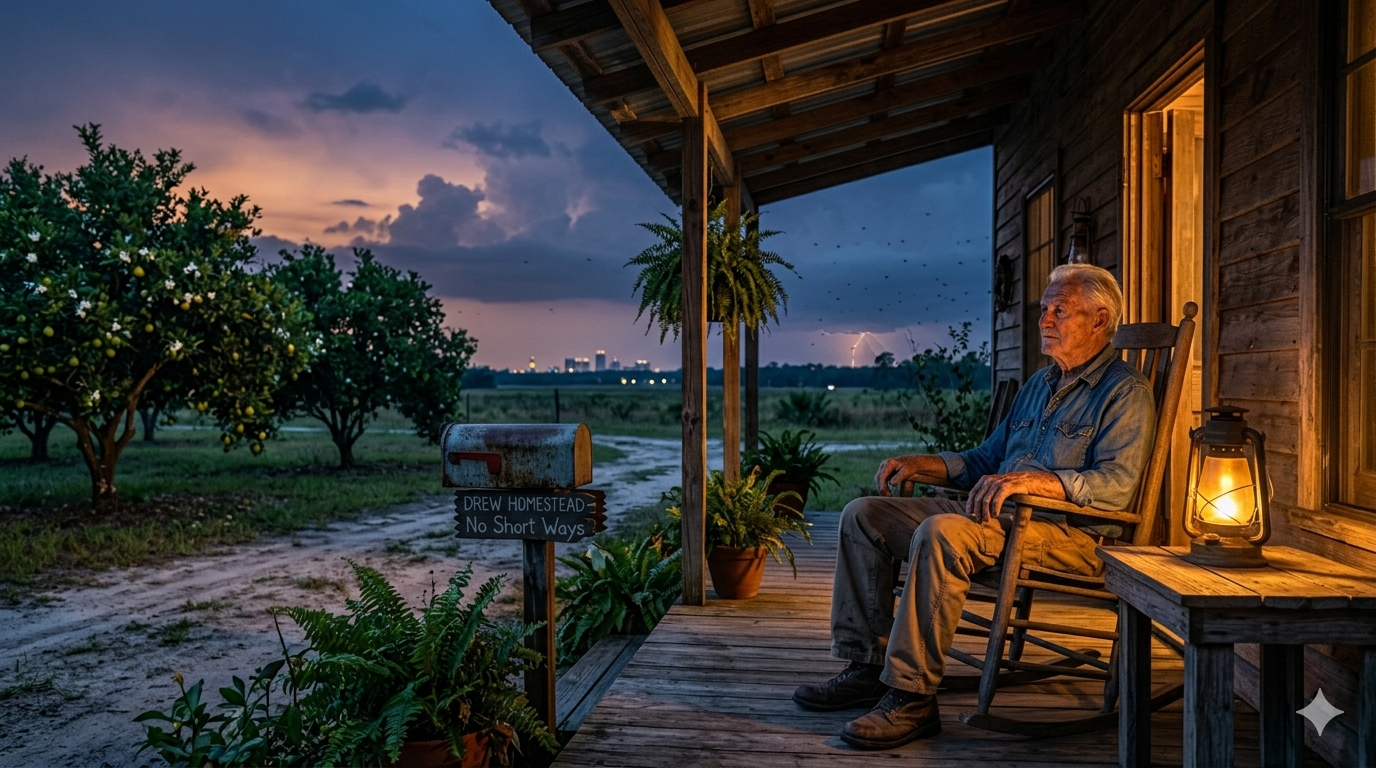
End of the Day Granpa on the porch
Pull Up a Chair
The world moves fast, and "New Money" is always looking to pave over "Old Dirt." But here on the porch, we take the long version of the story.
👉[Subscribe for weekly field notes and stories delivered to your inbox.]
Thanks for spending part of your day with Florida Unwritten.
If this story felt familiar, salty, strange, or a little too Florida to explain at dinner, share it with someone who’d understand.
Florida Unwritten is a labor of love dedicated to the places the brochures forget.
See Ya Friday
Earl lee
