Why You've Never Been Bitten by a Mosquito at Disney World
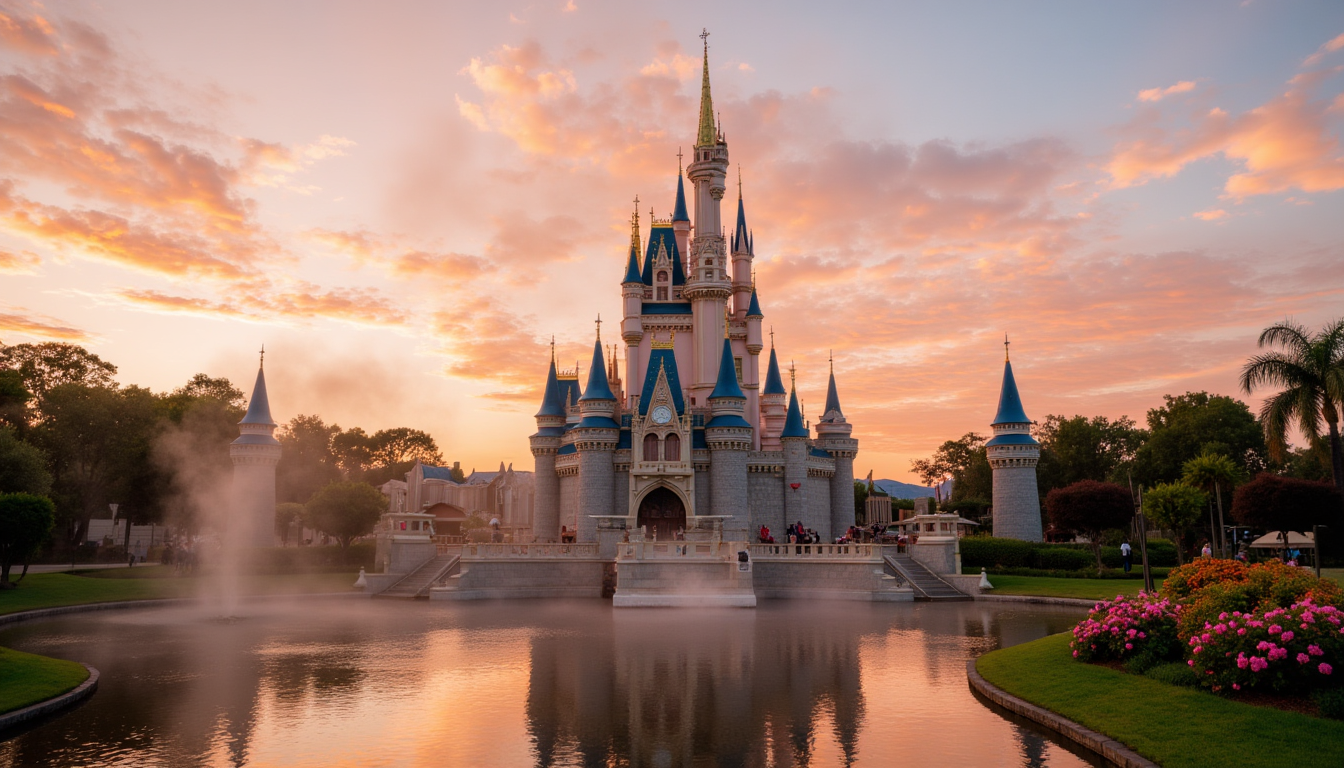
Disney World Castle at sunset
Florida is famous for a few undeniable truths: the humidity will ruin your hair within thirty seconds of stepping outside,
The afternoon thunderstorms are as punctual as a Swiss watch, and the mosquitoes are practically the state bird.
If you've ever stepped outside in Central Florida during the summer, you know the familiar, frantic dance of swatting away these relentless pests.
It's a rite of passage to return indoors smelling of DEET and defeat. Yet, millions of families flock to the heart of this swampy peninsula every year, donning shorts, tank tops, and mouse ears,
and wandering around a massive outdoor theme park from dawn until dusk.
And somehow, miraculously, they leave without a single itchy red welt.
Have you ever stopped mid-bite of your Dole Whip, looked around at the lush tropical foliage, and wondered:
Why have I never been bitten by a mosquito at Disney World?
The Swamp That Walt Bought
To understand the magnitude of this miracle, we have to rewind to the mid-1960s.
When Walt Disney was flying over Central Florida in a chartered plane,
Scouting locations for his highly secretive "Florida Project,"
He wasn't looking at pristine, ready-to-build real estate.
He was looking at thousands of acres of raw, untamed, aggressively hostile swampland. It was a humid, murky wilderness,
teeming with alligators, venomous snakes, and, of course, billions upon billions of mosquitoes.
The locals considered the land practically worthless.
Most people looked at that land and saw an uninhabitable bog that belonged strictly to the reptiles.
Walt looked at it and saw the future.
But he also possessed enough practical sense to know that his vision of a utopian entertainment enterprise
It would quickly turn into a nightmare if his guests were constantly being eaten alive.
You can't exactly enjoy the whimsical charm of "It's a Small World" while aggressively scratching your ankles,
Nor can you appreciate a parade while slapping your own forehead.
The magic would be broken instantly.
Disney needed a solution, and he needed it to be entirely invisible to the guest.
"You can't exactly enjoy the whimsical charm of 'It's a Small World' while aggressively scratching your ankles."
Enter Joe Potter, the Mosquito General
Walt didn't hire an exterminator; he hired a general.
Specifically, Major General William E. "Joe" Potter,
an MIT-educated engineering mastermind who had previously served as the governor of the Panama Canal Zone.
If there was anyone on earth who knew how to battle mosquitoes in a tropical,
swampy, malaria-prone environment, it was Potter.
Walt met Potter at the 1964 World's Fair, and soon after,
Potter became the man responsible for taming the Florida swamp.
When Potter arrived in Florida, he didn't bring a fleet of crop dusters filled with toxic chemicals to carpet-bomb the area.
He brought a philosophy. He knew that you couldn't just kill the adult mosquitoes;
It was a losing battle against nature's sheer numbers.
You had to stop them from ever being born.
And to do that, you had to control the water.
Mosquitoes need stagnant, still water to lay their eggs.
Potter's mission was simple in theory but monumental in execution:
Make sure the water at Disney World never, ever stops moving.
☀ Every Friday, We Head Back Out
Every Friday, another piece of old Florida drifts in—fishing stories, backroads, quiet places, and the kind of truth you won’t find on a billboard.
Pull up a chair. We’ll save you a spot.
👉 Join the newsletter and get it in your inbox every Friday.
The Architecture of Flow
The next time you're strolling through the parks,
Take a closer look at the water features.
They aren't just there for beauty and appeal or to house animatronic hippos;
They are highly engineered components of a massive, property-wide pest-control system.
Every fountain, every moat around Cinderella Castle, every decorative pond is constantly flowing.
Potter designed an intricate, sprawling network of drainage ditches, canals,
and automated locks that keep the water levels perfectly regulated and constantly circulating.
Even the architecture of the buildings plays a crucial role.
Have you noticed the shape of the buildings in the parks?
There are very few flat roofs.
They are sloped, curved, and angled to ensure that rainwater immediately runs off and doesn't pool.
The landscaping is meticulously graded so that water flows directly into the drainage system.
There are no puddles left behind after those daily 3:00 PM downpours.
It's a masterpiece of civil engineering,
hidden in plain sight behind the facade of a fairy tale castle and a futuristic space mountain.
Disney-style stone canal
☀ Every Friday, We Head Back Out
Every Friday, another piece of old Florida drifts in—fishing stories, backroads, quiet places, and the kind of truth you won’t find on a billboard.
Pull up a chair. We’ll save you a spot.
👉 Join the newsletter and get it in your inbox every Friday.
The Garlic Spray and the Sentinel Chickens
Of course, moving water isn't the only trick up Disney's sleeve. They do use repellents,
But in true Disney fashion, they do it differently.
Instead of blanketing the parks with harsh, chemical pesticides that could harm the environment, disrupt the local ecosystem,
Or bother guests with sensitive noses, they use a surprisingly culinary weapon: liquid garlic.
Mosquitoes, much like vampires, absolutely despise garlic.
The scent masks the carbon dioxide that humans exhale, which is what attracts the bugs to us in the first place.
Disney sprays a highly concentrated liquid garlic extract around the parks.
The amount is so minuscule that human noses can't detect it—so don't worry,
the Magic Kingdom doesn't smell like the kitchen of an Italian restaurant on a Friday night—but to a mosquito,
it's an impenetrable wall of stench. It's an organic, safe, and highly effective barrier.
And then there are the chickens.
Yes, chickens. Hidden away in the backstage areas of the property,
far from the churro carts and character meet-and-greets,
Disney maintains flocks of "sentinel chickens."
These feathered employees live a very comfortable life,
with one specific job: being monitored.
Their blood is regularly tested for mosquito-borne illnesses like West Nile virus and Eastern Equine Encephalitis.
Because chickens don't get sick from these viruses but do produce antibodies when bitten,
they act as an early warning system.
If a chicken tests positive, Disney knows exactly which specific area of the 40-square-mile property
needs a targeted, immediate response.
It's a slightly quirky, incredibly effective biological alarm system.

The Mosquito General’s War Room
The Invisible Dome of Magic
The result of all this engineering, garlic, and poultry is nothing short of astonishing.
When you cross the threshold onto Disney property, it feels as though you've entered a protective bubble.
The harsh realities of the Florida swamps are kept firmly at bay,
allowing the parks' illusion to remain unbroken.
You can wear your shorts at midnight and emerge unscathed.
It's easy to marvel at the cutting-edge animatronics,
the spectacular fireworks displays, and the sheer scale of the attractions.
But perhaps the most impressive feat of Imagineering isn't a ride at all.
It's the invisible infrastructure that allows you to stand by the water in Epcot at dusk,
watching the lights reflect on the lagoon, without a single mosquito buzzing in your ear.
It's the meticulous,
obsessive attention to detail that ensures your comfort is never compromised by the natural world.
So, the next time you find yourself wandering down Main Street, U.S.A., or exploring the lush,
jungle trails of the Animal Kingdom, take a moment to appreciate the unseen magic.
Raise a Mickey-shaped pretzel to Joe Potter, the sloped roofs,
the flowing moats, and those unsung hero chickens working behind the scenes.
They are the reason the "Most Magical Place on Earth" isn't also the most itchy.
🌊 SHARE THIS
Enjoying Florida Unwritten?
Forward this to a friend or share it—
That’s how these stories keep moving.
Discovering the hidden narratives, forgotten histories, and invisible magic of the Sunshine State.
Eal Lee
Florida Unwritten
© 2026 Florida Unwritten. All rights reserved.
