Florida isn’t solid ground; it’s a Giant Wet Sponge (And Somehow We Built a State on it
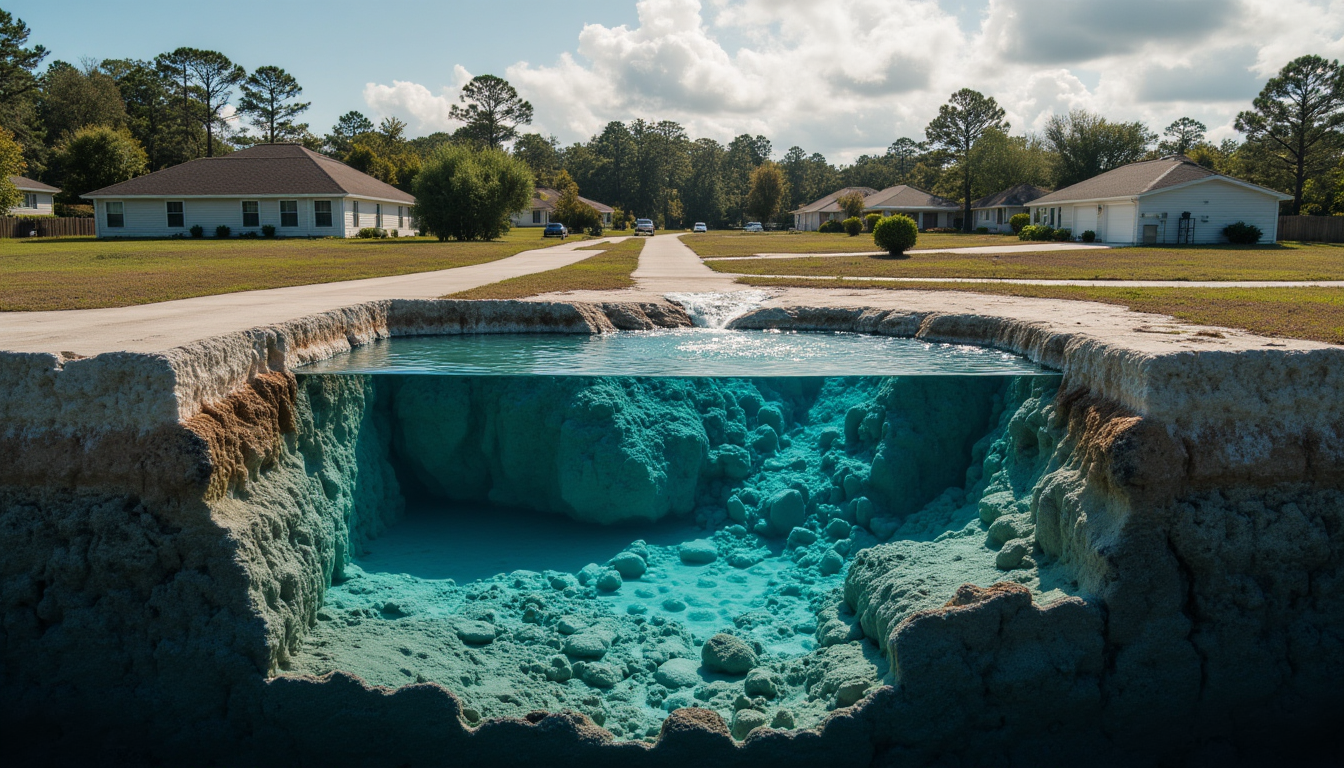
cross-section of Florida ground showing porous limestone like a sponge
True Stories6 min read
Why the Sunshine State is basically a giant, wet piece of Swiss cheese, and why we love our precarious peninsula anyway.
If you dig a hole in Ohio, you get dirt. If you dig a hole in Florida, you get a swimming pool—or, if you’re particularly unlucky that day, a portal to a subterranean realm that hasn’t seen the sun since the Ice Age.
Growing up in the Sunshine State, I learned early on that the ground beneath your flip-flops is less "solid rock" and more "wet Swiss cheese."
While the rest of the country builds its lives on sturdy granite or dependable clay, we Floridians have chosen to erect our subdivisions,
our sprawling theme parks, and our neon-lit strip malls on a geological structure that is, scientifically speaking, a giant, calcium-rich bath sponge.
Living here requires a certain level of geological denial. You have to wake up every morning, look at your driveway, and decide to believe it will still be there by dinner. It’s a precarious,
hilarious and damp existence that truly defines what it means to be a Floridian.
The Limestone Reality: Living on a Damp Pie Crust
Geologists have a very sophisticated, professional term for our landscape: karst topography. Personally, I prefer to call it "living on a prayer and a massive pile of ancient seashells."
To understand why your backyard might occasionally feel like a trampoline, you have to go back millions of years.
Once upon a time, Florida wasn’t a peninsula; it was a shallow, sun-drenched seabed.
It was a tropical paradise for prehistoric oysters, coral colonies, and bitey marine creatures who were, apparently, very committed to their future roles as our foundation.
Over eons, their crushed shells and skeletal remains piled up in layers hundreds of feet thick. Under the weight of the ocean, this debris compressed into limestone.
The problem—or the magic, depending on how much you like cave diving—is that limestone is highly porous and chemically sensitive.
When rain falls in Florida, it picks up carbon dioxide from our decaying tropical vegetation, becoming slightly acidic.
As this "pineapple-flavored" acid rain seeps into the ground, it doesn't just sit there. It eats the rock.
Slowly but surely, the earth beneath us is being hollowed out.
The water carves out a vast, invisible network of underground cathedrals, winding rivers, and jagged voids.
We aren't living on a continent; we are essentially living on the crust of a very fragile, very damp lemon meringue pie.
Every time a new skyscraper goes up in Miami or Orlando, I can’t help but imagine the limestone beneath it letting out a tiny, calcified groan of protest
The Sinkhole Lottery: Florida’s Favorite Party Trick
Nostalgia in Florida isn't just about the scent of orange blossoms on a humid evening or finding a stack of vintage, paper Disney tickets in a kitchen drawer.
It’s also about the collective, unspoken understanding that your property line is merely a suggestion.
In Florida, the earth doesn't just erode; it relocates.
Sinkholes are the ultimate punchline to Florida’s geological joke.
Because the limestone is constantly dissolving, the "roof" of an underground cave eventually gets too thin to support the weight of whatever we’ve parked on top of it.
It could be a majestic live oak dripping with Spanish moss, a 1998 Toyota Camry, or a local mattress emporium.
I remember the local news cycles of my childhood being dominated by "The Big Ones."
There was an almost morbid excitement when a new hole opened up.
We’d crowd around the television to see aerial footage of a suburban cul-de-sac that now featured a sudden, perfectly circular abyss.
One minute you’re out in the yard, complaining about the mole crickets and the humidity; the next, you’re staring into a 40-foot drop that leads straight to China
It adds a certain thrill to homeownership that you don't get in the Midwest.
In Ohio, the biggest threat to your real estate is a bad winter; in Florida, it’s the possibility that your guest bedroom might decide to go on a subterranean field trip on a random Tuesday.
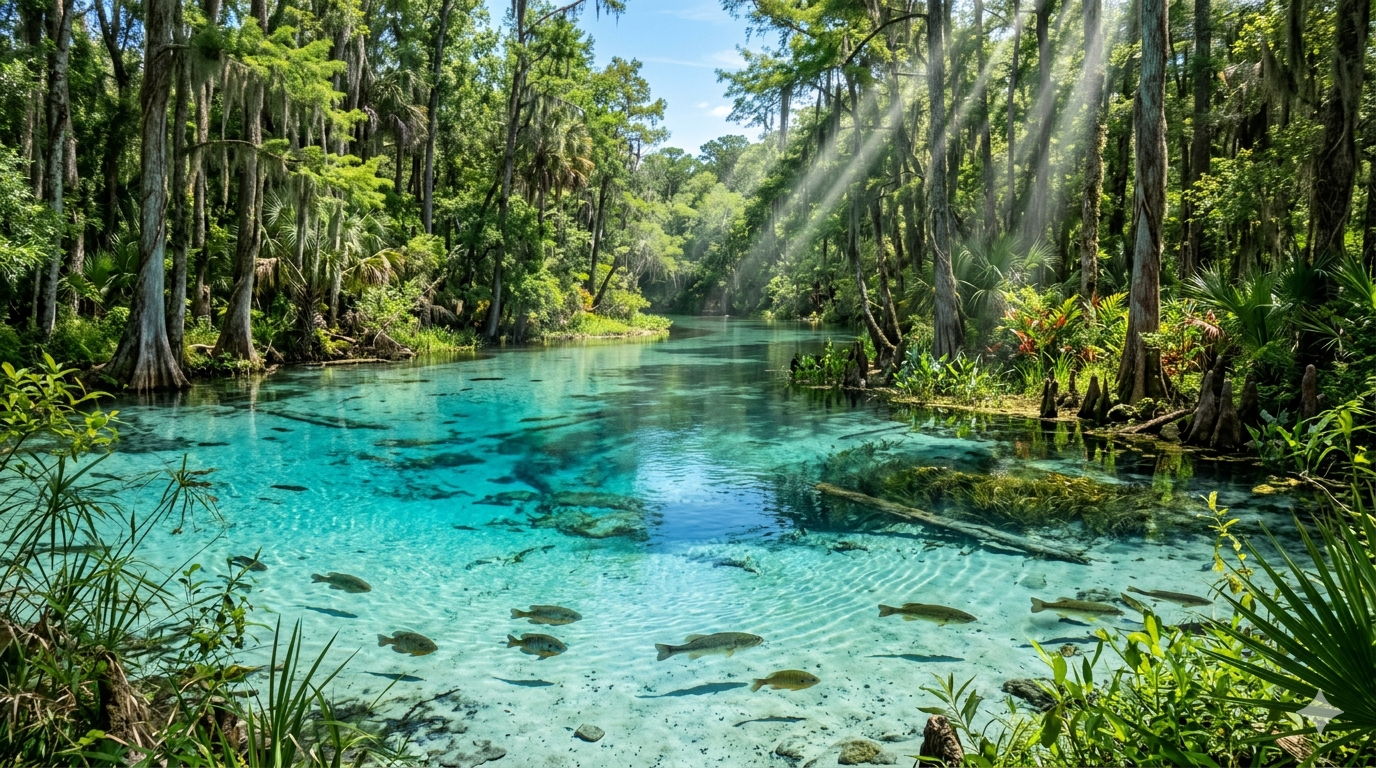
Crystal-clear Florida spring with turquoise water
Drinking from the Sponge: Our Subterranean Lifeline
But we can’t be too hard on the "wet sponge" beneath us, because it’s the only reason we can survive here. Tucked inside that brittle, holey crust, the Floridan Aquifer sloshes.
The name sounds majestic, doesn't it? It conjures images of a secret, sunless ocean ruled by blind, pale mermaids and glowing shrimp.
In reality, it’s a massive, rock-filled reservoir that serves as the state’s primary plumbing system. The Floridan Aquifer is one of the most productive in the world, holding billions of gallons of fresh water in its stony pores.
The same porous rock that threatens to swallow our patios acts as a world-class natural filter.
When it rains, the water trickles through the limestone, which scrubs away impurities before depositing it into the aquifer.
When you turn on the tap in Florida, you are quite literally drinking "sponge-water."
This is also the source of our legendary natural springs. Places like Silver Springs or Blue Spring aren't just pretty ponds; they are "leaks" where the pressure of the aquifer forces water back up to the surface through a hole in the limestone.
When you swim in that bone-chilling, 72-degree, crystal-clear water, you are essentially swimming in the Earth’s perspiration.
It’s a beautiful, terrifying, and deeply interconnected system that reminds us we are always just one crack in the rock away from a geological miracle.
Altitude Sickness and the Florida "Mountain."
Because our foundation is so soft, water-logged, and prone to collapsing under its own feelings, Florida doesn't really do "mountains." Or "hills." Or even "noticeable inclines."
If you’ve ever looked at a topographical map of Florida, it looks like a pancake that someone accidentally stepped on.
Our highest natural point is Britton Hill, which towers at a dizzying 345 feet above sea level. For context,
you can trip over a speed bump in Colorado and experience a more dramatic change in elevation.
I vividly remember a family road trip where my dad, squinting through the windshield of our wood-paneled station wagon,
proudly announced we were crossing the "Central Florida Ridge."
I pressed my face against the glass, expecting to see a jagged peak or at least a respectable slope. All I saw was a slightly taller pine tree and a billboard for a gator farm.
In Florida, "high ground" is a relative term. If you’re standing on a pile of mulch in your backyard, you’re practically an alpine explorer.
But that’s the charm of our geography. It doesn’t boast with soaring peaks or dramatic cliffs.
It lurks. It hides its complexity underground, letting the surface stay flat and unassuming while the real drama happens three hundred feet below the Sears parking lot.
“Jump on in and ride with us. We’ll drop you a Friday line, fresh as a new week.”
A Precarious Place to Call Home
It’s a strange thing, building a life on a limestone peninsula that is actively dissolving beneath your feet.
We are a state of people who have learned to live with the geological equivalent of a "Check Engine" light that never goes off.
But maybe that’s why Floridians are the way we are—a little weird, a little resilient, and always ready to adapt to the unexpected.
When your state is built on a sponge, you don't fight the current; you learn to just float with it.
We know that the ground is temporary, the water is rising, and the next sinkhole is just a heavy rainstorm away.
And yet, we wouldn't trade our "wet Swiss cheese" for all the solid granite in the world.
After all, where else can you find a backyard that might double as a freshwater spring by morning?
Geology Humor | Florida Life | Sinkholes
Enjoyed this dispatch from the edge of the abyss? The Florida Unwritten blog is dedicated to the stories that make the Sunshine State so uniquely... ourselves. Whether it's the wildlife, the weather, or the weird rocks beneath our feet, we've got you covered.
Join the Florida Unwritten newsletter for more stories from the swamp!
You’re reading Florida Unwritten.
Quiet places, true stories, and roads worth turning down.
Earl Lee
Florida unwritten
