
The Survival of Gatorland: Orlando’s Last True Roadside Attraction
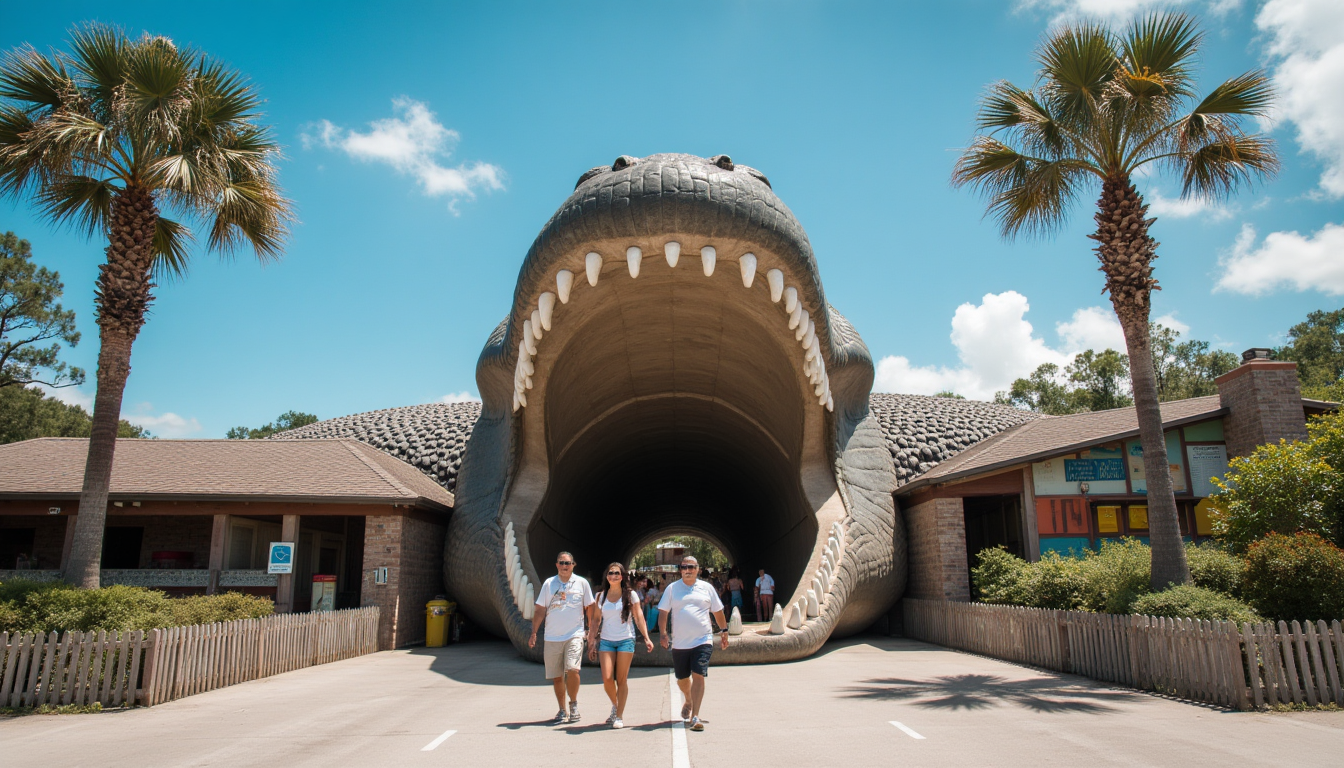
the iconic giant concrete alligator mouth entrance at Gatorland
How a man in safari gear and a swamp full of hungry reptiles outlasted the corporate theme park invasion by leaning into the weird, wild heart of Old Florida.
Oct 24, 2023
6 min read
Orlando, FL
The undisputed kings of the Florida roadside attraction.
Drive down the sprawling, neon-lit concrete artery of South Orange Blossom Trail today, and the polished, focus-grouped perfection of modern Orlando assaults you. Billboards promise immersive wizarding worlds, intergalactic space battles, and encounters with The Mouse, as we say here. It is a landscape engineered to extract maximum capital through frictionless, climate-controlled joy. But right there, stubbornly wedged between the sprawl of chain hotels and discount t-shirt emporiums, sits a gaping set of concrete alligator jaws.
Step through those jaws, and the air changes. The sterile hum of the highway fades, replaced by the primal, guttural bellow of a bull alligator and the humid, earthy scent of a genuine Florida swamp. You haven't just entered a theme park; you've stepped through a portal into 1949. You've entered Gatorland.
In an era where roadside attractions have largely gone the way of the dodo—paved over by mega-parks or abandoned to the creeping Spanish moss—Gatorland's survival isn't just a business success story. It's a testament to the enduring appeal of the authentic, the slightly dangerous, and the wonderfully weird. It is the story of wrangling the "last-day dollar" and refusing to be anything other than exactly what it is.
The Safari Man of Highway 441
To understand Gatorland, you have to understand Owen Godwin. Long before Orlando was the theme park capital of the world, it was cattle country and citrus groves. Godwin, a passionate outdoorsman and former butcher, saw an opportunity in the post-WWII boom of automobile tourism. Families were packing into station wagons and driving down Highway 441, eager for a taste of the exotic Florida wilderness.
Godwin gave it to them. In 1949, he opened the "Florida Wildlife Institute," which was soon—and much more catchily—renamed Gatorland. But Godwin wasn't just a businessman; he was a showman. He understood that tourists didn't just want to see animals sleeping in the sun; they wanted a spectacle.
He adopted a persona that would become legendary: the intrepid explorer. Godwin would stride through the park in full, unironic safari gear—pith helmet, khaki shirt, ascot, and knee-high boots. He looked less like a Florida cracker and more like a man who had just returned from the Serengeti, ready to entertain you with tales of narrowly escaping a charging rhino. This theatricality set the tone. Gatorland wasn't a museum; it was an adventure, hosted by a man who seemed to have wrangled every beast in the swamp himself.
Before the concrete poured in, Central Florida was a wild, untamed frontier.
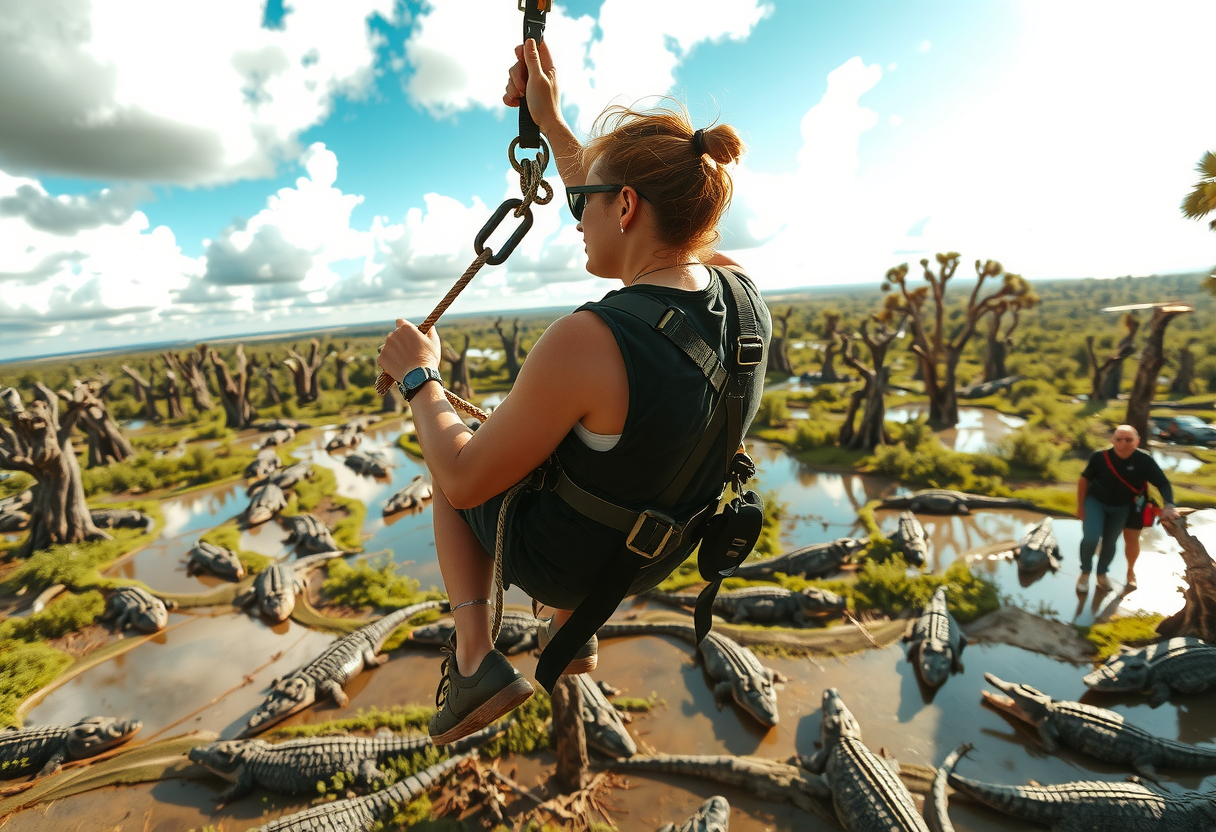
A person ziplining over a swamp filled with alligators at Gatorland
The Legend of the Jumparoo
If Owen Godwin's safari suit was the hook, the "Gator Jumparoo" was the line and sinker. It is, perhaps, the most iconic and enduring piece of Old Florida entertainment still in existence.
The premise is beautifully, terrifyingly simple. A trainer stands on a wooden platform suspended over a pool churning with dozens of massive, hungry alligators. The trainer holds a raw chicken carcass attached to a wire. They ring a dinner bell, slap the water, and coax the prehistoric beasts to launch themselves vertically out of the water to snatch the meat.
There are No hidden wires lifting the animals. Just pure, explosive muscle, snapping jaws, and the very real possibility that someone might lose a finger if they aren't paying attention. The Jumparoo is raw, visceral, and unapologetically unrefined. It taps into a primal fascination with apex predators that no roller coaster can replicate. For decades, families have stood at the edge of that murky water, gasping as a thousand-pound reptile defies gravity for a poultry snack. It is the beating heart of Gatorland's appeal.
The Mouse Moves In
For twenty years, Gatorland thrived as a premier roadside stop. But then, in 1971, the earth shifted. Walt Disney World opened its gates just a few miles down the road.
The arrival of the Mouse was an extinction-level event for dozens of classic Florida attractions. Mom-and-pop alligator farms, citrus towers, and mermaid shows suddenly found themselves competing with a multi-million-dollar empire of immaculate streets, smiling cast members, and cutting-edge rides. Tourists who once spent weeks meandering down the state's highways were now flying directly into Orlando and never leaving the Disney bubble.
Many predicted Gatorland would be swallowed whole, just another casualty of corporate progress. How could a guy in a pith helmet and a swamp full of gators compete with Cinderella's Castle?
Leaning into the Swamp
The Godwin family, who still own and operate the park today, made a crucial, brilliant decision: they didn't try to compete.
They realized that trying to out-polish Disney was a fool's errand. Instead, they leaned hard in the opposite direction. They doubled down on their roots. If Disney was pristine, Gatorland would be delightfully gritty. If Universal was high-tech, Gatorland would be hilariously low-tech.
They embraced a gentle, self-aware humor. The park's signage and shows developed a cheeky, slightly irreverent tone. They weren't afraid to poke fun at themselves or the mega-parks down the road. They introduced attractions like the "Gatorland Express" train, which is charmingly rickety, and the "Up-Close Encounters" show, where trainers handle venomous snakes with a casual, folksy bravado that leaves tourists both terrified and charmed.
They understood that while people love the sanitized fantasy of the big parks, they also crave authenticity. Gatorland offered something real. The smell of the swamp is real. The heat is real. The teeth are very, very real. In a landscape increasingly defined by artificiality, Gatorland became an oasis of the genuine.
No animatronics required. The appeal of the apex predator remains timeless.
Wrangling the Last-Day Dollar
Beyond their branding, Gatorland mastered a specific economic niche: the "last-day dollar."
A family visits Orlando for a week. They spend four days at Disney, two days at Universal. They are exhausted, their wallets are significantly lighter, and they have a flight out of MCO at 4:00 PM on Sunday. They have half a day to kill, but they don't have the time, energy, or budget for another $150-per-person theme park ticket.
Enter Gatorland. It's affordable. It's manageable—you can see the whole park in a few hours without needing a spreadsheet or a fast-pass strategy. It's close to the airport. It became the perfect, low-stress capstone to an Orlando vacation. The Godwins recognized this niche and catered to it perfectly, providing a high-value, high-entertainment experience that didn't require taking out a second mortgage.
The Enduring Bite of Old Florida
Today, Gatorland is thriving. It has expanded, adding a zipline that soars over the alligator breeding marsh (a brilliant addition that adds modern thrills while keeping the gators front and center) and a white leucistic alligator exhibit. But the core remains unchanged.
The Jumparoo still draws crowds. The trainers still crack the same corny jokes. And the concrete jaws still welcome visitors off the Orange Blossom Trail.
In a world that is constantly chasing the next technological marvel, there is something deeply comforting about Gatorland's survival. It proves that there is still a place for the quirky, the family-owned, and the slightly dangerous. It reminds us that sometimes, you don't need a billion-dollar budget to create a lasting memory; sometimes, all you need is a man in a safari suit, a piece of raw chicken, and a swamp full of hungry reptiles.
#OldFlorida#RoadsideAttractions#Orlando
Keep the weird alive.
Join the Florida Unwritten newsletter for more stories of forgotten roadside attractions, swamp legends, and the wild history of the Sunshine State.
