Mosquito Lagoon: Chasing Redfish in Florida's Wild Flats
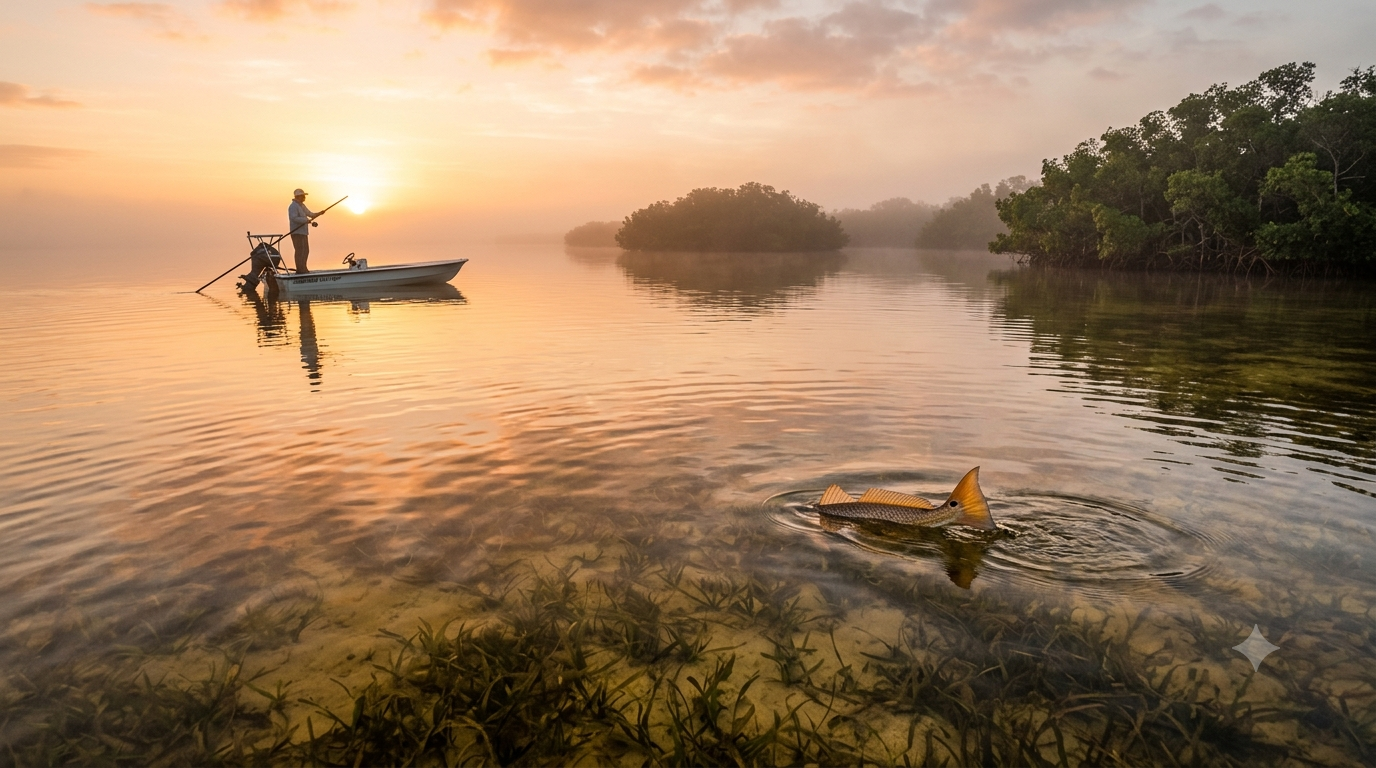
Florida's Mosquito Lagoon, shallow crystal-clear water reflecting golden light
If you drive about an hour east of Orlando’s neon standard, past the giant air-conditioned mouse and the endless strips of neon-lit t-shirt shops, the modern world begins to fray at the edges.
The concrete dissolves into salt-crusted asphalt, the billboards disappear, and the air starts to taste different—thick, heavy, and sharp with the unmistakable tang of decaying salt marsh.
This is the gateway to the Indian River Lagoon system,
a place where GPS signals feel optional and time operates on a completely different clock.
Welcome to Mosquito Lagoon.
Don’t let the intimidating name fool you; while the local insects certainly deserve their legendary reputation, the true inhabitants of these vast, glassy flats are far older, far stranger, and infinitely more captivating.
This isn't the manicured, postcard-perfect Florida of beach resorts and golf courses.
This is the "Real" Florida: a silent, liquid wilderness where the line between the present day and the prehistoric world is as thin as a single strand of monofilament fishing line.
The Sensory Symphony of the Mangrove Flats
To truly experience the lagoon, you have to arrive before the sun has fully unseated the morning fog.
As the skiff slides off the roller trailer and into the black water, the first thing that hits you isn't the view—it’s the smell. It’s an intoxicating, earthy perfume of rich sulfur, wet peat, and ancient brine.
To the uninitiated, it might just smell like a swamp, but to anyone who has ever held a fishing rod, it’s the sweet scent of pure opportunity.
The silence out here is almost heavy.
It’s an eerie, acoustic vacuum where the roar of the interstate is replaced by the gentle slap-slap of tiny wavelets against the skiff's hull.
The mangroves stand like skeletal sentinels along the shore, their tangled, spider-like prop roots gripping the muddy bottom. They look less like trees and more like petrified wooden hands reaching out of the primordial ooze.
There is a strange, comforting nostalgia in this stillness. It feels exactly like the Florida your grandparents described from their road trips in the 1950s, back when the roads were two lanes, and the air conditioning was just rolling the windows down.
Swimming with Dinosaurs: Sighting the Red Drum
The real magic happens when the skiff engine cuts out.
From this moment on, you move by horsepower of a different kind: a long, graphite push-pole used to silently guide the boat across flats so shallow your ankles would stay dry if you stepped overboard.
You are hunting Sciaenops ocellatus—the red drum, or more affectionately, the Redfish.
[Flats Visibility Chart]
Water Depth:   |||||| 6 Inches
Bottom Type:   Grass / Mud
Target Profile: Bronze Back / Spotted Tail
Fishing in six inches of water isn't about casting blind and hoping for a bite; it’s an underwater game of hide-and-seek.
You stare through polarized sunglasses until your eyes strain, looking for anything that breaks the flawless, mirrored pattern of the surface. And then, there it is.
A ghostly, copper-bronze shadow slowly cruising through the seagrass. When a Redfish feeds in water this shallow,
Its head goes down into the mud to root for crabs, and its spotted tail breaks the surface, waving like a tiny, spotted flag.
Seeing a tailing redfish up close triggers something deeply primal in your brain.
Your breath catches in your throat, your heart hammers against your ribs like a trapped bird, and suddenly you realize you’ve forgotten how to perform a basic overhead cast.
👉 Florida always has another story
Before Google: How Storytelling Built Florida's Identity
The River of Grass: 10 Surprising Facts About the Everglades
The Humbling Art of the Stealth Approach
This is where the gentle comedy of flats fishing truly begins.
In the quiet of Mosquito Lagoon, every sound is magnified by a factor of ten. Drop a copper pair of pliers on the deck, and it sounds like a metal trash can rolling down a concrete hill.
Slam a hatch lid, and you might as well fire a flare gun into the sky. The redfish, despite looking like ancient armor-plated tanks, possess the nervous system of a caffeinated squirrel. They are incredibly spooky.
You hold your breath, wind up, and make your cast. In your mind, the lure lands with the delicate grace of a falling leaf,
right in front of the fish's nose. In reality, the wind catches your line, and the heavy lead weight splashes down directly on top of the fish's head with a resounding plop.
The water explodes. A massive, muddy wake tears across the flat at Mach 1 as the startled dinosaur bolts for deep water,
leaving you standing on the bow of the boat, tangling your line around your own sunglasses, wondering how a creature with a brain the size of a peanut completely outsmarted you.
You can't help but laugh out loud at the absurdity of it all. It’s a beautiful, humbling reminder that on the flats, the fish always hold the upper hand.
New Story every Friday
Why Mosquito Lagoon Remains an Unwritten Classic
What makes this stretch of water so special isn’t just the quality of the fishing; it’s the preservation of a vibe that is rapidly disappearing from the rest of the Sunshine State.
In a world of high-speed toll roads and master-planned coastal communities, the lagoon remains stubbornly wild.
It’s a living museum of coastal biodiversity, shared with lazy manatees, hunting ospreys, and bottlenose dolphins that pop up so close to the boat you can hear them breathe.
Spending a day out here changes your perspective. You stop checking your phone because there's no service anyway,
and you start paying attention to the subtle shifts in the wind, the direction of the tide, and the sudden, electric movement of life just beneath the surface. It’s a place that demands your full attention and rewards you with a deep, meditative peace that you can't find anywhere else.
Finding Your Own Piece of the Real Florida
As the afternoon sun begins to bake the flats and the wind picks up, turning the glassy water into a choppy gray sheet, it’s time to wind in the lines and head back toward civilization.
Your skin is sun-baked, your shoulders are sore from casting, and you definitely smell like sulfur and old bait—but you feel completely restored.
The "Real" Florida is still out there, hiding in plain sight just past the edge of the neon signs and the crowded theme park parking lots.
It lives in the quiet places where the wild things are, waiting for anyone willing to slow down, look closely, and watch for shadows in the shallows.
Have you ever experienced the eerie, quiet beauty of the Florida flats? What's your favorite spot to escape the crowds and get back to nature?
Drop a comment below and share your stories—we'd love to hear how you find your own piece of the unwritten wild!
Thanks for spending part of your day with Florida Unwritten.
If this story felt familiar, salty, strange, or a little too Florida to explain at dinner, share it with someone who’d understand.
👉 More stories live at https://surl.lu/uilyob
📬 Subscribe for weekly Florida stories, coastlines, wildlife, weirdness, and the kind of local moments tourists usually miss.
Florida Unwritten is a labor of love dedicated to the places the brochures forget.
See Ya Friday
Earl lee
