Bridges at Midnight:The Night-Shift Anglers of the Keys
LOC: Seven Mile Bridge & Channel Five Span | TIME: 01:45 AM | TIDE: Falling Ebb
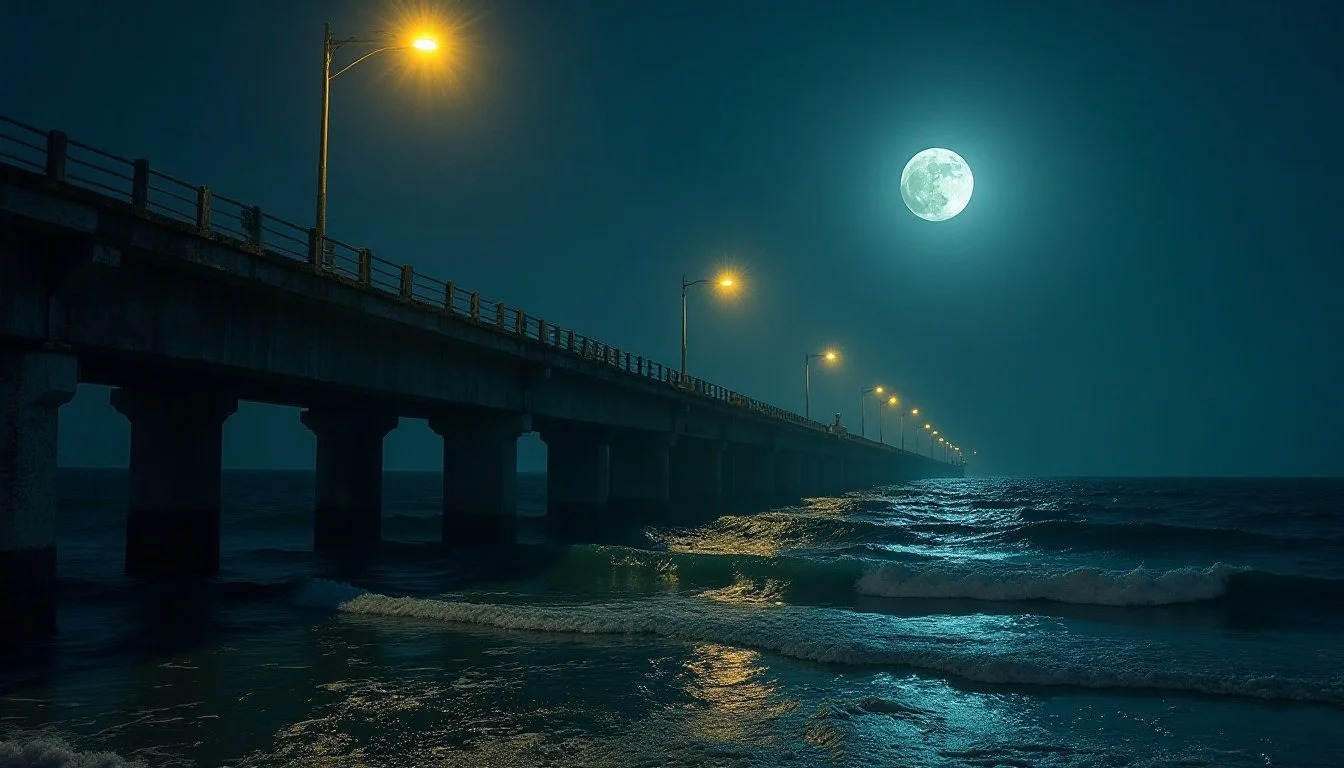
moonlit scene depicting the Florida Keys at 11 o'clock, where the last remnants of daylight give way to an inky, blackwater expanse.
Down here, context is everything. By eleven o’clock, the Florida Keys convert from a postcard into something far older and considerably heavier.
The neon rental-car glare dies off, the sunburned crowds back in Key West fade into their AC-chilled rooms, and US-1 goes dead quiet except for the occasional eighteen-wheeler hauling ice or reef fish north toward Homestead. That’s when the concrete comes alive.
You feel it before you see it. Stand on the deck of an old relief span—one of those historic concrete ribs running parallel to the new highway—and you’ll feel the tide tugging at the pilings below like a freight train pulling out of a dark yard. The Atlantic is emptying itself into the Gulf through those narrow concrete cuts,
pushing millions of gallons of black water through the bridge legs at six knots. And right where the yellow overhead streetlights hit the water, creating a razor-sharp division between sodium-glare and ink-black depth, lies the battleground.
We call it the shadow line. If you don't understand the shadow line, you don't know a damn thing about fishing the Keys at night.
The Brotherhood of the Concrete
The daytime angler is a creature of high-end sun shirts, polarized shades, and forty-thousand-dollar skiffs.
The night angler on the bridges is something entirely different. He’s dressed in faded blue jeans stained with fish slime and rust, a sweat-salted baseball cap pulled low, and work boots with the soles worn smooth from miles of concrete walking.
He carries his gear in a battered five-gallon bucket or drags it on a homemade cart welded together out of scrap aluminum and lawnmower tires.
There is no pretense at 2:00 AM on Channel Five Bridge. Nobody asks what you do for a living, because nobody cares. The only resume that matters is leaning against the rusted railing: a ten-foot heavy-action spinning rod, a reel packed with eighty-pound braided line,
and a bucket holding three live blue crabs or a couple of silver-sided mullet swimming frantically against a battery-powered aerator.
It’s a quiet fraternity. When a stranger walks up the concrete path toward your spot, there’s an unwritten protocol. You don't dump your bucket right next to his. You give him two bridge bents of space—about fifty feet—and you acknowledge him with the "Keys nod."
It’s not a wave. It’s just a slow, quarter-inch dip of the chin that says: I see you, you’re here for the same dark magic I am, and I won't tangle your line.
Chasing the Silver King in the Sodium Glow
The tarpon don't feed down here as they do on the daytime flats. During the noon heat, they are ghosts—skittish, translucent shadows floating over bright white sand that vanish if a fly line lands six inches too hard. But under the bridge lights at midnight? They are predators, pure and simple.
They lie in the dark water just six inches behind the shadow line cast by the bridge deck. They sit head-first into the brutal tide, completely invisible,
watching the illuminated river of water above them. The tide carries everything down the conveyor belt: disoriented glass minnows, injured shrimp drifting helplessly, and blue crabs skimming across the surface sideways.
When a crab floats into that yellow circle of light, a tarpon doesn't stalk it. It rolls up from the black, opens a bucket-sized mouth, and inhales the sea.
The Sound of the Pop: If you've never heard a 130-pound tarpon feed under a bridge at night, it’s hard to explain. It doesn't sound like a splash. It sounds like someone dropped a bowling ball from an overpass, followed by a violent, hollow "WHUMP" that echoes through the concrete pilings and vibrates right up into the soles of your boots.
Rigging for this isn't an exact science; it’s an exercise in survival. You hook a live crab through its lateral point, step up to the railing, and toss it fifty yards up-tide into the darkness.
Then you open your bail and let the current carry it down toward the light. You feed out line with your thumb, feeling the pulse of the tide through the graphite, waiting for that crab to cross the exact border where the yellow light dies, and the shadow begins.
When the strike comes, it isn't a nibble. Your line snaps tight so fast the water flies off it in a fine mist, and the drag on your reel screams a high-pitched, metallic shriek that shatters the midnight stillness.
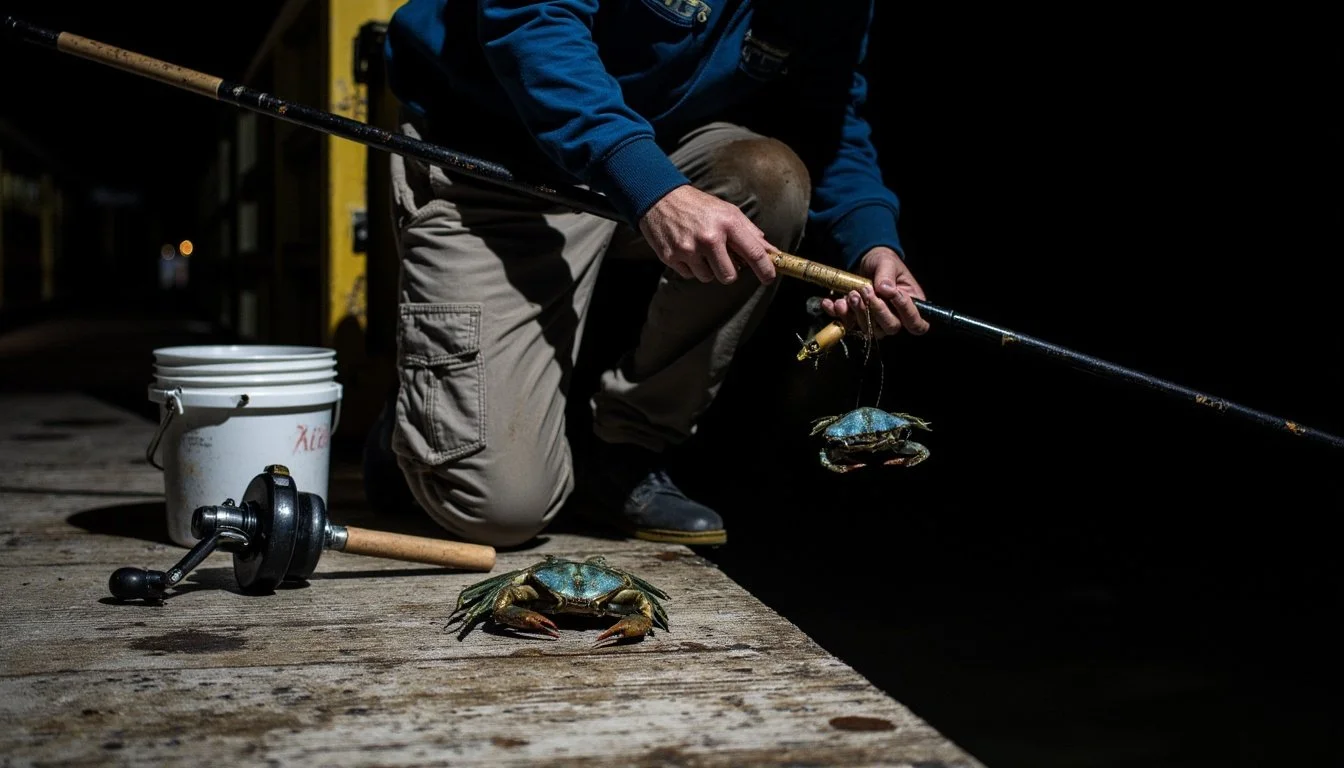
Live Crab in the Darkness Prompt: Close-up realistic fishing scene on an old Florida Keys bridge at night,
The Thermos at 2:00 AM
Between the tides, when the water slacks and the current pauses to catch its breath before turning around, the fishing stops. The tarpon sink deep into the channel, and the shadow lines go quiet. This is the hour of the thermos.
I was standing near the midpoint of the old Bahia Honda span a few seasons back when the tide went dead flat. The air was thick enough to chew—warm, salt-heavy, smelling of dried sea-rack and the sulfur of distant mud flats. A guy three bents down—a local named Sal who looked like he’d been carved out of driftwood and cured in tobacco smoke—walked over carrying a dented Stanley thermos.
"Tide’s dead for forty minutes," Sal said, pulling the green plastic cup off the top. "Coffee’s dark. Got a splash of condensed milk in it if you like it sweet."
We leaned our elbows against the cold iron railing, sipping scalding, thick coffee while watching the headlights of a solitary northbound semi slide across the new bridge a hundred yards away.
We talked about how the keys used to look before the high-rises went up in Marathon. We talked about old outboard motors that required three pulls and a curse to start,
and about the time a hammerhead shark longer than a skiff picked up a tarpon right under our feet and bit it clean in half with a sound like a wet towel snapping.
There is an intimacy in those conversations that you can't find in daylight. The darkness strips away the fluff. Nobody is trying to sell you a real estate parcel or a charter trip. You’re just two ghosts on a stretch of concrete built by Henry Flagler a hundred years ago, waiting for the tide to turn.
The Landings and the Lessons
Hooking a tarpon from a bridge is only ten percent of the work. The rest is pure, unadulterated chaos. You can't just reel a hundred-and-fifty-pound fish up thirty feet of air to the deck. You have to fight it through the dark, keeping it out of the barnacle-crusted pilings that will cut eighty-pound braid like a razor blade.
You have to walk the fish down the bridge deck, dodging light poles and abandoned crab traps, leading it like a bucking horse toward the shallow abutment at the end of the span.
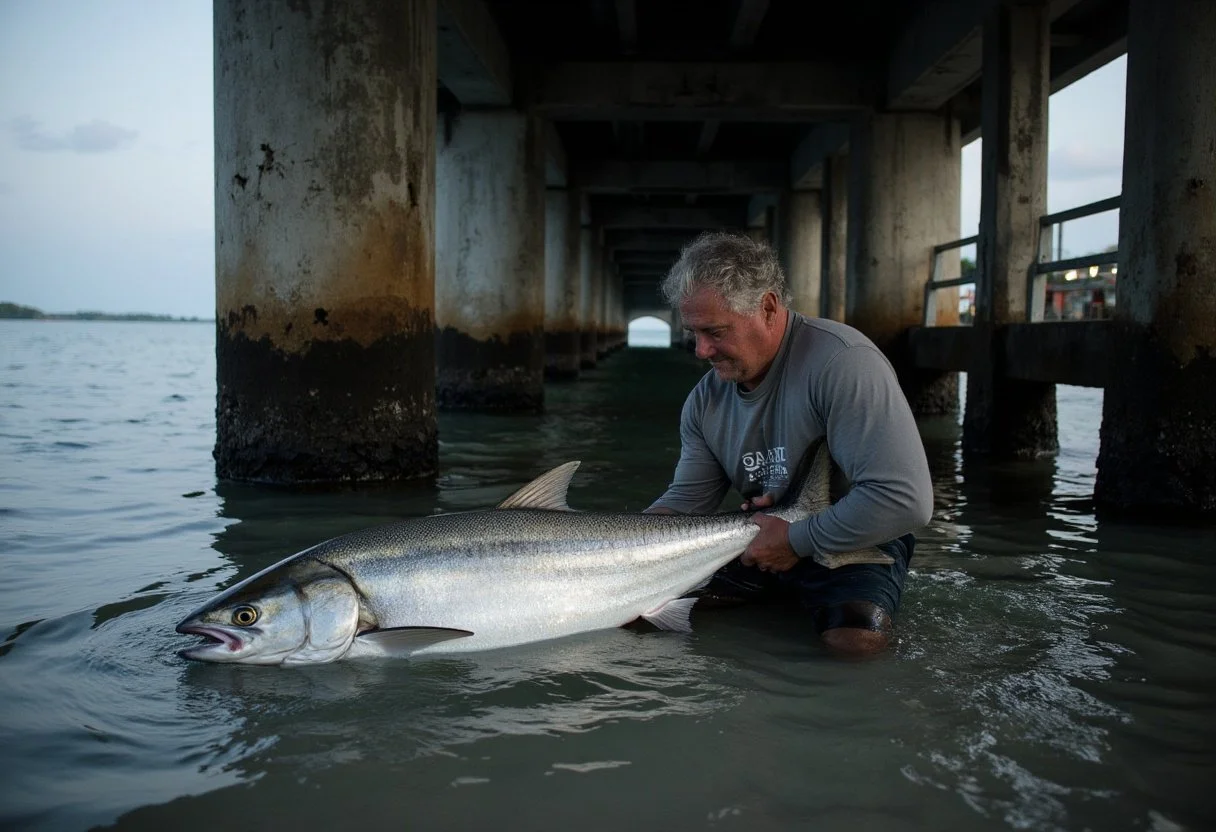
And when you finally get that fish into the knees-deep water along the rocky shoreline, when you reach down into the foam and grip that rough, sandpaper-like lower jaw to back out the circle hook, you look into an eye the size of a silver dollar.
It reflects the yellow moon hanging over the Gulf, ancient and totally unbothered by human presence.
You release the jaw, push the big fish back into the dark current, and watch the silver tail sweep once, twice, before it disappears into the black.
By 4:30 AM, the first hints of grey start to bruise the eastern horizon over Islamorada. The streetlights lose their harsh yellow glow, turning pale and ineffective against the pre-dawn mist. Up on the highway, the early morning commuters start to trickle past—tradesmen, tackle shop clerks, charter captains heading to the marina to prep their boats for the tourists.
The night-shift anglers begin packing up.
We reel in our lines, pack the buckets, and sling the heavy rods over our shoulders. We don't talk much as we walk back down the concrete incline toward our parked trucks. The salt has dried white on our shirts, our shoulders ache, and our hands smell of crab bait and slime.
The daytime world is waking up, loud and expensive and fast. But as we drive south with the windows down, listening to the hum of the tires on the bridge joints, we hold the secret. We know what happens under the lights when the rest of Florida is fast asleep.
Thanks for spending part of your day with Florida Unwritten
👉 More stories live at https://surl.lu/uilyob📬 Subscribe for weeklyFlorida stories, coastlines, wildlife, weirdness, and the kind of local moments tourists usually miss.
Florida Unwritten is a labor of love dedicated to the places the brochures forget.
Earl lee
