Papa Hemingway and the Birth of Florida Sportfishing
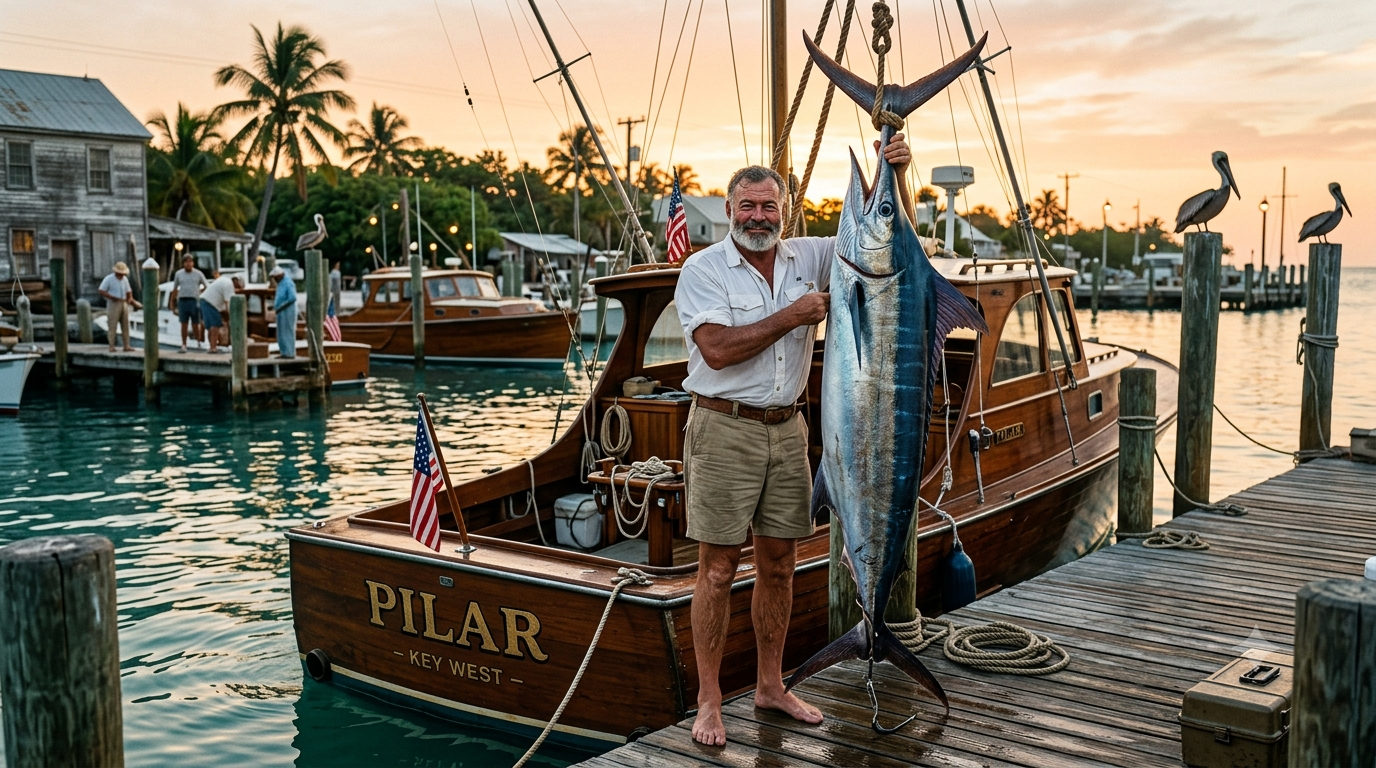
Ernest Hemingway stands confidently beside a classic wooden sportfishing boat holding a massive blue marlin.
Alright, pull up a weathered dock-side stool, grab a cold one (preferably something that doesn’t require a pinky in the air), and let’s talk about the man, the myth,
and the beard that launched a thousand fishing charters. If you’ve ever cast a line into the turquoise waters of the Florida Keys and felt even a tiny bit like a heroic protagonist in a tragic but manly novel, you’ve got one person to blame: Ernest "Papa" Hemingway.
Now, before the internet was a glint in a computer’s eye, Florida had its own brand of influencers. We didn’t have "content creators"; we had "legends," and Hemingway was the OG deep-sea fishing promoter. Alongside guys like Zane Grey and Ted Williams,
Papa did more to put Florida’s offshore angling on the global map than a million tourism brochures ever could. He didn’t just fish; he made fishing look like a spiritual, sweaty, and often boozy quest for truth.
The Key West Decade: 1928–1939
Hemingway landed in Key West in 1928 and basically decided he owned the place for the next decade. He lived in a Spanish-type villa at 907 Whitehead Street, where he had a second-story writing room that was probably much tidier than his tackle box. While he was there, he wasn't just working on his tan.
This was the most productive streak of his entire career. We’re talking A Farewell to Arms, For Whom the Bell Tolls, and The Snows of Kilimanjaro.
But let’s be real: between the typing and the "refreshments," the man was obsessed with the salt life. He spent his time writing, fishing, boxing, and—let’s be honest—drinking. He was the ultimate Florida Man before that term became a headline for someone trying to use an alligator as a bottle opener.
The Captain and the Marlin Marathon
Every great Florida fisherman needs a partner in crime, and Hemingway found his in Capt. Joe Russell. Their friendship didn't start over a shared love of literature; it started because Capt. Joe was the only guy in town with enough sense to cash a royalty check for Hemingway that a local bank had refused to honor.
Joe was the owner of the legendary Sloppy Joe’s Bar, which started at 428 Greene Street before sliding over to its famous home at 201 Duval Street.
With Russell at the helm, Hemingway once pulled off a feat that makes modern "pro" anglers look like they’re fishing in a bathtub: he caught an unheard-of 54 marlins in just 115 days. That’s nearly a marlin every other day for four months.
If that doesn't earn you a seat at the bar for life, nothing will. Hemingway actually liked Joe so much he modeled the character Freddy in his novel To Have and Have Not after him. That book, by the way, was the only novel he ever set in the United States, specifically right here in Key West.
A Nobel Prize for… a Sailfish?
You know you’ve made it in the fishing world when a country on the other side of the planet honors your literary genius with a picture of a fish. When Sweden issued a stamp for Hemingway's 1954 Nobel Prize in Literature, they didn't put a typewriter or a stack of books on it. No, they featured an image of Hemingway next to a sailfish, the exact kind he used to pull out of the Florida Keys.
It’s the ultimate Florida flex. Imagine winning the world's most prestigious writing award and the world says, "Yeah, the books are okay, but did you see that catch?"
He also bagged the 1953 Pulitzer Prize for The Old Man and the Sea, a story that followed an old Cuban fisherman down on his luck who finally hooks a giant fish only to have sharks ruin the party.
Most folks believe he drew that story from his own experiences and the tall tales he heard while haunting the docks of Key West.
The Statue and the Circus
If you wander over to the Customs House in Key West today, you’ll find a statue called "Young Hemingway".
And how is the great master of prose portrayed? As a poet? A soldier? Nope.
Sculptor Terry Jones knew what was up and portrayed him as a fisherman. It’s a fitting tribute because Hemingway’s angling brought massive publicity to the area, turning a sleepy island into a global destination for anyone who wanted to wrestle a monster from the deep.
But the influence doesn’t stop at bronze statues. We Floridians love a good excuse for a party, and every year, Sloppy Joe’s hosts the Ernest Hemingway Look-Alike Contest.
This year was the 34th annual event, where a sea of white-bearded men in wool sweaters (in the Florida July heat, no less) gather to see who looks the most like "Papa". It’s a hilarious, sweaty testament to how deeply the man is woven into our history.
Why It Matters for Your Next Fishing Trip
Hemingway’s legacy is why we have such a robust saltwater fishing culture today. He proved that Florida wasn't just a place to hide from the winter; it was a world-class arena for sportfishing.
He helped transition fishing from a way to put food on the table—like the old fishing ranchos of the 18th century where Spanish Cuban fishermen cured mullet and drum for the Havana markets—into a high-stakes adventure that tourists would travel across oceans to experience.
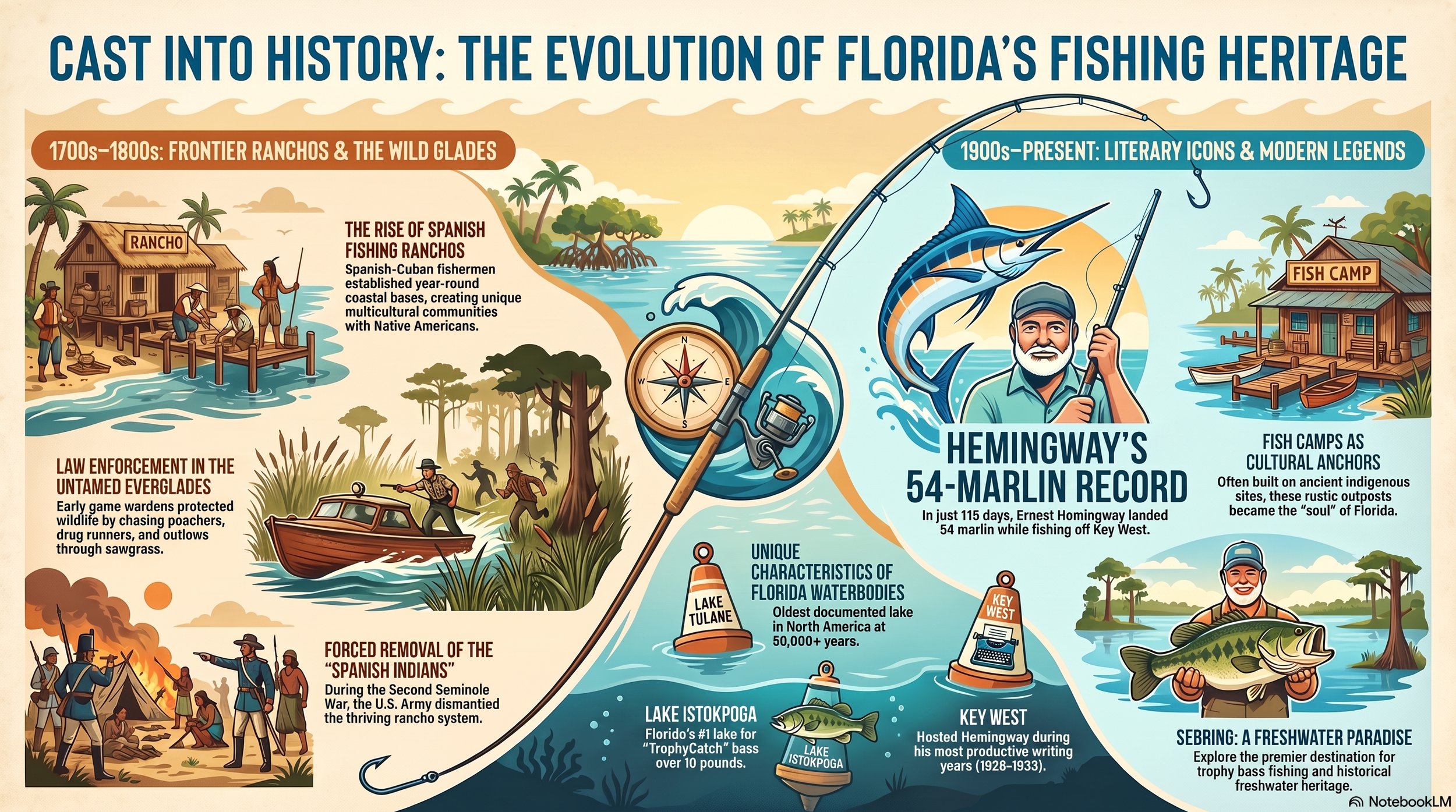
Florida's Fishing Heritage Evolution
While he was busy making deep-sea fishing famous, he was also inadvertently creating a world that future game wardens and lawmen would have to manage. As more people flocked to the "Bass Capital" and the "Marlin Meccas," the need to protect these resources grew.
So, the next time you’re out on the water, whether you’re chasing largemouth bass in a place like Lake Istokpoga (which is #1 in the state for 10+ pounders, just saying) or hunting for marlin in the Gulf Stream, remember "Papa."
He taught us that a bad day of fishing is still better than a good day at the office, especially if you have a royalty check and a friend like Joe Russell to cash it.
Hemingway's influence on Florida wasn't just about the words he put on paper; it was about the way he lived his life on the water.
He gave the Florida Keys a soul that was part-adventure, part-tragedy, and entirely salt-crusted. He turned our "aqueous state" into a literary landscape where every tug on the line could be the start of a masterpiece.
Join the circle new story every Friday
Key Takeaways for Your Hemingway Pilgrimage:
Visit 907 Whitehead Street: See where the magic (and the typing) happened.
Grab a drink at Sloppy Joe’s: Hemingway’s old stomping ground and home to the look-alike circus.
Look for the "Young Hemingway" statue: A reminder that even Nobel winners prefer a fishing rod to a pen.
Hit the water: Catching 54 marlins might be out of your reach, but you can always try for a sailfish in his honor.
Florida fishing history is a long, weird, and wonderful tale involving everything from Native American guides at ranchos to Everglades lawmen chasing poachers.
but Ernest Hemingway is the chapter that made the rest of the world want to read the book. Tight lines, folks—and keep your beards trimmed, just in case there’s a contest.
Thanks for spending part of your day with Florida Unwritten.
👉 More stories live at https://surl.lu/uilyob📬 Subscribe for weekly Florida stories, coastlines, wildlife, weirdness, and the kind of local moments tourists usually miss.
Florida Unwritten is a labor of love dedicated to the places the brochures forget.
Earl lee
Florida Unwritten
