Bloody Ed Watson: Who Was He?
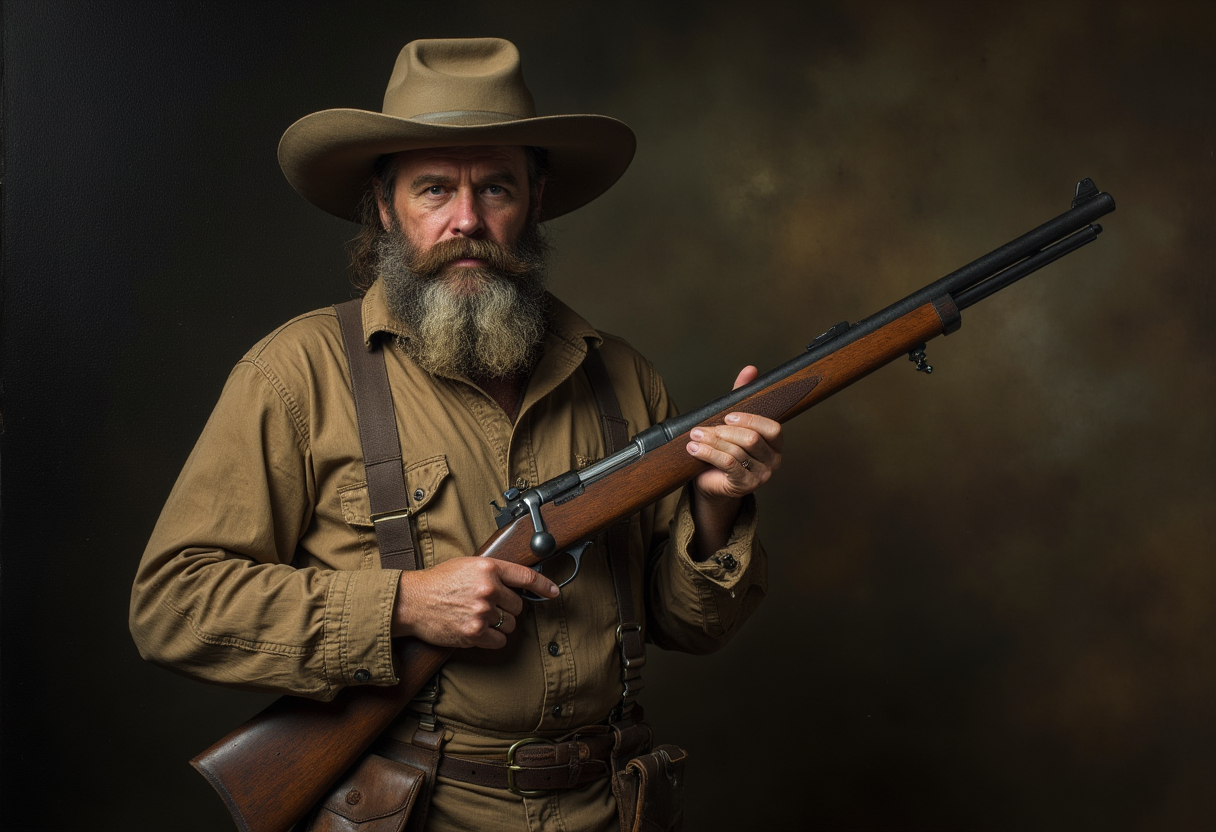
19th-century Florida frontiersman
Before Florida was postcards and highways, it was distance. It was waterlogged ground that swallowed footprints, heat that slowed time, and silence that protected the powerful. Long before Edward “Bloody Ed” Watson became one of the state’s most infamous figures, Florida itself had already written the rules that allowed men like him to exist.
This is not just the story of a killer.
It is the story of a place where law struggled to arrive, where fear traveled faster than truth, and where justice often came late, if it came at all.
Florida Was Different Then
In the late nineteenth century, Florida was not yet a unified place. It was a collection of margins. Settlements clung to rivers and coasts.
Inland, the land resisted permanence. Swamps stretched endlessly. Mangrove islands tangled together like a knotted rope. Roads were unreliable, when they existed at all.
The Ten Thousand Islands region, where Watson would later stake his claim, was among the most isolated places in the continental United States.
Travel was slow and dangerous. Boats replaced wagons—word traveled by mouth, not paper. A man could disappear into the wetlands and leave little behind beyond rumor.
Law enforcement faced the same obstacles as everyone else. Sheriffs covered enormous territories with minimal manpower. Evidence decayed quickly in heat and water. Witnesses were reluctant to speak, especially when those in power lived nearby and carried guns openly.
In Florida, the swamps served two purposes. They fed those who understood them, and they hid those who knew how to use them. Distance was protection. Silence was power.
Violence did not always shock communities. Sometimes it was expected. Disputes were settled quickly, often privately. For laborers, particularly Black laborers in the post-Reconstruction South, the risk of harm was part of the cost of survival. Complaints could lead to dismissal. Or worse.
This was the world Edward Watson stepped into. And the world that would, for a time, protect him.
The Man Known as Bloody Ed
Edward Watson was born in 1863, as the Civil War tore the country apart. By the time he reached adulthood,
the nation was rebuilding unevenly, and the South remained scarred by racial violence and economic instability.
Watson drifted south and eventually settled in Southwest Florida, where he became a sugarcane grower and landholder.
On paper, he was a pioneer. A man carving a livelihood from unforgiving land. He hired laborers, built camps, and worked the fields.
But Watson ruled through intimidation. He carried a rifle openly and often. He demanded obedience.
Workers who challenged him, or who he accused of theft, found themselves isolated in a place where isolation could be fatal.
It did not take long for his reputation to form.
People began calling him “Bloody Ed.”
The Workers’ World
To understand Watson’s crimes, you must understand the men who worked for him.
Migrant laborers in early Florida lived precarious lives. Many were paid irregularly. Some were paid in company credit rather than cash,
binding them to the very men who controlled their housing and food. Debt accumulated easily.
Escape did not.
Days began before sunrise. Sugarcane fields were punishing. The work was repetitive, exhausting, and dangerous.
Cuts festered in heat and humidity. Medical care was scarce. Quitting meant forfeiting wages already earned, if they were paid at all.
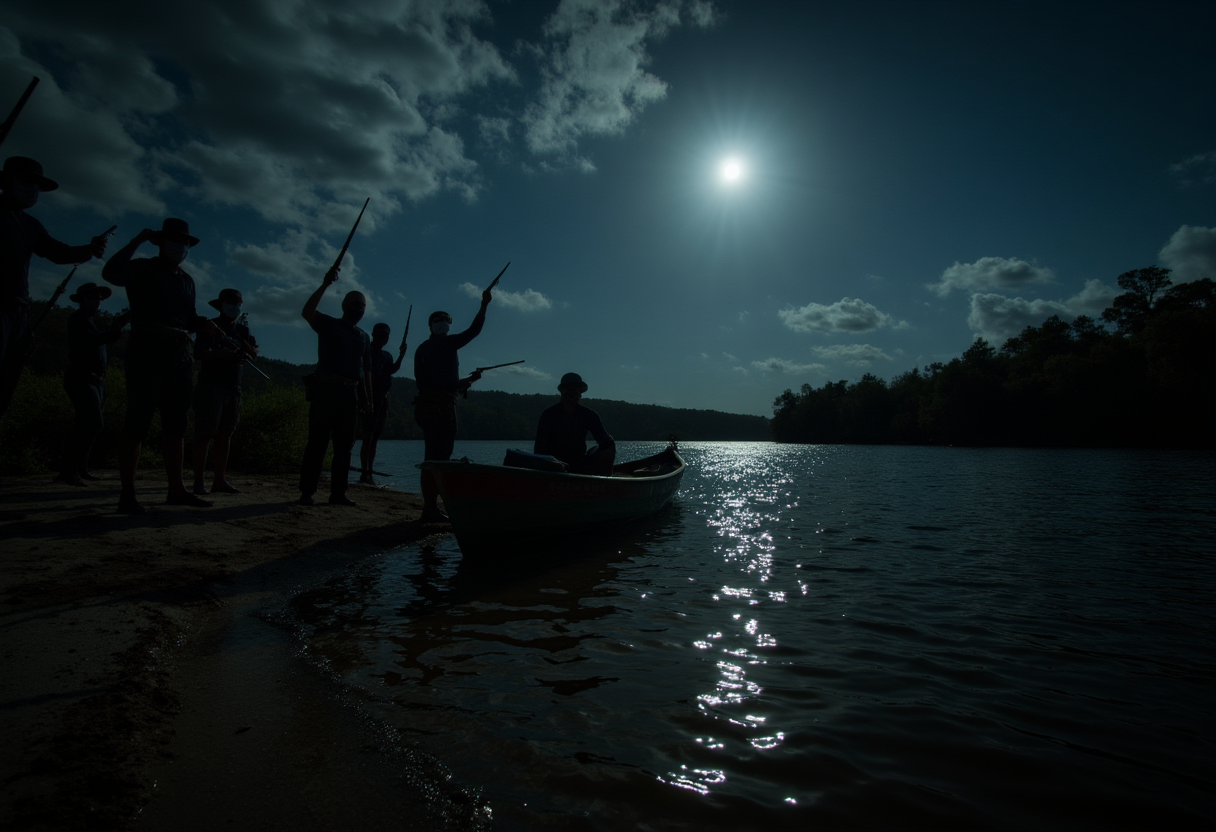
nighttime river ambush on the Caloosahatchee River
For Black workers in particular, the racial power imbalance was absolute. Speaking out against a white landowner could invite retaliation.
Local authorities often sided with property owners. Courts were distant. Protection was theoretical.
Reporting abuse meant being believed. Belief was rare.
Some workers vanished after arguments. Others simply failed to return from Watson’s land.
In an era without consistent records, absence quickly became explanation enough. Men moved on. Camps shifted. Life continued.
But memory lingered.
19th-century Florida frontiersman
Rumors in the Mangroves
In frontier Florida, information did not arrive neatly. It leaked.
Dockworkers whispered while unloading boats. Fishermen traded stories between tides. At trading posts, names surfaced briefly, then disappeared again into conversation.
Watson’s name circulated quietly. People spoke of workers being shot for stealing food. Of bodies dumped into canals.
Of shallow graves where the land remained disturbed longer than it should have.
No one claimed certainty. Certainty was dangerous.
Fear replaced proof. And fear was enough.
Each retelling added weight. Each silence confirmed suspicion. Watson became less a man than a warning,
a presence that people acknowledged by avoiding his land altogether.
Still, he remained free.
The Trial That Finally Came
In 1910, Edward Watson was arrested for the murder of a laborer named Jimmy Poyner. For once, the violence could not be ignored.
The body had been found. Witnesses stepped forward.
The trial drew attention from across the region.
The courthouse was crowded and stifling. Heat pressed against wooden walls. The audience naturally separated itself, lines drawn by race and class.
Watson sat calmly, observing, his posture controlled. He did not appear rattled.
Witnesses spoke carefully. Some hesitated. Others avoided eye contact. Years of fear do not evaporate under oath.
Accounts of violence emerged. Stories that mirrored the rumors. Patterns that suggested the Poyner killing was not an isolated act.
And yet, doubt crept in.
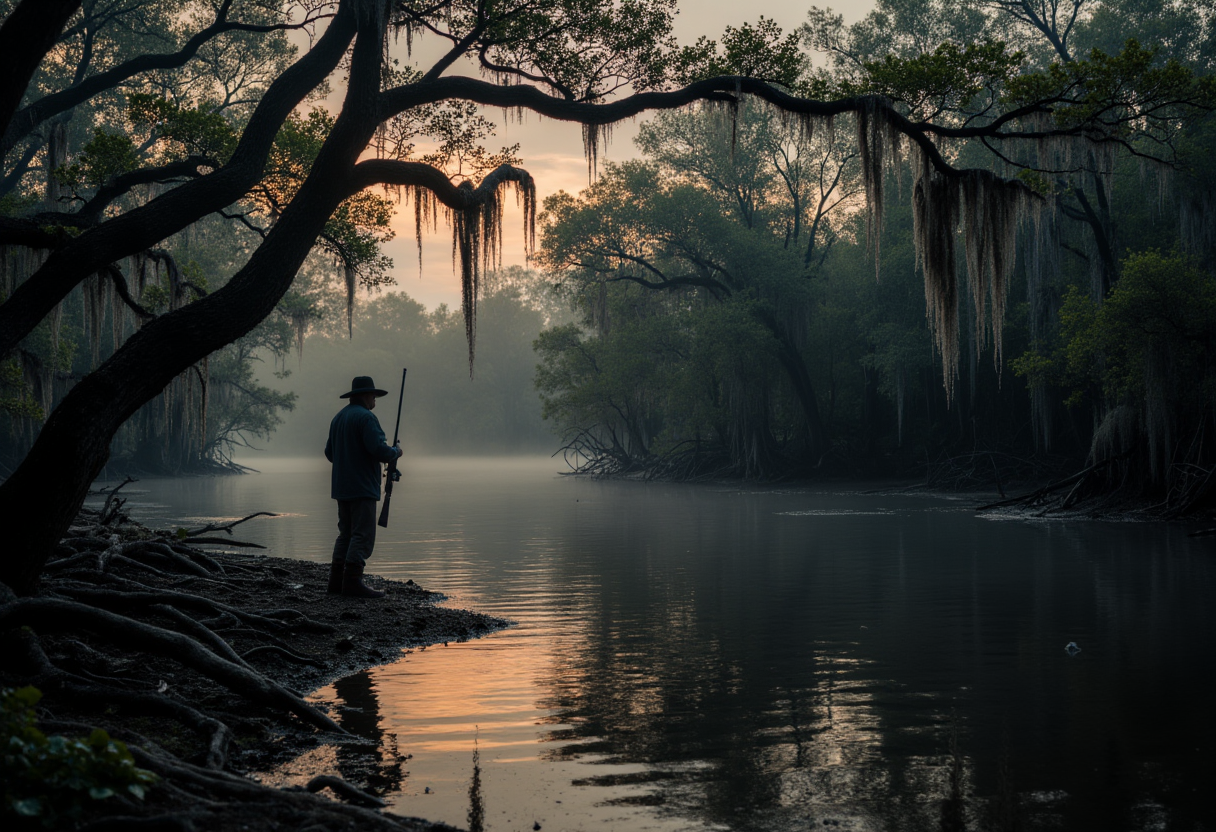
1900s Florida swampland
Evidence was circumstantial. Records were thin. Defense arguments leaned heavily on character and property rights.
In a system already tilted, that was often enough.
When the verdict was announced, Watson was acquitted.
The courtroom exhaled, but the community did not.
After the Verdict
Watson’s acquittal did not restore calm. It shattered it.
For those who had testified, fear intensified. Retribution felt possible, even likely. People avoided speaking about the trial afterward.
Conversations stopped mid-sentence when Watson’s name surfaced.
The verdict reinforced a familiar lesson. Justice was inconsistent. The law protected some more than others.
Silence remained the safest response.
Watson prepared to return home.
He did not make it.
nighttime river ambush on the Caloosahatchee River
Vigilante Justice on the River
As Watson traveled by boat along the Caloosahatchee River, masked men intercepted him. Accounts vary.
Some say shots were fired without warning. Others claim words were exchanged first.
What is known is this. Watson was killed. His body was thrown into the river.
No one was charged.
The vigilantes were never formally identified. In frontier Florida, this outcome was not unusual.
Many viewed the killing as a grim correction rather than a crime.
The community moved on.
And the story hardened into legend.
History Versus Legend
Separating fact from folklore in the case of Bloody Ed Watson is difficult.
Historical records confirm multiple deaths connected to Watson. How many remains uncertain.
Estimates range from seven to more than twenty victims. The swamps did not preserve evidence.
Neither did the institutions of the time.
Some details grew sharper with repetition. Others blurred. Over the decades, Watson became less a person and more a symbol of unchecked violence.
This transformation is common in isolated places. Where documentation fails, memory fills the gap.
Where justice falters, legend carries the weight.
Watson’s story survives not because it was recorded meticulously, but because it was remembered persistently.
Florida Moves On, But the Past Remains
The lands Watson once occupied are now protected. The Ten Thousand Islands National Wildlife Refuge attracts kayakers, anglers, and birdwatchers.
Mangroves thrive. The water glints harmlessly in the sun.
But history does not disappear simply because the landscape looks peaceful.
Watson’s story reflects a broader truth about Florida’s frontier era. Violence was often embedded in progress.
Exploitation went unchallenged. Power thrived in silence.
Remembering Bloody Ed Watson is not about fascination with cruelty. It is about acknowledging the conditions that allowed cruelty to flourish.
Florida became what it is by confronting, and sometimes burying, its past. But the swamps remember. The rivers remember.
And so should we.
Discover the Stories Florida Never Put on the Map.
Hidden places. Strange history. Stories the brochures forgot. Explore Florida Unwritten and see the Sunshine State differently.
Final Reflection
Bloody Ed Watson was not an anomaly. He was a product of his environment, enabled by isolation, fear, and a broken system of accountability.
His story forces us to look beyond individual evil and toward the structures that protect it. In doing so, it transforms from a true crime tale into a cautionary history.
Florida’s beauty is undeniable. But its shadows are just as real.
Stay Unwritten. Share the story.
Subscribe to Florida Unwritten for stories you won’t find anywhere else.
Earl Lee
