
The King of the Mullet and the Ghost of the Frontier

Old wooden dock in the Ten Thousand Islands at dusk
Pull up a chair, lean back, and let the mosquitoes have their fill for a moment—they’re the only ones who remember the story exactly the way it happened.
Down here in the Ten Thousand Islands, where the mangroves grow thick enough to swallow a man’s secrets and the tide is the only law that ever really stuck,
There lived a man who was less of a person and more of a tectonic force.
His name was Cap Knight. And if you ever had the privilege—or the misfortune—of sitting at his table, you knew you weren't just eating dinner.
You were participating in a religious rite of Old Florida, one that usually involved a heavy side of sweat, a dusting of cigarette ash,
and the very real possibility of ending your evening airborne.
The Barefoot Sovereign
Cap Knight was the kind of character that modernization tried to pave over, but the asphalt just wouldn't take.
He was the barefoot and shirtless king of a small restaurant empire tucked away in the wild southern frontier of the Everglades.
In a land that beckoned as a "land’s end" for wrongdoers, creeps, and those just looking to drop off the map, Cap was the anchor.
To see him was to see the essence of the frontier. He didn't believe in the "fullness of modernization" that was beginning to march across the state.
While the rest of the world was worrying about neckties and polished shoes, Cap was standing over a hot stove, shirtless,
with the Florida humidity clinging to him like a second skin. He was intimidating yet welcoming—a paradox wrapped in a weathered Captain’s hat.
He didn't need a menu. He had the Gulf. And he had mullet.
A Side of Ash and Authenticity
Now, you have to understand the culinary experience at Cap’s.
This wasn't a place for the "damned furriners" from Georgia or the city slickers from the East Coast who were starting to eye our coastline for hotels and condominiums.
If you walked into Cap’s place, you accepted the man as he was.
He’d be leaning over a skillet of fresh-caught mullet, a cigarette dangling from the corner of his mouth, the ash growing longer and more precarious with every flip of the fish.
He was a better cook than any man had a right to be, even if his "secret ingredients" often included whatever happened to fall off the end of that Lucky Strike.
As Gilbert Voss used to say, Cap represented the very spirit of a disappearing world—a world where the food was caught that morning and served by a man who had more salt in his veins than the Gulf itself.
But there was a rule at Cap’s. It wasn't written on a sign, and it wasn't whispered by the waitress. It was a law of nature: You enjoyed the food. Or else.
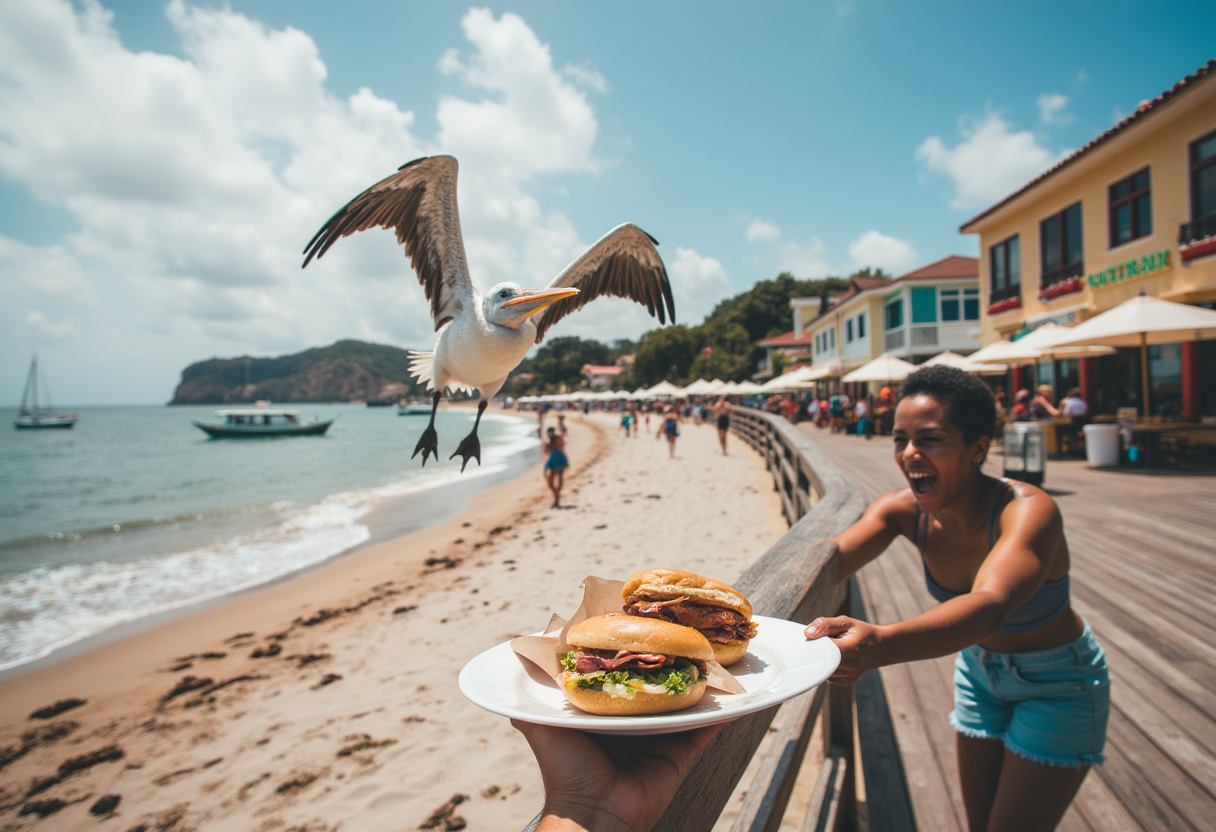
pelican in mid-heist, swooping down to snatch a Cuban sandwich from a
The Great Heave of 1930-Something
The story they still tell on the docks at Everglades City involves a particularly brave—or particularly stupid—gentleman who made the mistake of complaining about his plate.
This fellow, likely someone who had never seen a "gator hole" or watched a rum-runner slip through the mangroves under a moonless sky, pushed his plate back.
He looked at Cap—barefoot, ash-dusted, and glistening with the honest sweat of a June afternoon—and he said the words that no man should ever say to a king:
"This fish is a bit too oily."
The restaurant went silent. Even the cicadas outside seemed to hold their breath.
Cap didn't yell. He didn't argue. He walked over to the table with a smile that was described as "arctic"—the kind of grin that serial killers like Ted Bundy would later make famous, but Cap’s was born of frontier justice, not malice.
He looked the man in the eye, took the plate with one hand, and grabbed the back of the man’s collar with the other.
He didn't just walk the fellow out. He marched him. Out the screen door, across the weathered boards of the porch,
and straight to the end of the dock where the "Dream Girl" or the "Lucky Lady" was tied up.
With a strength born of years of hauling gill nets and wrestling snapper, Cap heaved the man right off the end of the dock.
The splash was heard all the way to Chokoloskee.
Cap stood there, barefoot on the salt-stained wood, watched the man sputter to the surface, and simply said,
"If you don't like the fish, try the water." Then he walked back inside and finished his cigarette.
A Sanctuary for the Volatile
That was Cap Knight. He was deeply devoted to his community, but he had no patience for those who didn't understand the price of living on the edge of the world.
He lived in Florida, where Prohibition was a "spectator sport," where rum-running was more common than a Sunday social,
and where the federal government’s attempts to regulate the wild southern frontier were treated with the same respect as a passing afternoon rainstorm.
He was part of a colorful collection of fishermen, rabble-rousers, and pioneers who called this spoiled southern frontier home.
It was a place teeming with wildlife—where crocodiles shared the flats with houseboats and where the water was thick with green water snakes.
To Cap, the environment wasn't something to be managed; it was something to be survived.
The Vanishing Frontier
In many ways, Cap Knight and his shirtless hospitality were locked in a struggle against a world that was becoming "unrecognizable." He was a man of the "Old Florida," a "Keeper of the Reefs" in his own way, protecting a code of conduct that didn't allow for the soft sensibilities of the modern era.
He saw the changes coming. He saw the way the Army Corps of Engineers was starting to dig those 1,400 miles of canals,
diverting the "River of Grass" and silencing the freshwater boils that once bubbled up in the rivers.
He saw the homesteads in the Ten Thousand Islands being burned to the ground as the National Park was established,
forcing families who had lived there for generations to move into "modern" dwellings in Everglades City or Goodland.
But Cap? Cap refused to be "relocated." He remained an "unconquered realm" all his own.
The Legacy of the Barefoot King
Today, Cap Knight is a ghost story told to keep the tourists in line. But his spirit is the "raw material" that fuels the legends we still share.
He was the original "Florida Man"—not the criminal caricature you see in the news today, but a man of rugged independence, fierce loyalty,
and a very short fuse when it came to bad manners.
He reminds us that history isn't just about the "elite" or the "institutional" narratives.
It’s full of vibrant, larger-than-life characters who were "gut-wrenchingly funny" and terrifyingly authentic.
So, if you ever find yourself in a little backwater diner near the Glades, and the cook comes out without a shirt on, smelling of sea salt and tobacco... do yourself a favor.
Take a bite of that mullet, look him straight in the eye, and tell him it’s the best thing you’ve ever tasted.
Because the water in the Gulf is deep, the tide is coming in, and Cap Knight might just be watching from the mangroves to see if you’ve got the stomach for the real Florida.
“We specialize in the Florida you won't find on a postcard. Keeping these stories 'unwritten'—but not forgotten—takes plenty of caffeine and even more bug spray. If you loved today's tale, you can buy me a brewto help keep the lights on. I'm glad you're here for the ride.”
Earl Lee
