Gear vs. Grit: Why Your Grandfather's Fishing Reel Still Works
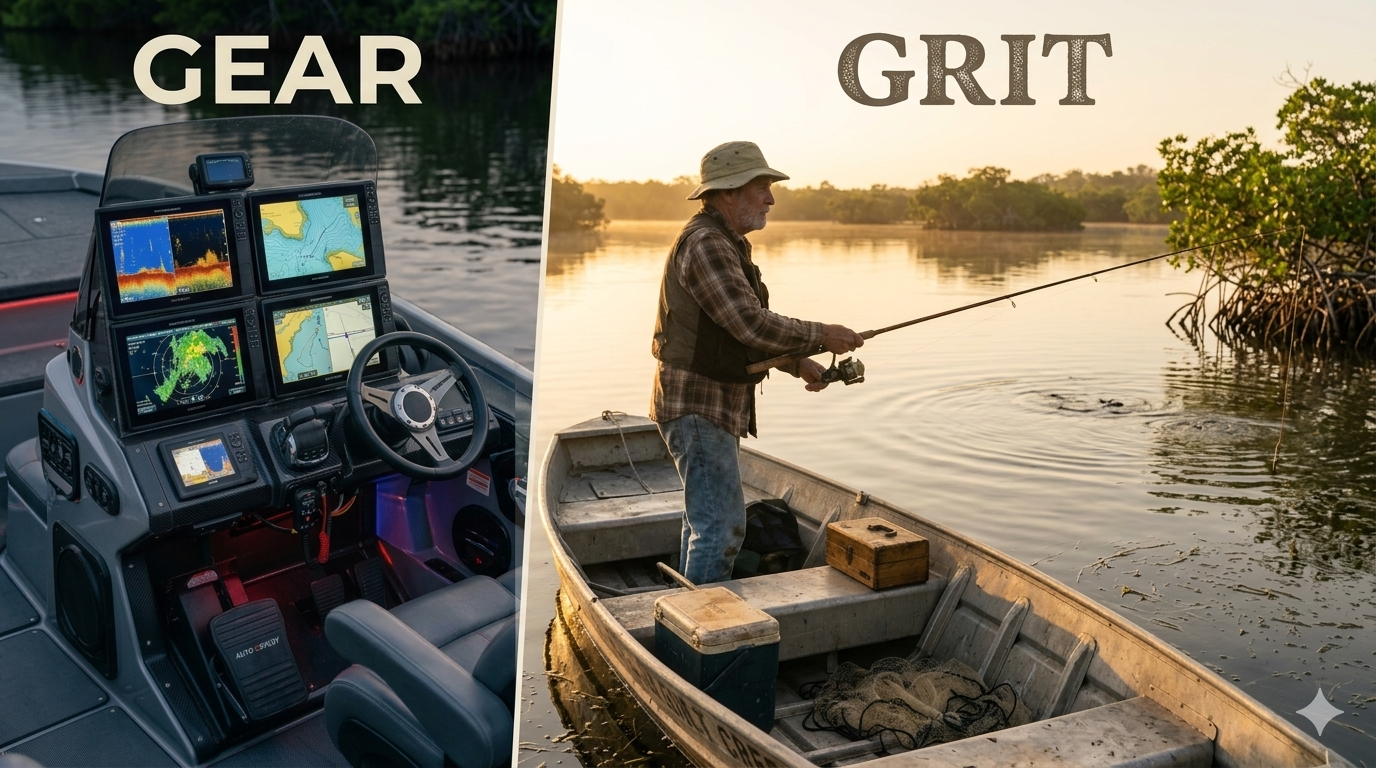
split-scene comparison. One side shows a modern fishing boat covered in large electronic screens, GPS units, and advance
There is a modern arms race happening at the local boat ramp, and it smells faintly of premium marine-grade vinyl, high-octane gasoline, and unbridled desperation.
Watch closely on any given Saturday morning, and you’ll see half-ton trucks backing sleek, metal-flaked fiberglass battleships into the brackish Florida waters.
These vessels are bristling with enough electronics to successfully coordinate a lunar landing.
We’ve got side-scan sonar, live-feed down-imaging,
and GPS-guided trolling motors that can hold a boat within an inch of a digital waypoint while the captain sips an iced macchiato in a gyroscopically stabilized captain's chair.
We have officially entered the space age of fishing, where a single outfit can easily cost more than a modest mid-century home in Ocala.
Yet, right next to these high-tech armadas, you’ll occasionally spot an old-timer.
He’s stepping into a weathered aluminum jon boat with nothing but a scratched plastic bucket, a thermos of black coffee, and a scratched Penn Peer reel attached to a fiberglass rod that looks like it survived Hurricane Donna.
The high-tech crowd smiles with polite pity.
But by noon, as the sun beats relentlessly down on the mangroves, a funny thing happens: the high-tech armada is still fiddling with their software updates, while the old man is already scaling his third redfish. The Allure of the High-Tech Tackle Box
Don't get me wrong; I am as vulnerable to shiny things as a hungry barracuda.
It is incredibly easy to fall down the rabbit hole of modern angling technology. Walk into any major outdoor retailer today, and you are instantly bombarded by gear designed to take the guesswork completely out of the sport.
We are told that if we just buy this specific multi-frequency transducer, or this hydro-dynamically optimized hard bait with internally balanced tungsten rattles, the fish will practically jump into the cooler themselves.
We’ve turned a primal, intuitive pastime into a data analytics seminar.
Anglers sit glued to glowing multi-use displays, tracking pixelated blobs moving across a screen in real-time.
"Look at that,"
They’ll whisper excitedly, pointing to a fuzzy blue smudge forty feet beneath the hull. "That’s a shooter."
They drop a lure engineered by aerospace software, twitch it according to a mobile app's seasonal cadence algorithm, and... nothing. The smudge swims away.
The anglers sigh, curse the atmospheric pressure, and check their digital barometers. We have successfully traded the mystery of the sea for the frustration of an IT support desk.
Overheard at the Dock:"I spent three hours updating my fishfinder’s firmware last night just so it could tell me, with 99.9% scientific accuracy, that there are absolutely no fish biting where I am currently floating."

Click new story every Friday
The Anatomy of Grandfather’s Unstoppable Reel
Meanwhile, back in the bed of a faded 1994 Ford Ranger, lies the antithesis of the digital revolution.
It’s a conventional reel, perhaps an old green-sided Garcia Mitchell or a brass-geared Penn Senator, scarred by decades of salt spray and bumping against truck tailgates.
It doesn’t have a digital drag matrix. It doesn’t connect via Bluetooth to a smartphone to log the exact coordinates of every strike.
What it does have, however, is a soul forged in simplicity.
Inside that metal casing are three or four heavy-duty brass gears that require nothing more than a drop of household oil once a presidential administration to keep spinning. It doesn’t care if it gets dunked in the mud.
It doesn’t shut down because its lithium-ion battery overheated in the midday heat of the Sunshine State.
When a stubborn snook decides to wrap itself around a jagged mangrove root, that old reel doesn’t calculate an optimal tension curve; it just holds.
It relies on the angler’s thumb, a piece of calloused skin that has developed its own innate pressure-sensing algorithm through years of trial and error.
👉 Florida always has another story
The Spirits of the Storm: Florida Hurricane Legends and Myths Busted
The Secret Science of Reading the Ripples
The real secret weapon of the old-timer, though, isn’t stashed in his rusty tackle box.
It’s located right between his ears. The high-tech angler relies on synthetic data to locate fish, while the seasoned traditionalist relies on acute observation.
Twenty or thirty years of sitting quietly on the water teaches you a language that no sonar screen can ever translate.
An experienced fisherman doesn’t need a screen to tell him the bottom structure. He watches the way the current bends around a point.
He notices the subtle "nervous water"—that tiny, almost imperceptible shimmer on the surface that signals a school of mullet being shadowed by predators underneath.
He watches the behavior of a single snowy egret standing perfectly still on a mudflat, knowing that the bird’s patience is a far more reliable indicator of baitfish presence than any sonar sweep.
He reads the water like a morning newspaper, noting the shifting tides, the angle of the sun, and the smell of the air, knowing exactly when the flats are about to wake up.
Grit Wins the Day (And Fills the Frying Pan)
When you strip away the marketing gloss and the high-dollar sponsorships, fishing comes down to a direct negotiation between a human, a line, and a fish.
This is where grit outclasses gear every single time. Grit is the patience to sit out a slow tide change without switching lures twenty times because an online forum said chartreuse was out of style.
Grit is knowing how to tie a perfect blood knot by muscle memory alone when the wind is blowing twenty knots and your eyes aren't what they used to be.
When the fancy electronics glitch—when a fuse blows, a salt-water crust shorts out a wire,
Or a software error freezes the screen—the high-tech angler is completely blind, stranded in an expensive floating living room.
But the person with the cane pole or the ancient conventional reel keeps casting.
They don't need a satellite connection to tell them where the deep hole is;
They remember it from the low tide of 2008. They cast with a rhythmic, unhurried confidence, knowing that water always tells the truth if you stay quiet long enough to listen.

Honoring the Wisdom of the Old Waterfront
There is a beautiful, understated peace in stripping away the unnecessary noise of the modern world and returning to the roots of the sport.
The next time you find yourself browsing the glowing aisles of a sporting goods store,
staring down a piece of gear that costs the equivalent of a cruise vacation, take a breath.
Remember that the fish haven't evolved spreadsheets or Wi-Fi receivers.
They are doing exactly what they have done for thousands of years: looking for an easy meal in the shadows.
The true magic of Florida’s waters isn’t something you can buy, unbox, or download.
It’s earned through early mornings, sunburned necks, missed strikes, and the quiet satisfaction of a line humming under tension.
Your grandfather’s reel still works because it was designed for the reality of the water, not the perfection of a laboratory. It demands your presence, your focus, and your respect for the environment.
Thanks for spending part of your day with Florida Unwritten.
If this story felt familiar, salty, strange, or a little too Florida to explain at dinner, share it with someone who’d understand.
👉 More stories live at https://surl.lu/uilyob
📬 Subscribe for weekly Florida stories, coastlines, wildlife, weirdness, and the kind of local moments tourists usually miss.
Florida Unwritten is a labor of love dedicated to the places the brochures forget.
See Ya Friday
Earl lee
