Forget the GPS: How to Navigate Florida Using Only Quirky Local Landmarks
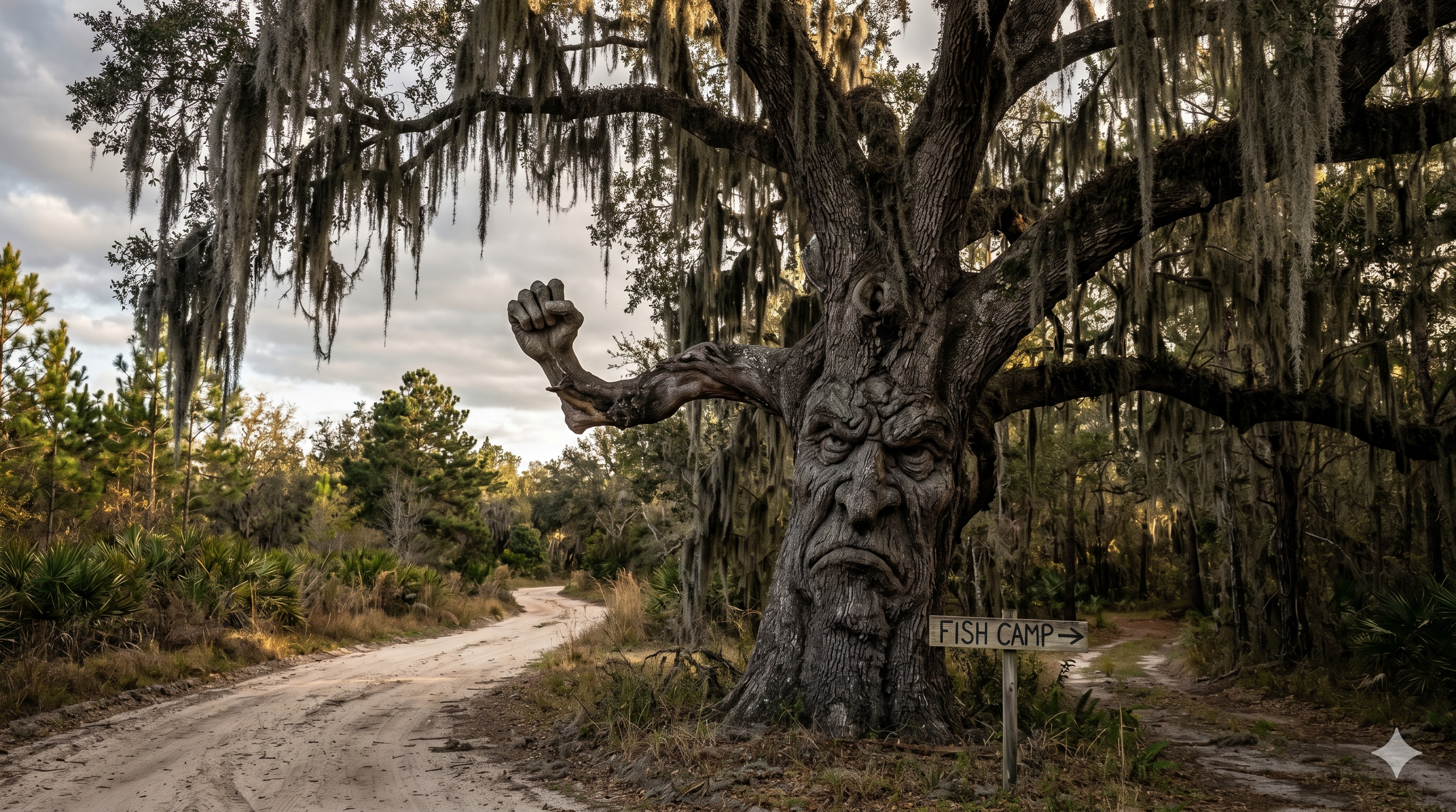
massive ancient live oak tree in rural Florida that appears to have a personality
The Day the Satellites Failed in the Scrub Pines
The GPS on my dashboard was having a midlife crisis.
According to the pleasant, robotic lady trapped inside my phone, I was supposed to "turn left on County Road 412." The only problem?
County Road 412 didn't have a sign.
In fact, it barely had asphalt. As I sat idling at a dusty crossroads in the middle of Florida’s interior ridge country, flanked by nothing but sand pines and a wall of oppressive humidity,
An old-timer in a faded John Deere cap pulled up alongside my window in a beaten-up truck.
"You look turned around, friend," he said, shifting a toothpick from one side of his mouth to the other.
I told him I was looking for the old spring-fed swimming hole.
He chuckled, shook his head at my glowing phone screen, and leaned out the window. "Drop that gadget.
Here’s what you do: drive down this road until you see the oak tree that looks like it’s holding a serious grudge.
Hang a left there. Keep going past the mailbox shaped like a manatee. If you hit the rusted tractor sinking into the palmettos, you’ve gone too far."
I thanked him, turned off my GPS, and found the spring twenty minutes later.
That was the day I realized that the real Florida doesn't live on Google Maps. It lives in the unwritten, highly subjective landmarks that locals have used to navigate the backroads for generations.
The Flora with Attitude: Trees That Hold Grudges and Give Directions
      _-_
    /~~   ~~\
 /~~         ~~\
{               }
 \  _-     -_  /
   ~  \\ //  ~
    _  |||  _
   (_|  |||  |_)
     \_____/
In the Sunshine State, nature isn't just a backdrop—it’s an active participant in the conversation.
When a local tells you to look for a specific tree, they aren’t talking about a generic pine or a standard-issue palm.
They are referring to a botanical character with a distinct personality.
Take the "Grudge Tree,"
a massive, lightning-struck live oak draping with Spanish moss that looks distinctly like a hunched-over old man shaking his fist at traffic. For fifty years, it has served as the unofficial gateway to a hidden fish camp.
Our trees have survived hurricanes, real estate booms, and decades of blistering heat,
giving them a gnarled, weathered look that no street sign can match.
You haven't truly experienced a Florida backroad until you’ve been told to "turn right where the pine tree splits into a slingshot," or "if you pass the cypress knee that looks exactly like Richard Nixon, you missed the boat ramp."
The Heavy Metal Markers: Rusted Tractors and Forgotten Machinery
     ______
   _//  ||  \__
  [____________]
   O--O    O--O
Every rural Florida community has at least one piece of agricultural equipment that has officially retired and become part of the geography.
It might be a 1950s Fordson tractor slowly being swallowed whole by a patch of aggressive wild blackberries,
or a bright yellow bulldozer that broke down during the Carter administration and was simply left to rust in peace.
These mechanical relics are the anchors of backroads navigation.
They represent a boundary line, a warning, and a historical marker all at once. "If you see the rusted tractor, you’ve gone too far" is practically a holy commandment in the Florida interior.
Passing these heavy metal markers always brings a wave of nostalgia.
They remind us of a time when the pace of life was dictated by the speed of a harvest rather than the speed of a fiber-optic cable.
They stand as silent monuments to the farmers, citrus growers, and cattle ranchers who carved a living out of the palmetto scrub long before the theme parks arrived.
3. Mailbox Masterpieces: Navigating by Folk Art
     ______
    |  __  |   __
    | |  | |  / /
    | |__| | / /
    |______||_/
       ||
       ||
When street numbers fade in the blistering Florida sun, rural residents get creative.
On the backroads, a mailbox is not just a receptacle for utility bills; it is a canvas for self-expression and a vital navigational beacon.
To find the best secret barbecue joint or the entrance to a hidden kayak launch, you have to keep your eyes peeled for the local folk art.
You’ll be told to look for the mailbox shaped like a five-foot largemouth bass,
or the one welded out of old chain links, or the classic coastal favorite: a manatee wearing a seasonal hat (a Santa hat in December, sunglasses in July).
These quirky landmarks do more than guide you to your destination; they give you a glimpse into the soul of the neighborhood.
They tell you that the folks living down this dirt road don't take themselves too seriously, and that they value a bit of whimsical fun over cookie-cutter suburban uniformity.
4. The Architecture of Appetite: "Turn Right at the Boiled Peanut Stand."
   _________________
  |  BOILED PEANUTS |
  |   HOT & SALTY   |
  |_________________|
        ||   ||
       _||___||_
      [_________]
Finally, you cannot talk about navigating the Florida backroads without talking about the smells and sights of roadside commerce.
In a state where a generic gas station sits on every highway exit, the backroads rely on a completely different kind of infrastructure:
the hand-painted plywood sign.
"Turn right at the boiled peanut stand—the one with the silver trailer and the green umbrella, not the one by the creek." This is a literal directive I’ve received more than once.
These pop-up landmarks—whether they are selling hot bags of salty, Cajun-boiled goobers, jars of dark orange-blossom honey, or flats of fresh-picked strawberries—are the true compass points of the interior.
They represent the flavors of our childhoods and the enduring spirit of roadside Florida. If you track your journey by the number of peanut stands you pass, you aren't just navigating; you’re tasting the history of the state.
Embracing the Scenic Route
There is a quiet joy in getting lost just enough to have to look for a tree with a grudge or a rusted-out piece of history.
It forces us to roll down our windows, slow down our engines, and actually look at the world passing by, rather than staring blankly at a blue dot on a digital map.
The next time you head out to explore the heart of Florida, do yourself a favor.
Turn off the voice navigation, ignore the highway signs, and ask a local for directions.
Look for the character in the landscape, embrace the quirks, and remember that in the real Florida, the best stories are always found just past the landmark you can't find on a map.
Thanks for spending part of your day with Florida Unwritten.
If this story felt familiar, salty, strange, or a little too Florida to explain at dinner, share it with someone who’d understand.
👉 More stories live at https://surl.lu/uilyob
📬 Subscribe for weekly Florida stories, coastlines, wildlife, weirdness, and the kind of local moments tourists usually miss.
Florida Unwritten is a labor of love dedicated to the places the brochures forget.
See Ya Friday
Earl lee
