
Lessons from the 1928 Okeechobee Hurricane
Back Roads | Florida Unwritten: The Storm That Didn’t Leave:
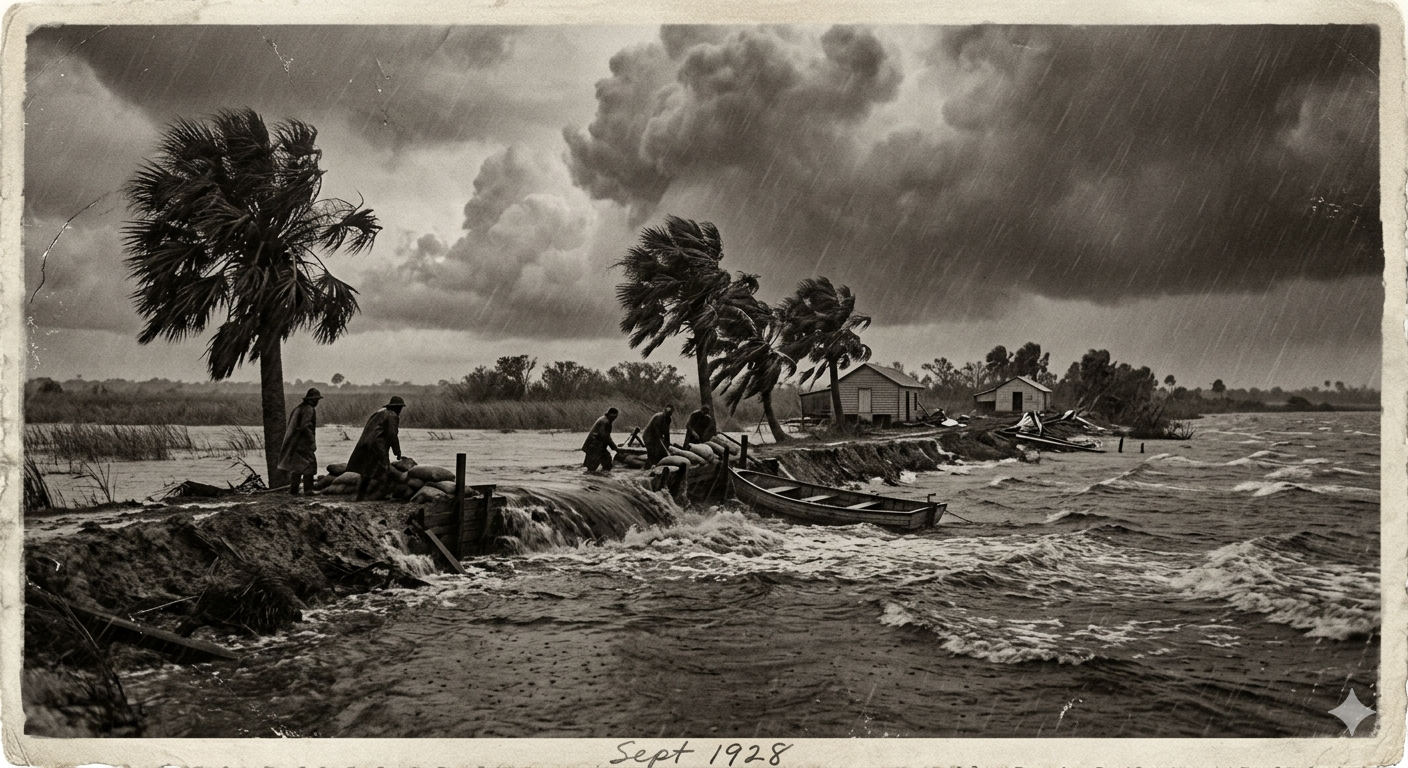
Lake Okeechobee during a 1920s hurricane
The Barber Shop Forecast
There are two places in Florida where the truth gets told plain: the back porch and the barber shop.
The barber shop, especially. That’s where storms live long after the clouds are gone.
I must’ve heard the story of the 1928 Okeechobee Hurricane a dozen times in that cracked vinyl chair, cape snapped tight around my neck, the smell of talc and aftershave floating like a low tide breeze.
Every old-timer told it a little differently. Some swore the wind screamed like a freight train. Others said it didn’t scream at all—that it went quiet right before everything broke.
But every version circled back to the same thing:
The lake rose. The levee failed. And the water didn’t ask permission.
At the time, I thought it was just another Florida story. The kind that grows taller every time it’s told.
Turns out… it wasn’t.
When the Lake Came Calling
A Storm Bigger Than Memory
In September 1928, the Okeechobee Hurricane rolled across the Caribbean, somewhere to be and no patience to get there.
It slammed into South Florida with Category 4 force, but wind wasn’t the real villain. Not this time.
Lake Okeechobee sat shallow and wide, like a giant dinner plate filled too close to the edge.
Back then, the lake was held in check by modest earthen embankments—not the engineered wall we know today.
When the hurricane pushed water north, it piled up. When the winds shifted, all that water came rushing back south.
And the levees… gave way.
Not cracked. Not weakened.
Gone.
A wall of water swept across farming communities—Belle Glade, Pahokee, South Bay—places built low, flat, and vulnerable.
Entire neighborhoods disappeared in the dark.
The numbers still don’t sit right when you say them out loud: over 2,500 lives lost. One of the deadliest disasters in U.S. history.
But numbers don’t tell you how it felt.
The barber shop did.
☀ Every Friday, another piece of old Florida drifts in—
fishing stories, backroads, quiet waters, and the kind of places you won’t find on a billboard.
Pull up a chair. We’ll save you a spot.
👉 Join the newsletter and get it in your inbox every Friday.
The Stories That Stayed Behind
“Water Don’t Knock First”
One man used to lean forward when he told it, elbows on his knees, voice low like he was sharing something borrowed.
“Water doesn’t knock first,” he’d say. “It just comes in like it owns the place.”
He wasn’t there in 1928, of course. None of them were. But they talked like they had been—because somebody in their family was.
A grandfather. A great-aunt. A neighbor who never quite liked storms after that.
They told stories of people climbing onto rooftops in the pitch dark. Of livestock carried off like driftwood.
Of folks tying themselves to trees because there was nowhere else to go.
And then there were the stories that got quiet.
Migrant workers—many of them Black laborers in the agricultural fields—were among the hardest hit.
They lived closest to the lake, in the lowest ground, in homes that stood little chance against a surge like that.
Afterward, even in death, inequality lingered. Mass graves. Unmarked resting places. A silence that took decades to fully acknowledge.
History, like water, has a way of settling into the lowest places.
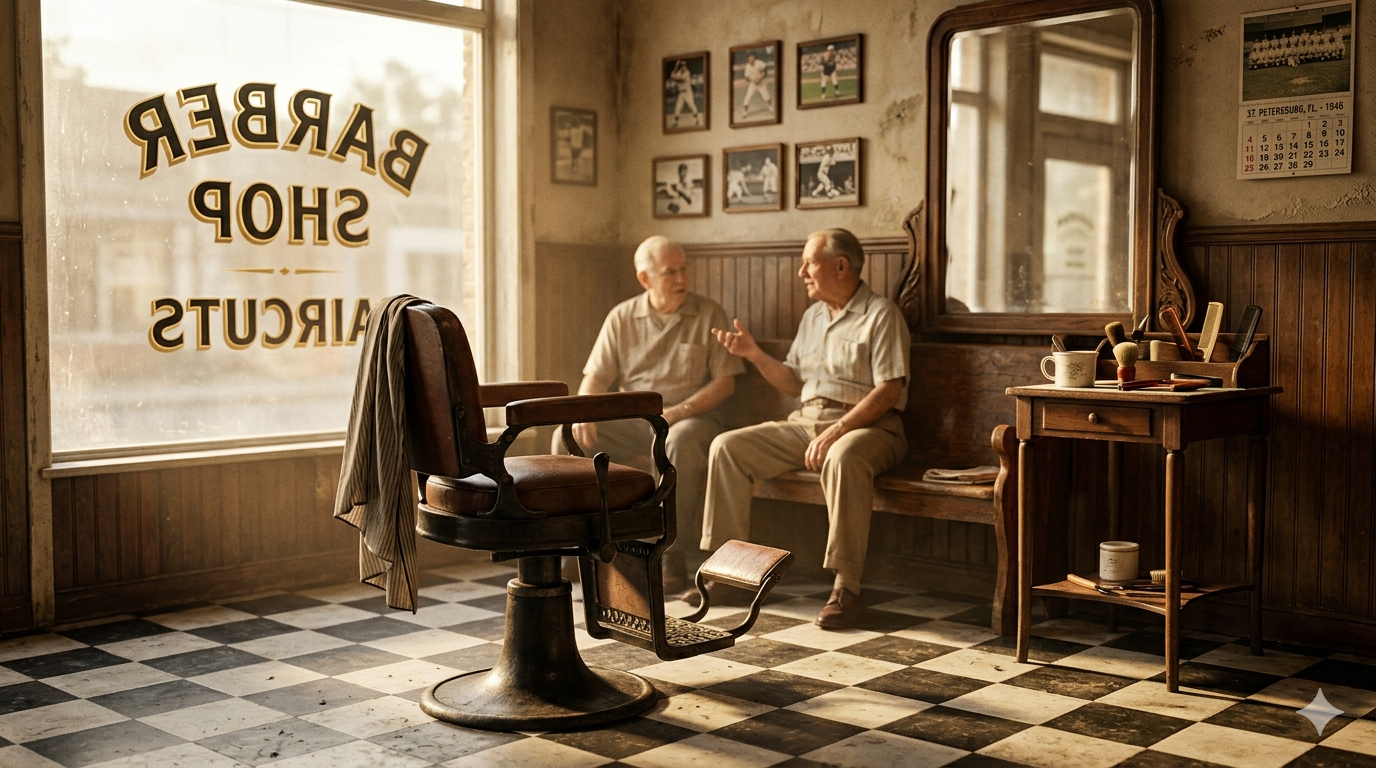
“Vintage Florida barber shop interior, 1940s
Rebuilding on Higher Ground
The Levee That Memory Built
Out of that devastation came something stronger.
The disaster forced change. Engineers, lawmakers,
and communities came together—some reluctantly, some urgently—to make sure the lake would never again rise unchecked.
The Herbert Hoover Dike was eventually constructed, a massive earthen barrier encircling Lake Okeechobee like a belt pulled tight after a hard lesson.
It wasn’t just infrastructure.
It was memory, shaped into dirt and stone.
Today, when you drive those back roads around the lake, it doesn’t look like much at first glance.
Just a long, grassy rise against a wide horizon.
But that ridge?
That’s a line drawn between what was and what we refused to let happen again.
The Lesson That Followed Me Home
Storms Don’t Always Look Like Storms
Funny thing is, I didn’t understand why those barber shop stories stuck with me until much later.
Life has its own way of testing your levees.
Not always with wind and rain. Sometimes it’s quieter.
A job loss. A bad decision. A season where everything feels just a little too heavy, like water creeping higher inch by inch.
And then one day, you realize something’s about to give.
That’s when those old voices came back.
Build stronger than you think you need.
Don’t wait for the water to prove a point.
Pay attention to what’s rising around you.
The people in 1928 didn’t fail because they were weak.
They were caught in something bigger than what they had prepared for.
That’s the real lesson.
Not fear.
Preparation.
Awareness.
Respect—for nature, for history, for the quiet warnings we tend to ignore.
Back Roads Perspective
What Florida Remembers (Even When We Don’t)
If you drive past Lake Okeechobee today, you might not see tragedy.
You’ll see sugarcane fields stretching toward the sky.
Airboats skimming across the marsh. Fishermen casting lines into water that looks calm enough to trust.
Florida has a way of healing like that. It grows over its scars. Covers them in green.
Turns them into something livable again.
But underneath?
The stories are still there.
Waiting in barber shops. Sitting on porches. Riding shotgun down back roads.
Closing: The Quiet Wisdom in the Chair
I still think about that barber chair sometimes. The slow spin.
The hum of clippers.
The way time seemed to loosen its grip just enough for old stories to breathe again.
Back then, I thought I was just getting a haircut.
Turns out, I was getting a warning.
Not the loud, flashing kind.
The quiet kind.
The kind that sticks.
Enjoyed the ride down this back road?
If this story meant something to you, share it with someone who knows that Florida isn’t just beaches and sunshine—it’s stories, lessons, and the people who keep them alive.
And if you’ve got a story passed down over coffee, porch swings, or barber shop chairs…
I’d like to hear that one too.
Know someone who needs a weekend escape? Forward this email to them.
Florida Unwritten .com
