The "Old-Timer" Forecast: Why Grandfather Smelled Hurricanes Long Before Doppler
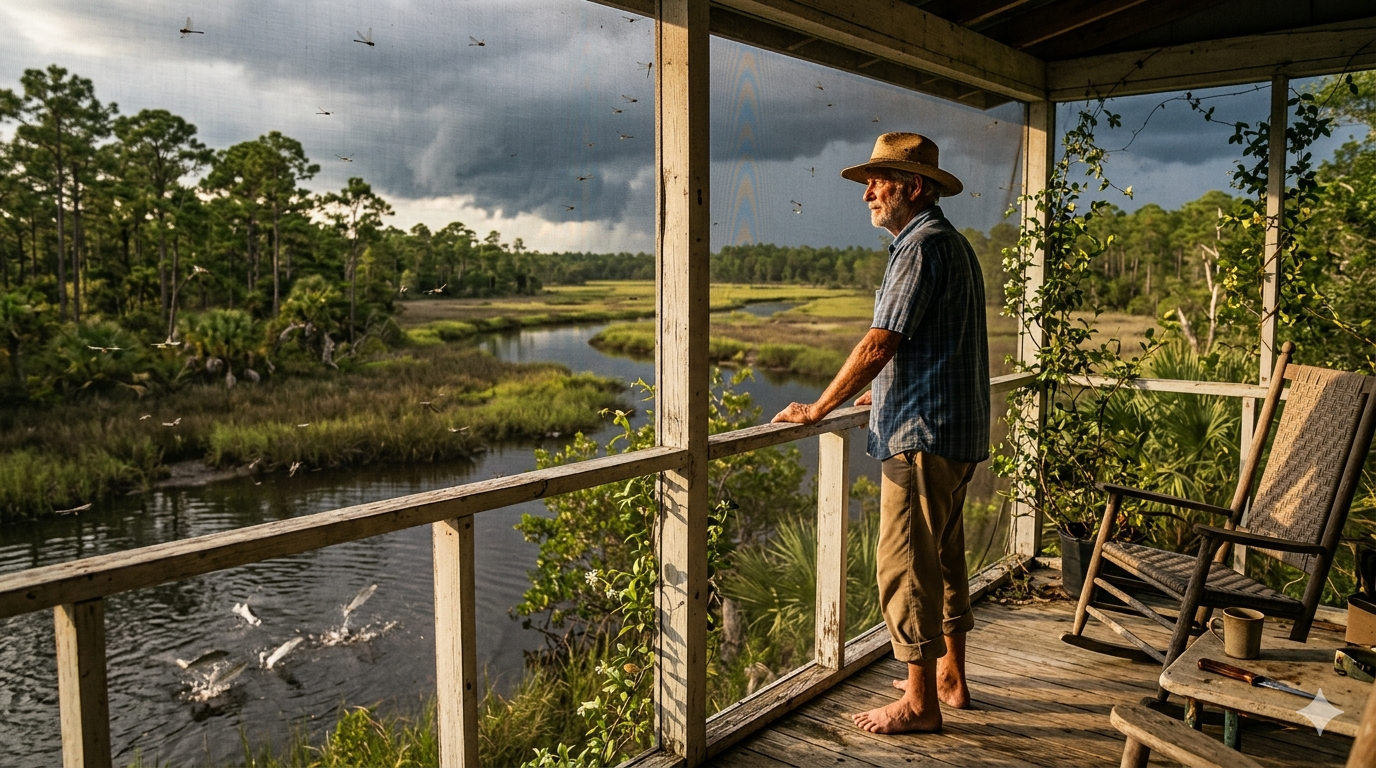
a screened porch overlooking pine flatwoods and marshland. An elderly Florida cracker grandfather in a weathered straw hat
If you turn on any local Florida news station between June and November,
You will be treated to a dazzling, multi-million-dollar spectacle of modern meteorology.
There are flashing neon tracks, high-definition satellite loops, and something inevitably called the "Super Doppler Triple-Pulse Max Impact Radar." Meteorologists in crisp, moisture-wicking shirts stand before massive interactive green screens,
tracing atmospheric pressure drops with surgical precision.
They can tell you exactly when a rain band will clip a specific exit on the interstate down to the very minute.
It is an undeniable marvel of human ingenuity. But if you grew up on the hidden back roads of rural Florida, you know a quiet, undeniable truth: none of those satellites can compete with an old-timer standing on a creaking screened porch,
taking a deep drag of the humid air, and declaring that a blow is coming because the mullet are acting up.
The Subtle Alchemy of the Old-Hand Barometer
Long before we carried real-time weather alerts in our pockets, Florida’s back-road veterans relied on a living, breathing network of environmental barometers.
To my grandfather, the air wasn’t just a mixture of nitrogen and oxygen; it was a canvas that wrote its intentions in the language of the swamp.
Two or three days before a tropical system even earned a name out in the Atlantic, he would step outside, tilt his head back, and look past the pine canopies.
It wasn't a scientific calculation, but rather a lifetime of accumulated observation—a subtle alchemy of sensory details that modern machinery simply can't capture.
He would tell you that a major storm had a distinct scent.
It wasn’t the smell of rain itself, but a heavy, pungent aroma of sulfur and decaying peat kicked up from the bottom of the marshes as the atmospheric pressure plummeted.
The earth itself was exhaling its secrets.
While the city folks were blissfully grilling burgers and enjoying the sunshine, the old-timers were already checking their oil lamps and looking for the twine.
They didn't need a blinking red banner on a television screen to know that the atmosphere was quietly shifting its weight.
◇ ◇ ◇
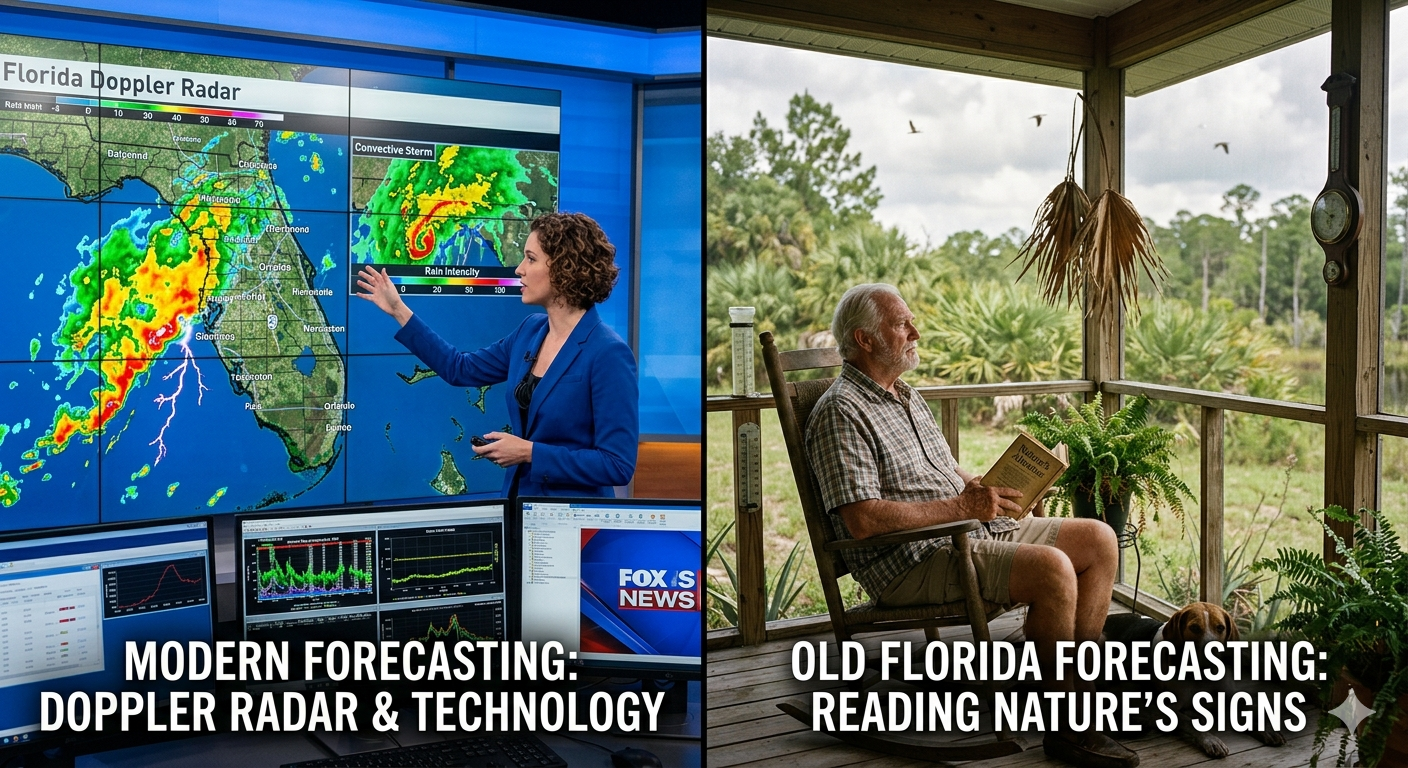
Modern vs Old Florida Forecasting Split-scene
When the Mullet Start Flying and the Dragonflies Carpet the Sky
The most reliable indicators, however, didn't require human senses at all; they were written in the behavior of the local wildlife.
In the tidal creeks and brackish backwaters, the silver mullet would suddenly go rogue. Normally, a jumping mullet is just a casual part of a coastal afternoon—a single flash of silver breaking the glassy water.
But forty-eight hours before a storm, the river would practically turn to a rolling boil.
Mullet would begin leaping in frantic, synchronized bursts, throwing themselves into the heavy air as if the water itself had grown uncomfortable. Grandfather always said they could feel the pressure bruising their swim bladders, forcing them to find relief above the surface.
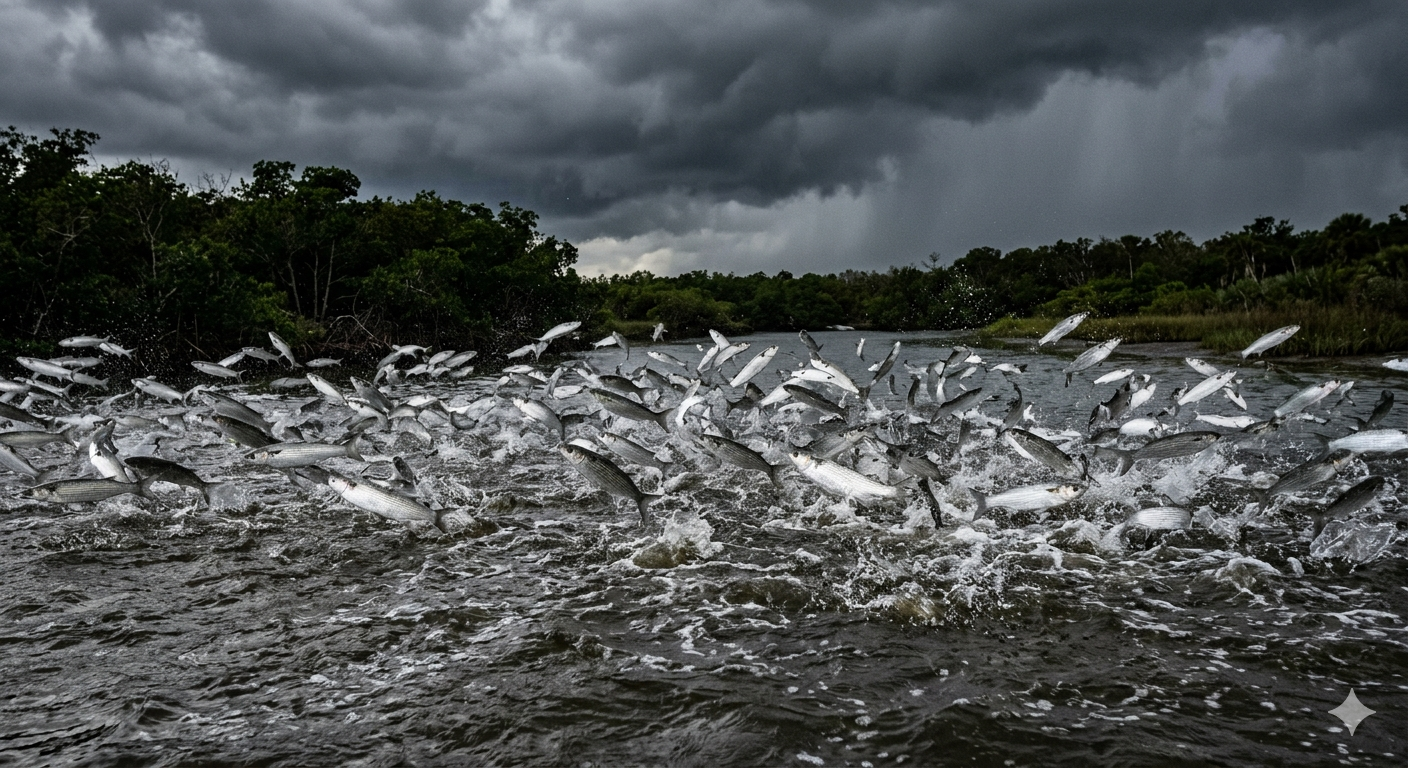
Jumping Mullet Large schools of silver mullet leaping from a Florida tidal creek under ominous skies
Up in the air, the signs were equally unmistakable.
Suddenly, the sky over the palmetto scrub would be completely blanketed by thousands of dragonflies.
They would hover in thick, low clouds, darting frantically just inches above the sawgrass. It wasn't a social gathering; it was a desperate feeding frenzy.
The dropping barometric pressure drew millions of tiny gnats and mosquitoes out of the mud, and the dragonflies were seizing their last chance to gorge themselves before the high winds arrived.
If you saw a dragonfly carpet covering the yard on a bright, cloudless Tuesday morning, you didn't plan a picnic for Thursday.
"The television fellas can tell you where a storm is going once it’s already built," Grandfather used to say, tapping his worn pocket knife against his thumb. "But the swamp tells you when it’s still dreaming about it."
The Eerie Silence of the High Pine Canopies
As the storm crept closer, the visual cues gave way to a profound, heavy auditory shift across the back roads.
Florida is rarely a quiet place; the scrub is usually a raucous theater of mockingbird chatter, cicada buzzes, and the constant, rhythmic scolding of blue jays.
But twelve to twenty-four hours before the outer bands arrived, a suffocating silence would drop over the hammocks.
The birds would vanish entirely, tucked deep into the dense, protective hearts of the live oaks and cabbage palms.
Even the trees seemed to change their posture. The silver-green undersides of the oak leaves would turn upward, flipping in the eerie, warm breeze that always seems to precede a tempest.
Grandfather would point out the cattle in the neighboring pasture.
They wouldn't be grazing scattered across the field; they would be huddled tight against the thickest strand of pine trees, their tails turned toward the east,
instinctively presenting their backs to the oncoming weather. It was a silent, beautifully choreographed retreat that no computer model could ever replicate.
◇ ◇ ◇

New Stories Ever Friday
Join The Circle
How to Spot an Impending Florida Storm Without Your Phone
While we might live in an era of hyper-localized push notifications and computer models, the ancient signs are still actively operating in the background of our daily lives.
If you happen to find yourself away from cell service—or if you just want to test the accuracy of the old ways—here is a quick, time-honored checklist for reading a Florida storm using nothing but your own senses and the back-road environment:
The Great Dragonfly Gathering: Look closely at the airspace right above your lawn or the nearest ditch. A sudden, massive swarm of dragonflies hovering unusually low to the ground means the barometric pressure is falling rapidly, pushing their microscopic prey upward.
The Sulfur Exhale: Pay close attention to the wind when it shifts out of the east. If the air suddenly carries a heavy, damp smell resembling river mud, marsh gas, or old sulfur, the coastal waters and wetlands are literally off-gassing due to the dropping atmospheric pressure.
The Silver Flip: Walk out to the nearest live oak or sweetgum tree. If the leaves look pale or silver as they twist backward in a gentle breeze, the tree is reacting to a sharp rise in humidity and a shifting wind direction that traditionally heralds a major front.
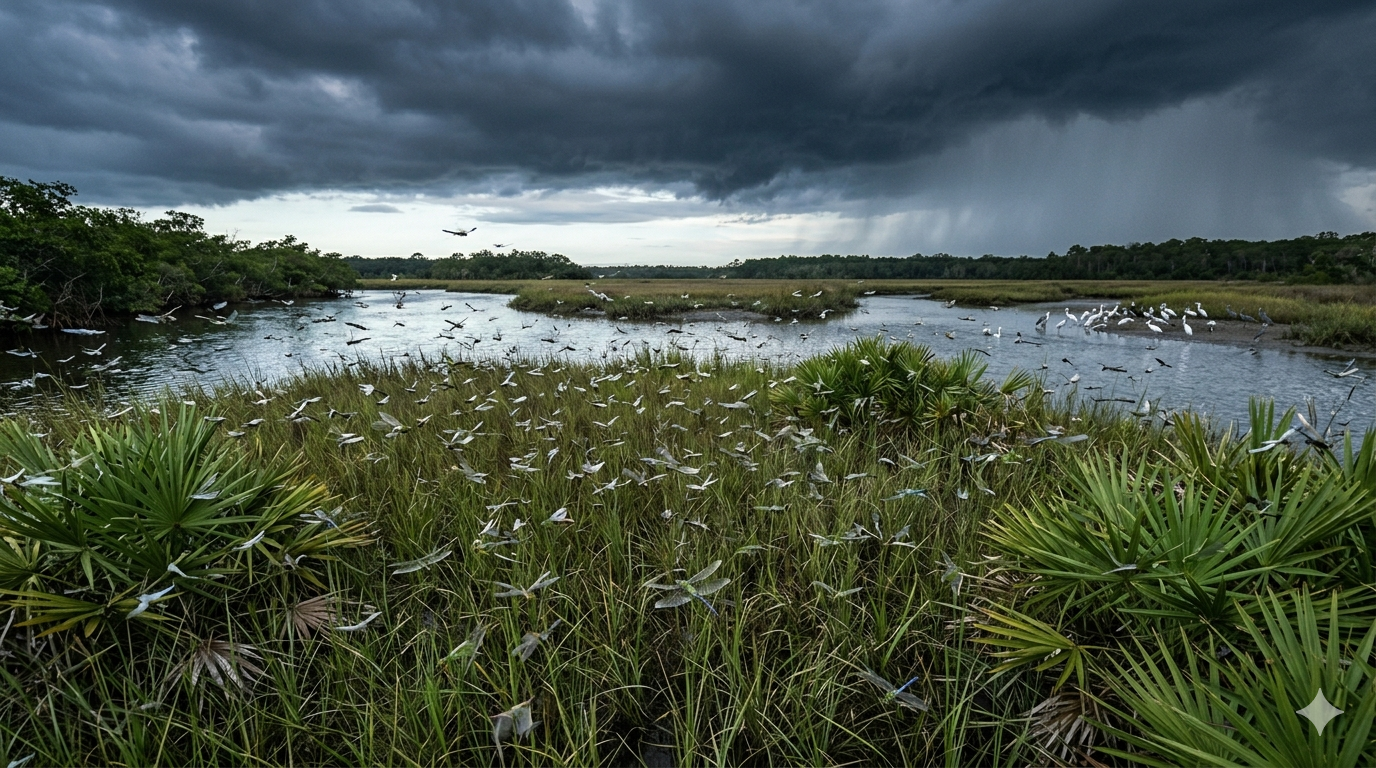
Thousands of dragonflies hovering low above sawgrass and palmettos
Preserving the Wisdom of the Screened-Porch Prophets
There is no denying that modern Doppler radar saves lives, and we should absolutely heed every evacuation warning and tracking map provided by the experts.
But there is a distinct sadness, beauty in remembering the old-timer methods.
They remind us that our ancestors weren't just passive residents of this wild peninsula; they were deeply attuned participants in its natural rhythms.
They didn't view a hurricane as an abstract red polygon on a digital screen, but as an intimate, powerful force that the entire ecosystem anticipated together.
So the next time a tropical depression begins to form out in the warm waters of the Caribbean, go ahead and track its path on your favorite weather app.
But now and then, step outside away from the screens. Take a slow, deep breath of the heavy Florida air, look down at the grass, and see if you can hear the swamp whispering what's to come.
Thanks for spending part of your day with Florida Unwritten.
If this story felt familiar, salty, strange, or a little too Florida to explain at dinner, share it with someone who’d understand.
👉 More stories live at https://surl.lu/uilyob
📬 Subscribe for weekly Florida stories, coastlines, wildlife, weirdness, and the kind of local moments tourists usually miss.
Florida Unwritten is a labor of love dedicated to the places the brochures forget.
See Ya Friday
Earl lee
