Before the Mouse Moved In: The Night the Tin Roof Sang
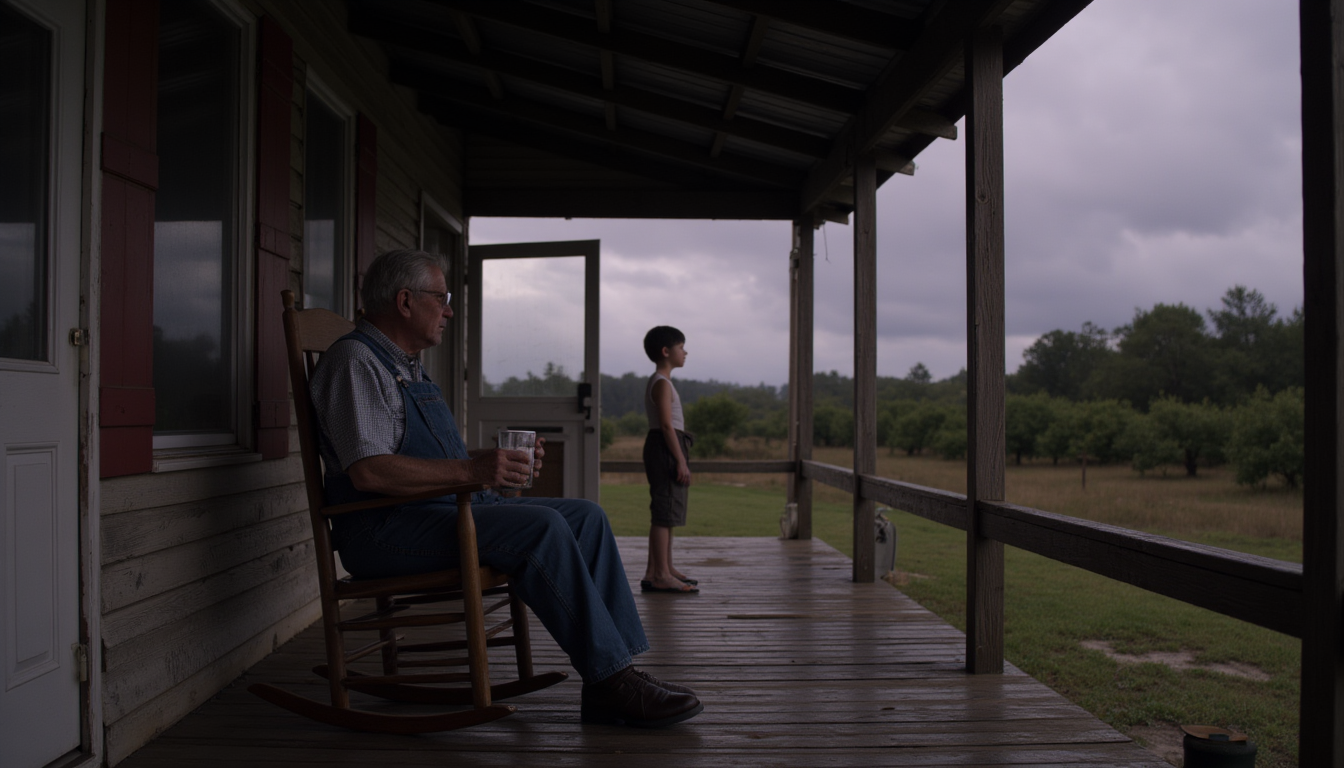
weathered wooden porch in the Florida twilight.
The Rhythms of a Disappearing World
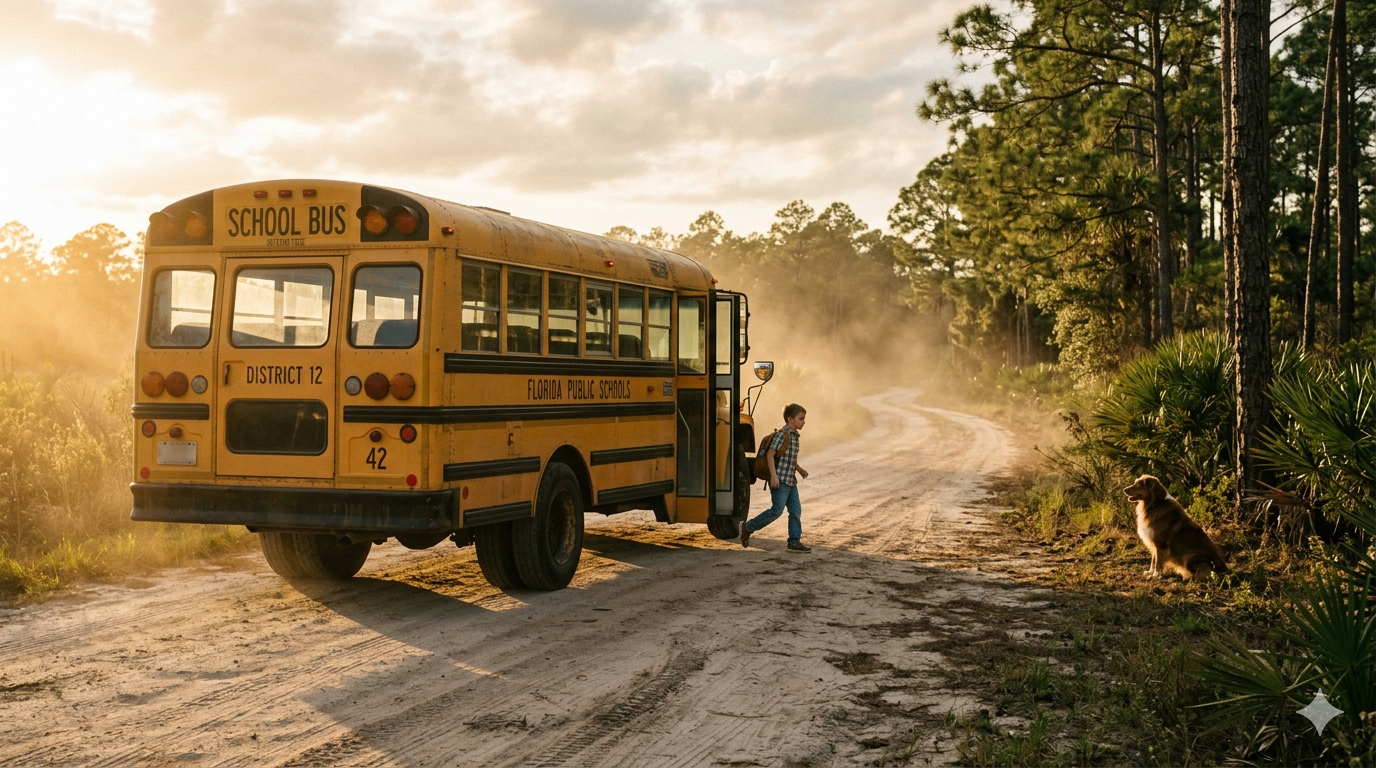
The yellow school bus didn't just drop me off; it exhaled me onto the dirt road in a cloud of dust and diesel fumes.
Before the dust could even settle, there he was.
Red, my three-year-old Australian Shepherd,
was already waiting at the edge of the line where the asphalt ended and our life began.
I often pondered how that dog could tell time.
We lived secluded—the kind of Florida secluded where the nearest neighbor’s kid was a hike through palmettos and pine scrub away.
In a world without cell phones, satellites, or a glowing screen in your pocket to Google every answer,
The world felt infinitely larger and more mysterious.
Red wasn't just a pet;
He was my best friend and the silent partner in my imagination.
Together, we occupied a world of endless possibilities,
mostly because no one was around to tell us what was impossible.
As we made the turn around the last towering longleaf pine, the house came into view.
And there, like a permanent fixture of the landscape, was Grandpa.
"Got any homework?" he called out as I approached.
"Not today," I said, a wide grin breaking across my face.
"Good," he smiled back, though his eyes always held a bit of a twinkle that suggested he knew exactly what was coming next.
"Change your clothes and come see me."
In our house, that was the polite translation for: It’s time for chores. ### The Price of the Porch
Every day followed the same sacred geometry.
There were roughly two hours of work—feeding, fixing, hauling, and sweating.
It was the "entry fee" for the evening. Because at the end of the chores,
there was always the porch.
The porch was where the labor of the day was distilled into the wisdom of a lifetime.
Grandpa had a literal ton of "Grandpa-isms"—cryptic,
rhythmic sayings that never gave you a straight answer but always kept you wondering.
If you asked him a direct question, he’d give you a riddle wrapped in a story.
Back then, it was frustrating. Now, I realize he wasn't trying to hide the truth; he was trying to teach me how to find it for myself.
Tonight, the air was heavy, the kind of Florida humidity that feels like a wet wool blanket.
Grandpa was rocking a little slower than usual.
He started in on a story about "The Men."
For weeks, men in sharp suits and shiny shoes had been roaming the county.
They were buying up orange groves and marshland for double,
sometimes triple what it’s worth.
They were offering "new money" for "old dirt."
"They came by again today, Earl,"
Grandpa said, staring out toward the tree line.
I knew the drill. I’m sure they got the long version of our history.
He would have told them about how our family had been rooted in this specific patch of Central Florida for over a century.
He would have explained that you can't put a price on the way the light hits the lake at 6:00 AM,
and you certainly can't sell the bones of your ancestors just because someone offered you a stack of paper.
He didn't refuse to sell because he was stubborn;
He refused because he was a steward.
To him, the land wasn't an asset; it was an identity.
This post is part of our A Florida Lesson in Patience, Fog, and Growing Up” series, exploring the writers who captured the heart of Old Florida. For more on the legends of the scrub, check out our pillar post
The Mistake of the "Short Way"
I asked him why the men were making such a "mistake" by offering so much money.
I thought maybe they just didn't know any better.
Grandpa just chuckled and reached for his glass.
"Earl, some men look at a forest and see timber.
Some look at a swamp and see a drain.
But these men... they look at Florida and see a stage.
They think they can build a world that doesn't have to answer to the seasons."
I realized this story was going to call for another tall glass of sweet tea.
The moral of the story that night was about "Changing Times."
It was a version of a sermon I’d heard him give before,
and like any ten-year-old who thinks he knows everything, I partially dismissed it.
I figured the world would always look like this. I figured the dirt road would always be dirt,
and the nearest neighbor would always be a hike away.
I said my goodnights and headed off to bed,
leaving Grandpa on the porch to finish his tea and his thoughts.
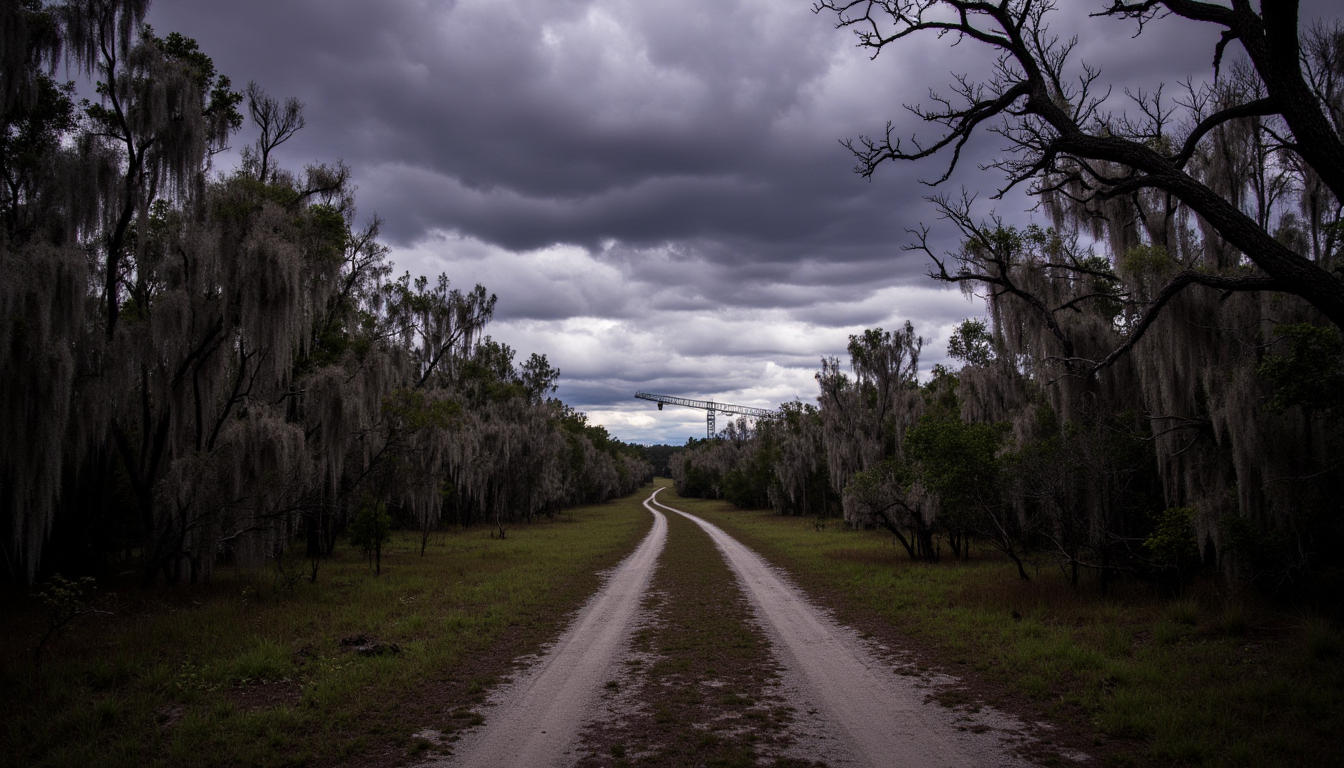
landscape shot The "Old Florida."
The Symphony on the Tin Roof
Lying in bed that night, I did what I always did—I tried to break down what he had said.
I tried to figure out the "Grandpa-ism" of the day.
But before I could get too deep into the logic, the sky opened up.
If you’ve never lived under a tin roof in Florida, you’ve never truly heard the rain.
It produces a distinct, percussive rhythm that no other material can replicate.
It starts as a gentle, melodic pitter-patter, a soft warning from the clouds.
Then, it swells into a loud, roaring, resonant drumming that vibrates in your very chest.
It is the most honest sound in the world.
It’s the sound of the sky meeting the earth.
I could lie there for hours listening to that drumming,
trying to catch the moment it ended, but I never could.
The rain always won. It sang me to sleep every time.
But as I drifted off that night, tucked safely under the rhythmic roar of the storm,
I had no idea that the "Changing Times" Grandpa spoke of weren't just a story.

join our newsletter
The Mouse and the End of the "Unwritten"
Less than 25 miles from where I slept, the earth was already moving.
The Mouse was coming.
Walt Disney had been buying up land under dummy corporations, piecing together a kingdom that would,
eventually swallow the orange groves and the silence.
My life, and Central Florida as I knew it, was about to undergo its first major fracture.
Grandpa saw it.
He smelled the change in the air long before the first bulldozer cleared the first acre of scrub.
He knew that the "Endless Possibilities" of my childhood were about to be paved over
and sold back to us in half-hour increments.
He was trying to explain to me that once you sell the "Old Dirt," you can never buy it back.
Once the dirt road becomes a highway,
you can’t hear the Australian Shepherd waiting for the bus anymore.
That night was one of the last nights of "Old Florida."
The rain on the tin roof was the same as it had been for a hundred years,
but the world outside the reach of our porch was becoming something unrecognizable.
I didn't know it then, but I was growing up on the edge of what was real.
Everything on our side of the fence was built on sweat, chores, and stories.
Everything on the other side was about to be built on magic, movies, and asphalt.
Grandpa didn't sell.
He stayed on that porch until the very end, a man who refused to let the "Short Way" dictate his life.
He was the navigator who remembered the way back,
even when the landmarks were being replaced by neon signs.
Before Florida changed, there was a man who explained it to me.
I just wasn't quiet enough to hear him yet.
ctashare our story
Thanks for spending part of your day with Florida Unwritten.
If this story felt familiar, salty, strange, or a little too Florida to explain at dinner, share it with someone who’d understand.
👉 More stories live at https://surl.lu/uilyob
📬 Subscribe for weekly Florida stories, coastlines, wildlife, weirdness, and the kind of local moments tourists usually miss.
Florida Unwritten is a labor of love dedicated to the places the brochures forget.
See Ya Friday
Earl lee
