Zora Neale Hurston in Eatonville: The Front Porch Where Folklore Became History
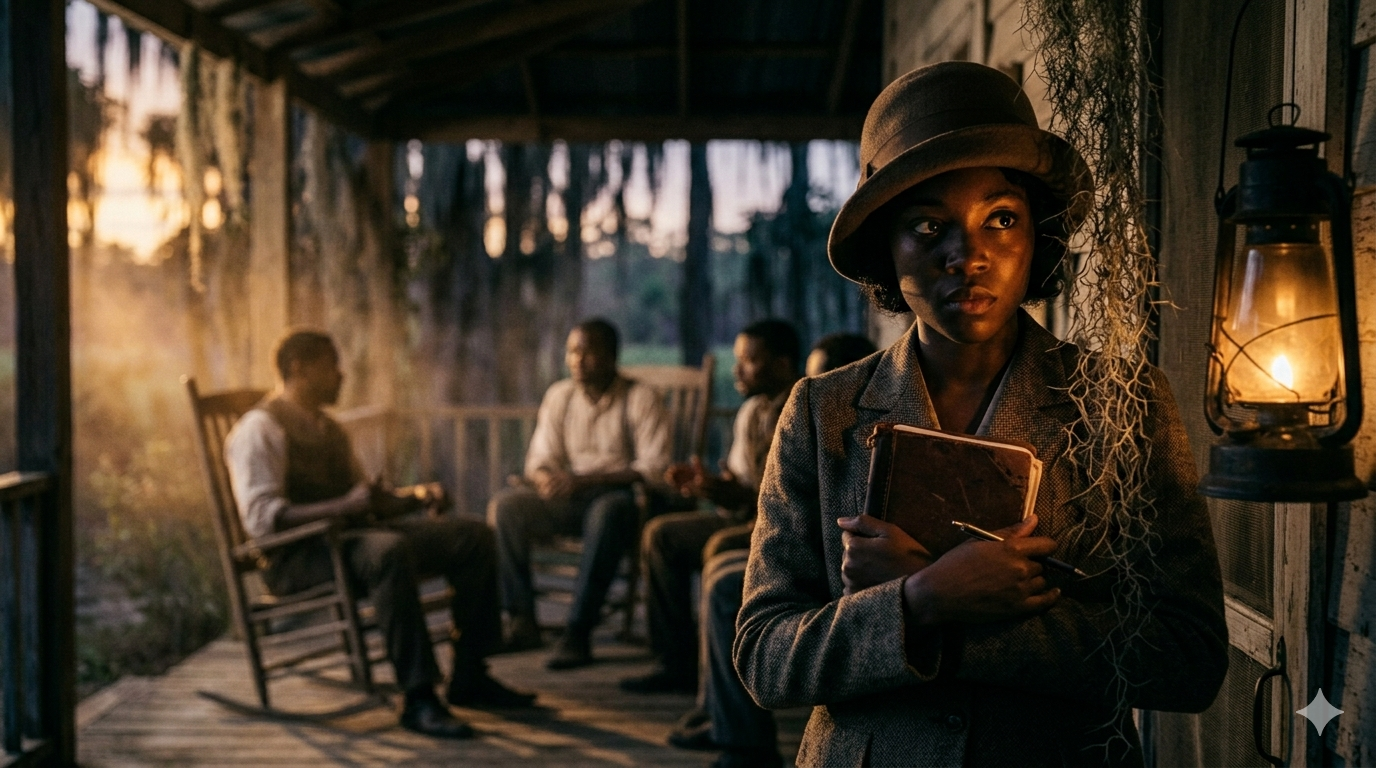
American woman inspired by 1920s writer standing partially in shadow near a porch
This post is part of our Literary Spy-Glass series, exploring the writers who captured the heart of Old Florida. For more on the legends of the scrub, check out our pillar post: [Voices from the Porch: A Journey Into Florida’s Unwritten Past].
If you’ve ever sat on a wooden porch in the Florida twilight, you know that the air doesn’t just carry the scent of damp earth and jasmine—it carries voices.
There is a specific frequency to a Southern conversation, a rise and fall of "big old lies" that are actually heavy with the truth of how people survived.
Long before we had digital archives, we had the "Gateposts." In Eatonville, Florida—the first all-Black incorporated town in the United States—the front porch of Joe Clarke’s general store was the ultimate headquarters of intelligence.
And standing there, with a notebook in one hand and a steady gaze in the other, was Zora Neale Hurston, adjusting her "spy-glass."
Zora didn't just walk into history; she swaggered into it, usually wearing a hat tilted at a defiant angle.
She understood something that the dusty academics of the 1920s couldn't grasp: that the most profound philosophy in the world wasn't being debated in ivy-covered halls,
but on the pine planks of Eatonville’s porches.
To her, folklore wasn't a dead specimen to be pinned under glass; it was a living "survival kit."
The Girl Who Talked to the Trees
To understand Zora’s research, you have to understand the girl she was before she became the "Queen of the Harlem Renaissance."
Growing up in Eatonville, Zora was the kind of child who would sit atop a gatepost and wave at travelers, asking them where they were going and if they had a story to trade for the view.
She was a "natural-born world-traveler" who hadn't yet left her zip code.
She spent her afternoons eavesdropping on the "lying sessions" at Joe Clarke’s store. These weren't lies in the sense of deception;
They were "tall tales"—elaborate, rhythmic, and competitive stories about God, the Devil, and every creature in between.
These stories were the "unwritten" heartbeat of the community. Even then, Zora was subconsciously calibrating her spy-glass.
She wasn't just hearing words; she was learning the cadence of resilience. She saw that through humor and metaphor, her neighbors were processing the weight of a world that often tried to deny their humanity.
The Spy-Glass: Seeing the Sacred in the Profane
When Zora eventually left Florida to study anthropology under the legendary Franz Boas at Columbia University, she was given a new set of tools.
But as she sat in those New York classrooms, she realized that the "scientific" way of looking at culture often stripped the soul right out of it.
Her professors wanted data; Zora wanted the "will to adorn."
She famously coined the term "spy-glass" to describe her approach to folk research. A spy-glass does two things: it brings the distant close, and it focuses the blurry into sharp relief.
When she returned to Eatonville in 1927, driving a sturdy Chevrolet she named "Sassy Susie" and carrying a chrome-plated pistol for protection,
she wasn't just a local girl coming home. She was a scholar using the spy-glass of anthropology to validate the genius of her own people.
She realized that the "unwritten" stories of Eatonville were a sophisticated succession of language.
When the men on the porch told stories about Brer Rabbit outsmarting the larger animals, they were really talking about the art of survival in a rigged system.
Zora didn't just record the words; she recorded the feeling of the porch. She knew that to get the real "stuff,"
You had to be willing to sit down, share a piece of fried fish, and let the sun go down before you even opened your notebook.
The Art of the "Lying Session"
Let’s talk about those "big old lies." If you were to pull up a chair at Joe Clarke’s store in 1928, you wouldn't find a quiet library atmosphere. It was a theater.
One man would start a story about how the woodpecker got his red head, and another would "cap" it with a story about why the sun and the moon live in the sky.
Zora’s research captured the competitive nature of storytelling. It was a sport. The men used language like a "cut and thrust" sword.
This wasn't just passing time; it was a communal ritual that turned poverty into poetry.
Zora’s genius was in recognizing that these stories were a "succession of language" that kept the culture’s spine straight.
She often faced criticism from other Black intellectuals of the time—the "talented tenth"—who thought her focus on folk dialect and "country" stories made the race look uneducated.
Zora, with her characteristic wit, essentially told them they were looking through the wrong end of the spyglass.
She saw the beauty in the "mule talk." She saw that the ability to turn a hardship into a belly-laugh was the highest form of intelligence.
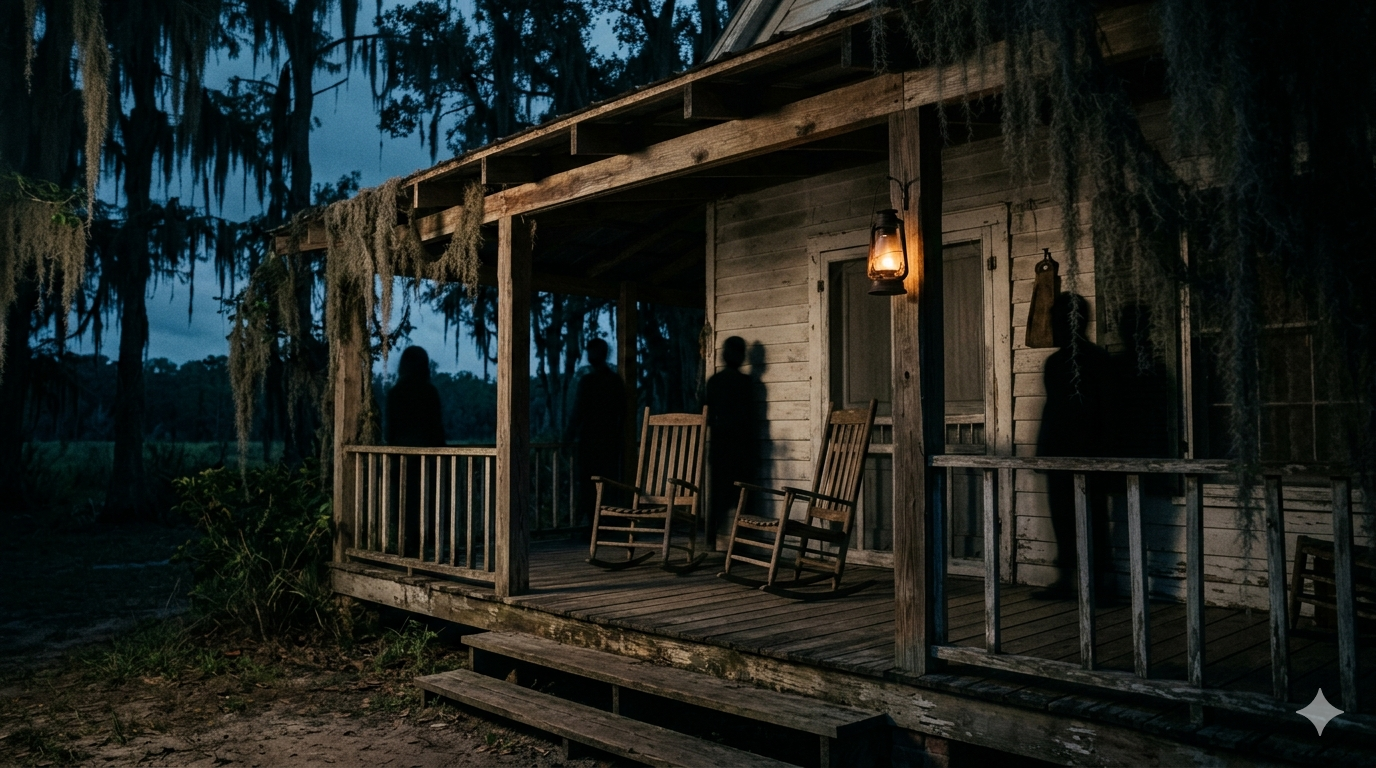
1920s Eatonville Florida wooden porch at twilight
Collecting the "Survival Kit"
Zora’s research trips in Sassy Susie took her across the South, from the turpentine camps of North Florida to the Bahamian communities in the Keys.
She was looking for the "survival kit"—the songs, the hoodoo rituals, and the recipes that kept people whole.
In her book Mules and Men, she describes how she had to go through a "becoming" process to get the stories.
In the turpentine camps, she couldn't just show up as a college-educated researcher. She had to "act as she knew."
She had to prove she could hold her own in a conversation and that she wasn't there to judge.
This was the "unwritten" protocol of the South. You don't get the truth until you’ve earned the trust.
Her research revealed that Florida’s folklore was a melting pot. It was a blend of African rhythms, Caribbean imagery, and the raw, wild energy of the Florida frontier.
It was a "cosmic secrecy" that she was finally bringing into the light, one recorded song and one transcribed joke at a time.
Why Zora Matters for Florida Unwritten
The reason we look through Zora’s spyglass today is that we are still in danger of losing our "unwritten" past. In a world of 280-character thoughts and fleeting TikTok trends,
The "long-form" wisdom of the porch swing is at risk of being silenced by the static.
Zora Neale Hurston taught us that our local history is sacred.
She showed us that the way your grandmother describes a thunderstorm or the way a local fisherman talks about the tides is just as important as anything written in a textbook.
She permitted us to honor our own voices.
I created the Digital Porch of Florida Unwritten to carry on her legacy. When we share these stories, we are polishing our own spy-glasses.
We are making sure that the "succession of language" continues. We are filling our own backpacks with the wit of Bone Mizell,
the grit of the Cracker pioneers, and the rhythmic genius of the Eatonville storytellers.
Pulling Up a Chair
The sun is dipping low over the cypress trees now, and the shadows are stretching across the porch.
The "big old lies" are starting to fly, and if you listen closely, you can hear Zora laughing somewhere in the distance.
She’s probably telling a story that would make a mule blush and a preacher pray, and she’s doing it with a twinkle in her eye that says,
"Don't you dare forget where you came from."
We are the tenants of this land, but we are the owners of our stories. Let’s not let them get lost in the sawgrass. Let’s keep the spy-glass clean and the conversation going.
What’s a "truth" you learned from someone who never wrote a book?
Think back to your own "Eatonville porch"—maybe it was a kitchen table, a garage workbench, or a tailgate at the edge of a field.
What was one piece of wisdom or one "tall tale" passed down to you that you’ve carried in your survival kit ever since?
Leave a comment below and help us add another plank to our Digital Porch. Your story is the history that hasn't been written yet.
Support the Porch Light
Help keep Florida’s stories burning after sunset.
Earl Lee
Florida Unwritten
