The Spanish Galleon Shipwreck That Almost Moved Itself
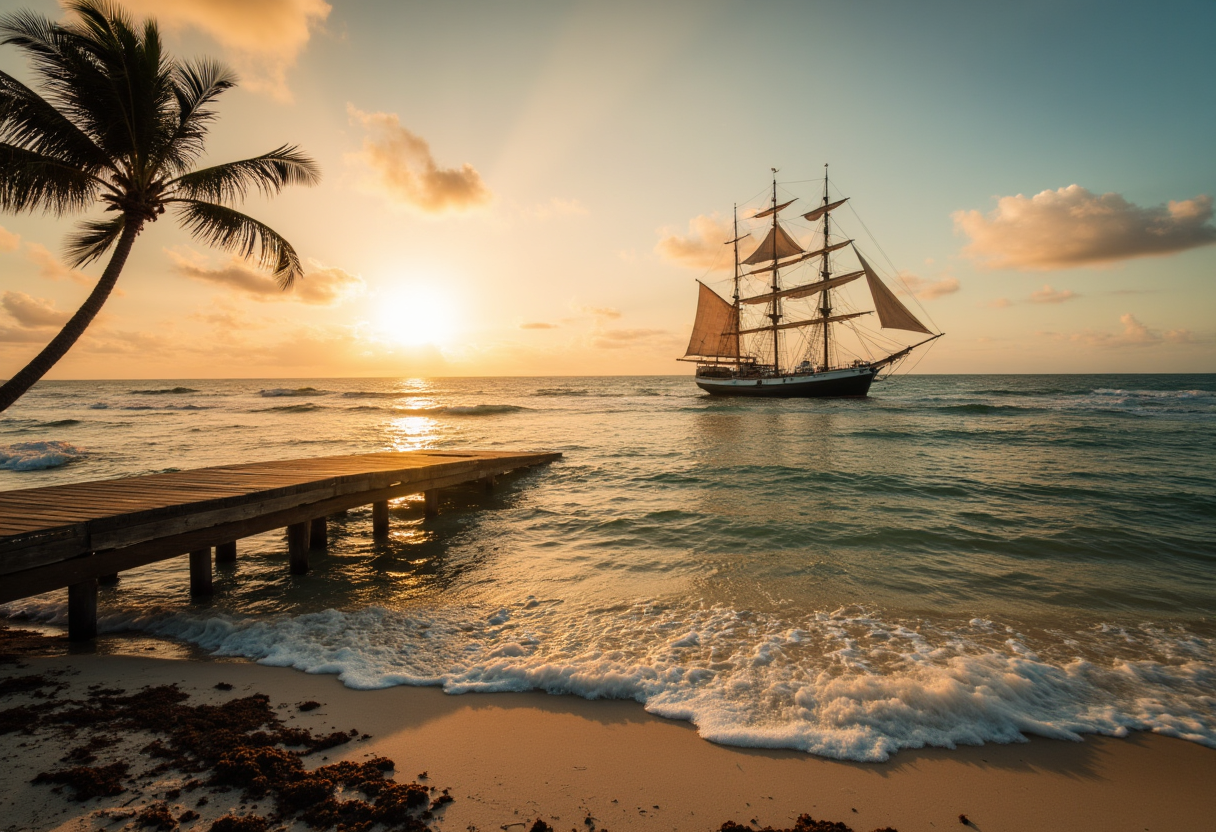
The Treasure Almost Moved Itself
Florida has a complicated relationship with truth.
Not because we don’t respect it. We do. We believe truth sometimes needs room to wander, maybe grab a drink, maybe sit down for a while and rethink its story.
Which brings us to the Spanish galleon shipwreck you’ve probably never heard of. Not because it wasn’t real. It absolutely was. A real ship. Real gold. Real sinking. The history books have that part nailed down.
It’s what happened after that causes people to lower their voices.
Because according to locals, divers, old fishermen, and at least one guy who swears he doesn’t even believe in this sort of thing, the treasure didn’t always stay where it sank.
No one says it walked away.
They just say it wasn’t where it was yesterday.
A Ship That Did Everything Right Until It Didn’t
The galleon went down like many did. Storm. Reef. Darkness. Gravity doing what gravity does best.
Spain lost ships in Florida waters the way people lose sunglasses at the beach. Often. Permanently. Usually with regret.
This one slipped beneath the surface somewhere off the Florida coast, carrying cargo that mattered very much to the Spanish crown and would later matter even more to treasure hunters with questionable sunscreen habits.
For centuries, it stayed quiet. Buried under sand. Left to fish and barnacles. Forgotten by everyone except history books and the occasional cartographer who squinted too hard at old maps.
Then people started looking again.
And that’s when things allegedly got strange.
Storms That Rearranged More Than Sand
Florida storms don’t just pass through. They reorganize.
Ask anyone who’s watched patio furniture migrate overnight.
After a particularly aggressive storm season, divers returned to the wreck site expecting the usual changes. A little more sand here. A little less visibility there.
What they didn’t expect was… inconsistency.
Markers didn’t line up. Familiar shapes felt off. Coins that had been documented carefully seemed scattered differently. Nothing dramatic. Nothing provable. Just enough to make a diver surface, remove their mask, and stare at the horizon longer than necessary.
Storms move sand, everyone agrees on that.
But storms don’t usually redecorate with intent.
The Treasure That Wouldn’t Sit Still
This is where Florida storytelling enters its natural habitat.
Someone mentioned that a chest looked tilted. Another swore a pile of coins had “shifted downhill,” which is a strange direction when you consider underwater geography. A third insisted that an artifact was visible one day and gone the next, without any signs of disturbance.
“No drag marks,” they said.
“No digging.”
“No explanation.”
The logical answer is currents. Or erosion. Or memory being unreliable.
The Florida answer is simpler.
“Maybe it got tired of being buried.”
The Diver Who Swore the Ship Sighed
Every Tall Tale needs a witness who didn’t ask to be part of the story.
This one involves a diver who, by all accounts, was practical, experienced, and deeply annoyed to be questioned about it later.
He claimed that while surveying the wreck, something shifted beneath him. Not a collapse. Not a current surge. A slow, subtle movement that felt deliberate enough to make him kick backward.
When asked what he thought caused it, he reportedly said, “Probably nothing.”
Then added, “But it felt like the wreck exhaled.”
He has not been eager to elaborate since.
Florida Logic Applies Pressure Over Time
Florida does not rush its legends. They form slowly, like limestone or gossip.
No one claims the ship rose from the seabed or swam toward shore. That would be ridiculous.
What people claim instead is far more reasonable by local standards.
They say the wreck “settled differently.”
They say “the sea rearranged it.”
They say, “You wouldn’t believe how many things move down there.”
And then they say, quieter, “But still.”
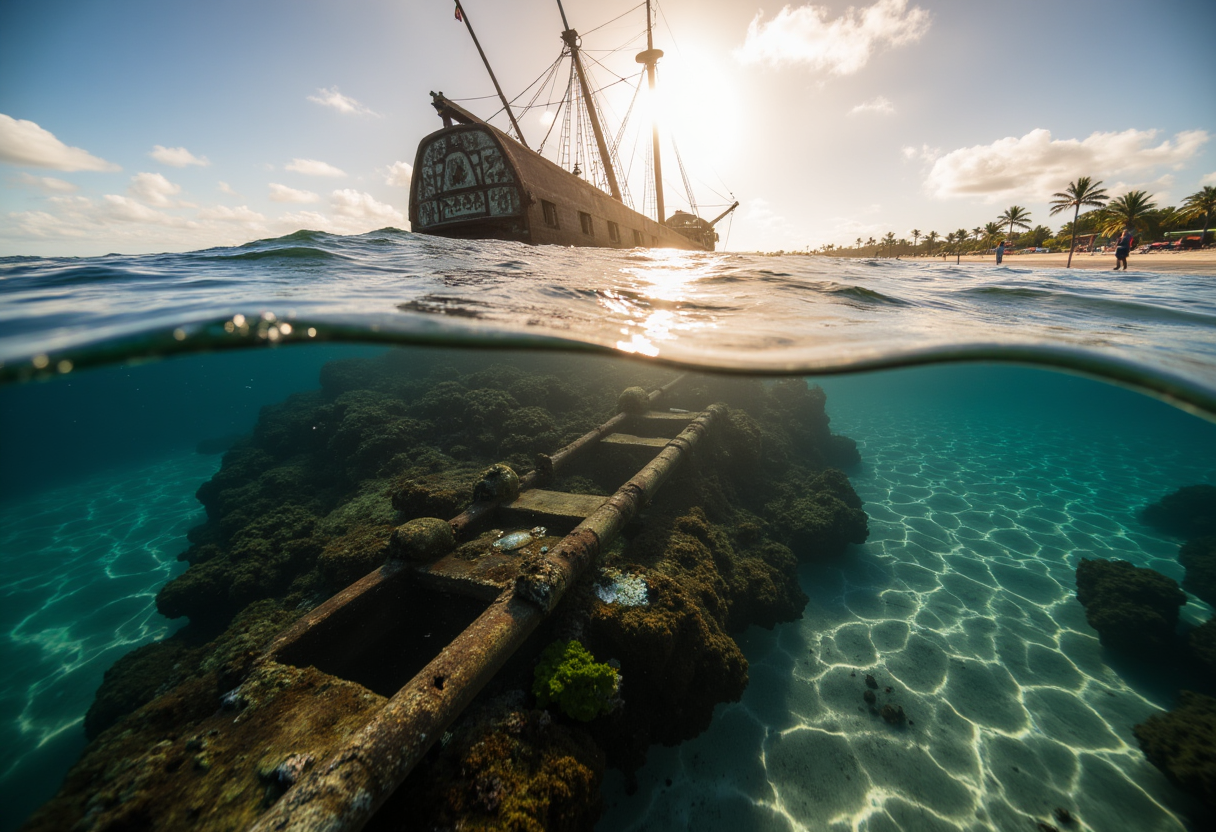
They Say the Shipwreck Shifted Overnight
The Old-Timers Know Better Than to Overexplain
Somewhere near the coast, there is always an older man with sun-damaged skin and a chair that has outlived multiple administrations.
Ask him about the wreck and he’ll nod.
Ask him if it moved and he’ll shrug.
“Water’s alive,” he’ll say, which is not helpful but feels important.
Push further and he’ll tell you that gold doesn’t like being forgotten. That storms wake things up. That the Gulf Stream has opinions.
Then he’ll change the subject to bait prices.
Maps That Never Quite Agree
Another problem with this shipwreck is that maps don’t line up as cleanly as historians would prefer.
Early records are vague. Later surveys contradict earlier ones by just enough distance to be annoying. Modern GPS fixes still don’t land everyone in exactly the same spot.
Some blame old navigation tools.
Some blame shifting sands.
And some quietly suggest the wreck might not care to be found in the same place twice.
Florida’s Long History of Almosts
This would not be the first time Florida has hosted something that almost behaved.
We have animals that almost obey rules.
Weather that almost follows forecasts.
Roads that almost stay dry.
Why should treasure be any different?
The idea that a shipwreck might slowly, subtly reposition itself fits comfortably into the Florida worldview. Not dramatically. Not maliciously. Just enough to stay interesting.
Just enough to remind people it’s still there.
Why These Stories Never Die
Tall Tales survive because they explain feelings facts can’t.
They give shape to unease. They fill in gaps between measurements. They let people say, “Something felt off,” without being laughed out of the room.
In Florida, where history sinks, resurfaces, and sinks again, it makes sense that even a shipwreck wouldn’t stay perfectly still.
So Did the Treasure Move?
Officially? No.
Unofficially? Also no.
But if you ask around long enough, you’ll hear the same phrase repeated with different wording.
“It just didn’t look the same.”
And in Florida, that’s often as close to truth as things get.
Tall Tales Disclaimer
This story is inspired by real shipwreck history, real storms, and very real Florida storytelling traditions. Any movement of treasure is unproven, exaggerated, implied, rumored, or the result of standing in the sun too long.
Which is exactly how Florida likes it.
Share if you smiled, until next time, watch the tide.
Earl Lee
`
