The Unofficial Map of “Don’t Go There”
A Survival Guide to Florida’s Skinny Water
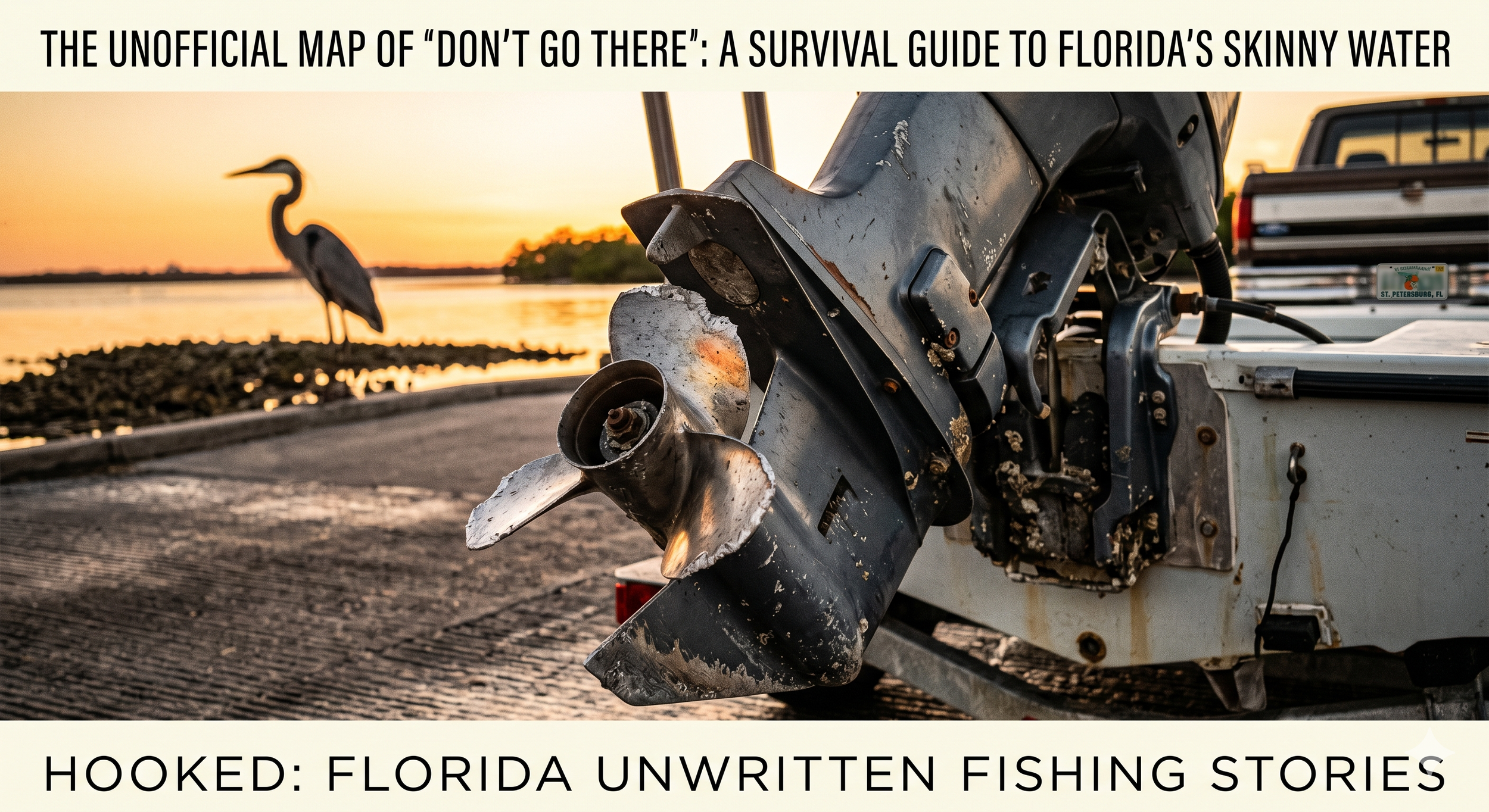
A close-up, low-angle shot of a weathered outboard motor
If you’ve spent more than twenty minutes at a Florida boat ramp, you’ve heard the sound.
It’s a sickening, metallic crunch followed by the high-pitched whine of an outboard motor suddenly finding nothing but air. It’s the sound of a "New-to-Florida" boater meeting a prehistoric oyster bar at six knots.
In the world of Florida fishing, the water that looks the most inviting is often the water that wants to keep your lower unit as a souvenir.
We call it "Skinny Water," and while it holds the shadows of the biggest Redfish you’ll ever see, it’s also a minefield of propeller-eating limestone and mud flats that can turn a half-day trip into a twelve-hour wait for the tide to return.
The Siren Song of the Glassy Flat
There is a specific shade of turquoise—that shimmering, translucent hue—that acts like a siren song for new guides and weekend warriors alike. You see a tail flip three hundred yards away, and suddenly, your common sense evaporates faster than a rain puddle in July. You think, “I can make that.”
But here’s the thing about Florida’s coastline: it’s a master of optical illusions.
What looks like four feet of water is often four inches of water over a limestone shelf that hasn’t moved since the Pleistocene. The "Don't Go There" map isn't printed on any GPS or laminated chart you buy at the marina.
It’s etched into the scarred skegs of the locals. Learning to read the water isn't just about finding fish; it's about respecting the fact that the bottom of the bay is rarely where it appears to be.
The Oyster Bar: Florida’s Natural Shredder
If you want to understand the true meaning of "grit," look no further than a Florida oyster bar.
These aren't just clusters of shells; they are razor-sharp clusters of calcium carbonate that can slice through a flip-flop—or a fiberglass hull—like a hot knife through butter.
Educational tip for the uninitiated: Watch the birds.
If you see a Great Blue Heron standing perfectly still in what looks like the middle of the channel, he isn't walking on water. He’s standing on a reef that is currently waiting to introduce itself to your prop. A seasoned eye looks for the "texture" of the water. If the surface looks "nervous" or has a ripple that doesn't match the wind direction,
you’re looking at a structural hazard. In the world of skinny water, "nervous" water is a warning sign, not an invitation to plane out.
"Cracker-style" porch at dusk. On a rustic side table sits a sweating glass of sweet tea and an old, leather-bound journal.
Don't Leave the Soul of Florida Behind
The best stories aren’t found on the main highways; they’re tucked away in the backroads and the shadows of the mangroves. Join the Florida Unwritten newsletter for a weekly delivery of the folklore, forgotten history, and strange truths that make this state what it is. Consider it the survival kit every Florida soul needs.
The "Custard" Mud: A Lesson in Patience
Then there are the mud flats—those vast, shimmering expanses that look like a shortcut but feel like wet concrete. In parts of the Nature Coast or the backwaters of the Everglades, the mud has a consistency we affectionately call "custard."
If you run aground on an oyster bar, you’ve got a mechanical problem. If you run aground on a mud flat, you’ve got a personality test. I’ve seen grown men try to push a skiff off a custard flat, only to sink hip-deep into the muck while the boat stays perfectly still.
The trick here is learning the "color" of depth. Deep water is a bruised purple or a dark navy; "don't go there" water is the color of a weak latte. If the water starts looking like breakfast, it's time to trim up and head for the channel.
“A Florida nautical chart is just a polite suggestion. The real map is written in the scars on your prop and the stories you tell at the bait shop.”
☀This story is part of the “Hooked On Fishing ” series—
Reading the "V" and the "Slick"
For the new guides trying to make a name for themselves, the most important lesson isn't how to cast—it’s how to read the "V." When the tide is moving, every submerged hazard creates a signature. A rock or a shallow bar will create a subtle "V" shape on the surface, pointing downstream.
Nostalgia usually tells us that the old-timers had a "sixth sense" for this. The truth is, they just didn't have GPS, so they had to actually look at the water.
They watched for the "slick"—that oily-looking patch of calm water that often indicates a change in bottom composition. If you’re humming along at twenty miles per hour and you see a slick that looks out of place, throttle back. Your wallet will thank you.
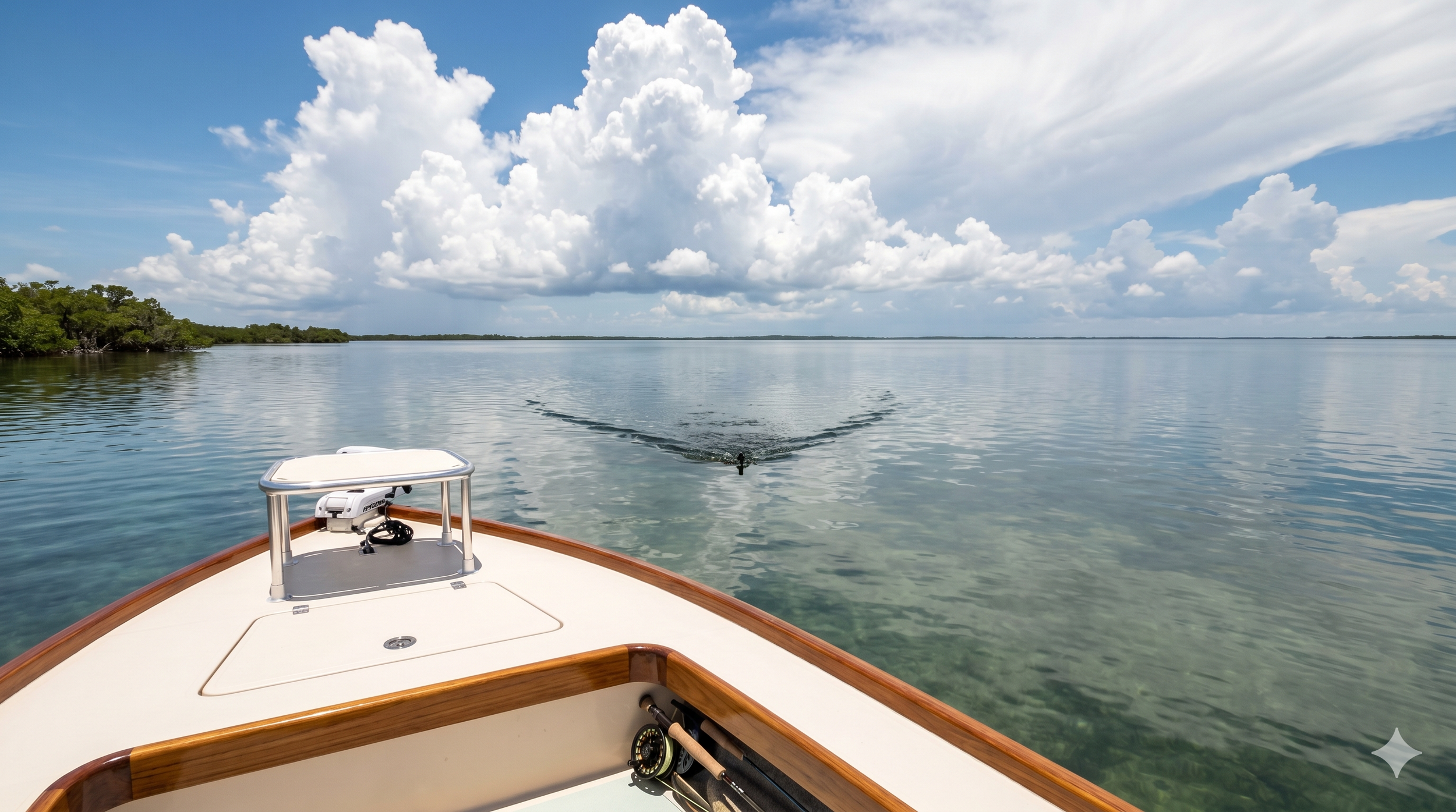
A wide-angle view from the bow of a flats skiff looking out over a vast, glassy expanse of water.
Become a Guardian of the Unwritten
If this story resonated with you, help us keep these Florida legends alive. Sharing our work ensures these "unwritten" corners of our history aren't forgotten. Send this to a fellow resident, a backroads traveler, or anyone who knows Florida is more than just a tourist destination.
Share this story: [Email to a Friend]
The Cost of an Education
Every local guide has a "Don't Go There" spot that they learned about the hard way. For some, it’s a specific corner of the Chassahowitzka; for others, it’s a hidden bar in St. Joseph Sound that only shows its teeth at a negative tide. We call these "educational expenses."
The goal of the [Hooked] section isn't to scare you off the flats—it’s to make sure you get home in time for dinner. Florida’s backcountry is a beautiful, shifting puzzle.
The sand shifts, the storms move the bars, and the mangroves are always reaching a little further out. Being a true Florida angler means admitting that you don’t know it all, and that sometimes, the best way to find the fish is to stay in the deep water and use your eyes instead of your engine.
Respect the Skinny
The next time you’re out, and you see a stretch of water that looks like a shortcut, take a breath. Look for the birds, check the "V" in the current, and remember that the fish will still be there five minutes from now. There’s no shame in taking the long way around if it means keeping your lower unit in one piece.
What’s the one spot you’ll never try to "shortcut" again? Tell me your "Prop-Eater" story in the comments—we’ve all got at least one.
Join tht Guardian call to action
Thanks for spending part of your day with Florida Unwritten.
If this story felt familiar, salty, strange, or a little too Florida to explain at dinner, share it with someone who’d understand.
👉 More stories live at [Your Website]
📬Join for weekly Florida stories, coastlines, wildlife, weirdness, and the kind of local moments tourists usually miss.
Stay Salty Until Next Time
FloridaUnwritten.com
