The Deep, Dark Secrets of Wakulla Springs
The Florida Unwritten Series | Part 5:
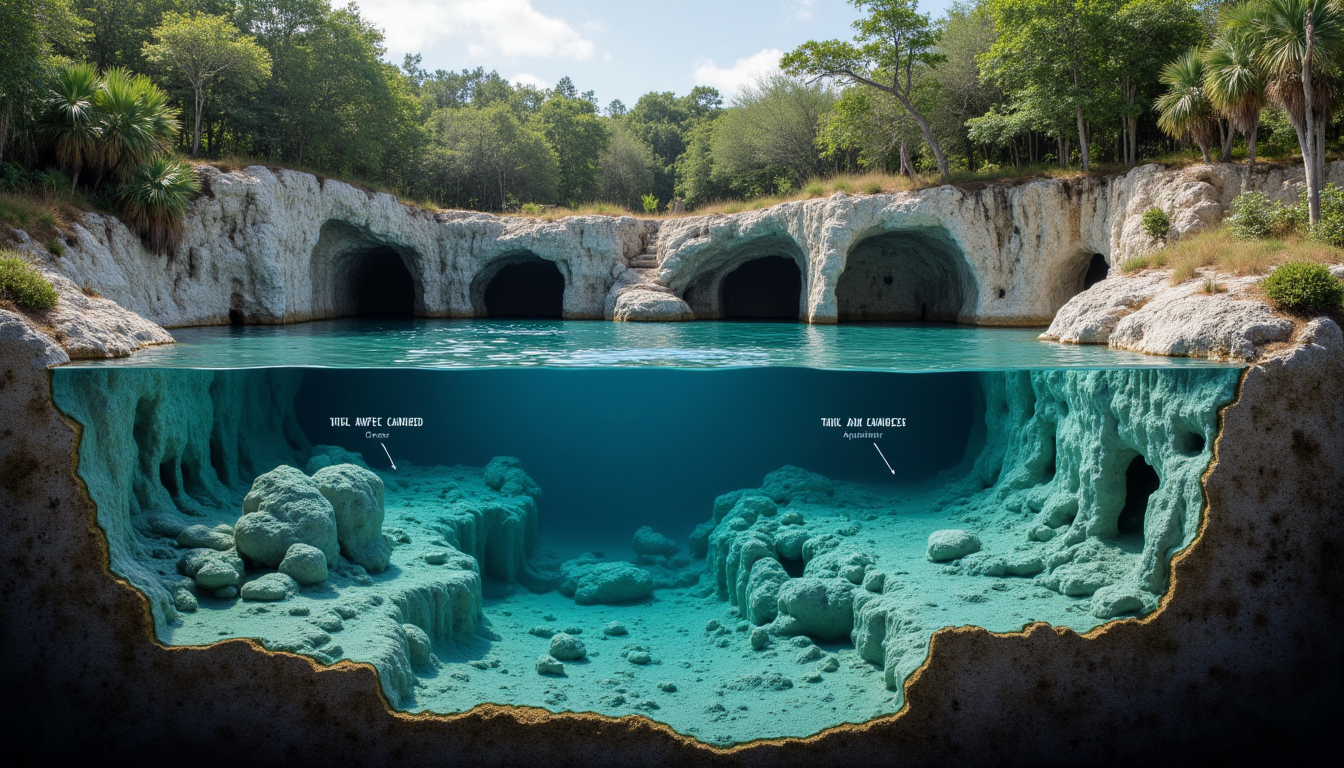
underwater limestone cave
If Florida has a "Final Boss" of nature, it’s not the Everglades or the Keys.
It’s the prehistoric, emerald-shrouded depths of Edward Ball Wakulla Springs State Park.
Located just south of Tallahassee, Wakulla isn’t your average "lazy river" spring. It is a place where the air feels heavy with history,
where the water is so deep it turns navy blue, and where you half-expect a mastodon to emerge from the cypress knees.
This is Florida at its most cinematic, its most ancient, and—honestly—its most eerie.
The Gateway to the "Upside Down"
Wakulla is one of the largest and deepest freshwater springs on the planet.
To understand the scale of what’s happening beneath the surface, you have to look at the numbers.
The main vent pumps out hundreds of millions of gallons of water daily
We aren’t just talking about a hole in the ground; we’re talking about a massive underwater cathedral.
Divers have explored miles of these tunnels,
discovering that the Wakulla-Leon Sinks cave system is the longest underwater cave system in the United States.
When you stare into the "Sapphire Sink," you aren't just looking at water; you’re looking at a world that hasn't changed since the Pleistocene.
Hollywood’s Original Horror House
Long before CGI and green screens, if a director wanted "untamed jungle," they didn't go to the Amazon—they went to Wakulla.
In the 1940s and 50s, this park was the Hollywood of the South.
Most famously, it served as the backdrop for the 1954 classic Creature from the Black Lagoon.
The "Gill-man" lurked in these very reeds, and Ricou Browning (the local legendary swimmer who played the Creature underwater) spent hours navigating these vents.
But it wasn't just monsters. Johnny Weissmuller’s Tarzan movies were filmed here, too.
Legend has it that some of the "jungle" plants you see today are actually descendants of the props left behind by film crews.
Walking through the cypress swamp today, you can still feel that cinematic tension.
The silence is only broken by the splash of an alligator or the prehistoric croak of a Great Blue Heron.
It feels like someone is still shouting "Action!" from behind a mossy oak.
The Ghost of Old Joe
You can’t talk about Wakulla without talking about Old Joe.
In the lobby of the historic lodge, you’ll find a massive, 11-foot-long alligator preserved behind glass.
That’s Joe.
For decades, he was the undisputed king of the spring, a peaceful giant that tourists loved.
In 1966, he was tragically poached, sparking an outrage that eventually helped strengthen alligator protections in Florida.
Today, Joe’s descendants still rule the roost.
If you take the iconic river boat tour—and you absolutely should—you’ll see gators that make the ones at Disney look like lizards.
They sun themselves on logs with a terrifying level of indifference to your presence.
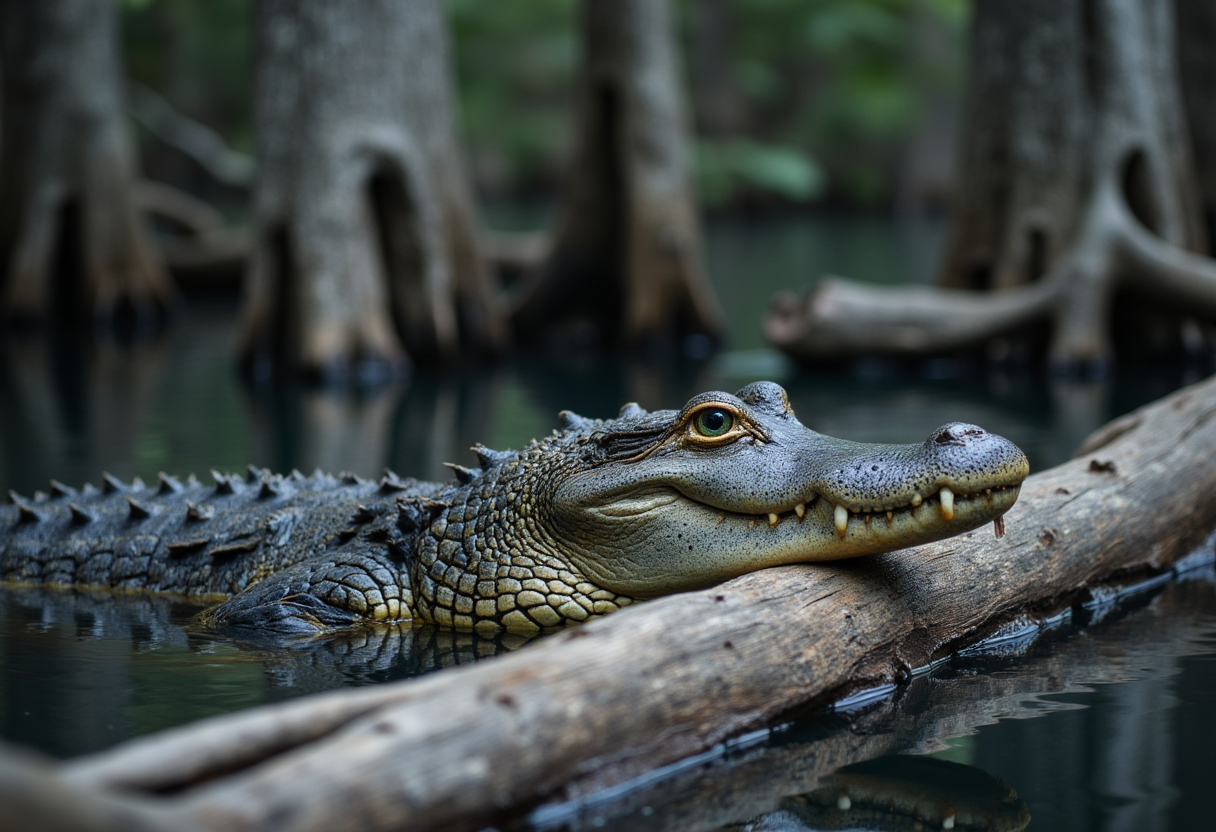
photograph of a colossal American alligator's eye and scales
The Lodge: A Step Back in Time
The park isn’t just about the water; it’s about the Lodge at Wakulla Springs. Built in 1937 by Edward Ball, this place is a masterpiece of Spanish-Moorish architecture.
The Ceiling: Look up in the lobby. The beams are hand-painted with intricate Florida folk motifs and depictions of the spring.
The Elevator: It’s one of the few remaining functional Art Deco elevators of its kind. It moves with a slow, mechanical dignity that reminds you you’re in no rush.
The Soda Fountain: Home to the world’s longest marble counter. Sit down, order a "Ginger Yip," and pretend it’s 1939.
The Lodge is rumored to be haunted (of course), but even if you don’t see a ghost,
you’ll feel the "Old Florida" energy. It’s the kind of place where people actually put their phones down because the real world outside is more interesting than the digital one.
The Science of the Deep
For the nerds among us, the physics of Wakulla are mind-blowing.
The spring is a "first-magnitude" spring, meaning it discharges at least 64.6 million gallons of water per day.
$$Q = A \times v$$
In the simple fluid dynamics of a spring, the discharge ($Q$) is the product of the cross-sectional area of the vent ($A$) and the velocity of the water ($v$). At Wakulla,
these variables are massive. This pressure is what kept the mastodons—yes, actual mastodons—preserved in the silt at the bottom of the spring for thousands of years.
In the 1930s, divers recovered almost entirely intact skeletons of these prehistoric beasts.
You can see one of them today at the Museum of Florida History in Tallahassee,
But knowing it came from the very water you're looking at adds a layer of "Jurassic Park" reality to your visit.
☀ Every Friday, We Head Back Out
Every Friday, another piece of old Florida drifts in—fishing stories,
backroads, quiet places, and the kind of truth you won’t find on a billboard.
Pull up a chair. We’ll save you a spot.
👉Join the newsletter and get it in your inbox every Friday.
The Modern Struggle: Why Wakulla Matters
It’s not all movie sets and marble counters. Wakulla is a fragile ecosystem.
In recent years, the "glass bottom boat" tours (which were the park's claim to fame for nearly a century) have become rare.
Why?
Because nitrogen runoff and pollutants from miles away travel through the Florida Aquifer and into the spring, causing algae blooms that cloud the once-crystal-clear water.
When the water is clear, you can see 75 feet down to the mastodon bones.
When it’s dark, it’s a tea-colored reminder that what we do on the surface impacts the world below.
Visiting Wakulla isn't just a trip; it’s a witness to the resilience—and the vulnerability—of Florida’s heartbeat.
Pro-Tips for the Unwritten Traveler:
Jump off the Tower: There is a wooden diving platform. It is high. The water is cold year-round. Do it anyway. It’s a Florida rite of passage.
The Boat Tour is Non-Negotiable: The guides are masters of "Dad humor" and deep Florida lore. They’ll spot a camouflaged snake on a branch from 50 yards away.
Visit in Winter: If you go on a cold morning, the spring "steams" as the warm water hits the chilly air,
and the manatees huddle near the vent for warmth. It’s ethereal.
Wakulla Springs is the Florida that existed before the mouse, before the highways, and before the neon.
It is deep, it is dark, and it is a little bit dangerous. It reminds us that we are guests in a land that belongs to the gators,
the manatees, and the ghosts of the Black Lagoon.
Florida Unwritten is a weekly letter about the quieter side of the state.
Springs that stay cold in July, towns the highway forgot, and the kind of places you only find by slowing down.
Every Friday morning, one good Florida story.
Warmly,
The Florida Unwritten Team
