The Highway That Ends in the Ocean: A Eulogy for the Dead End
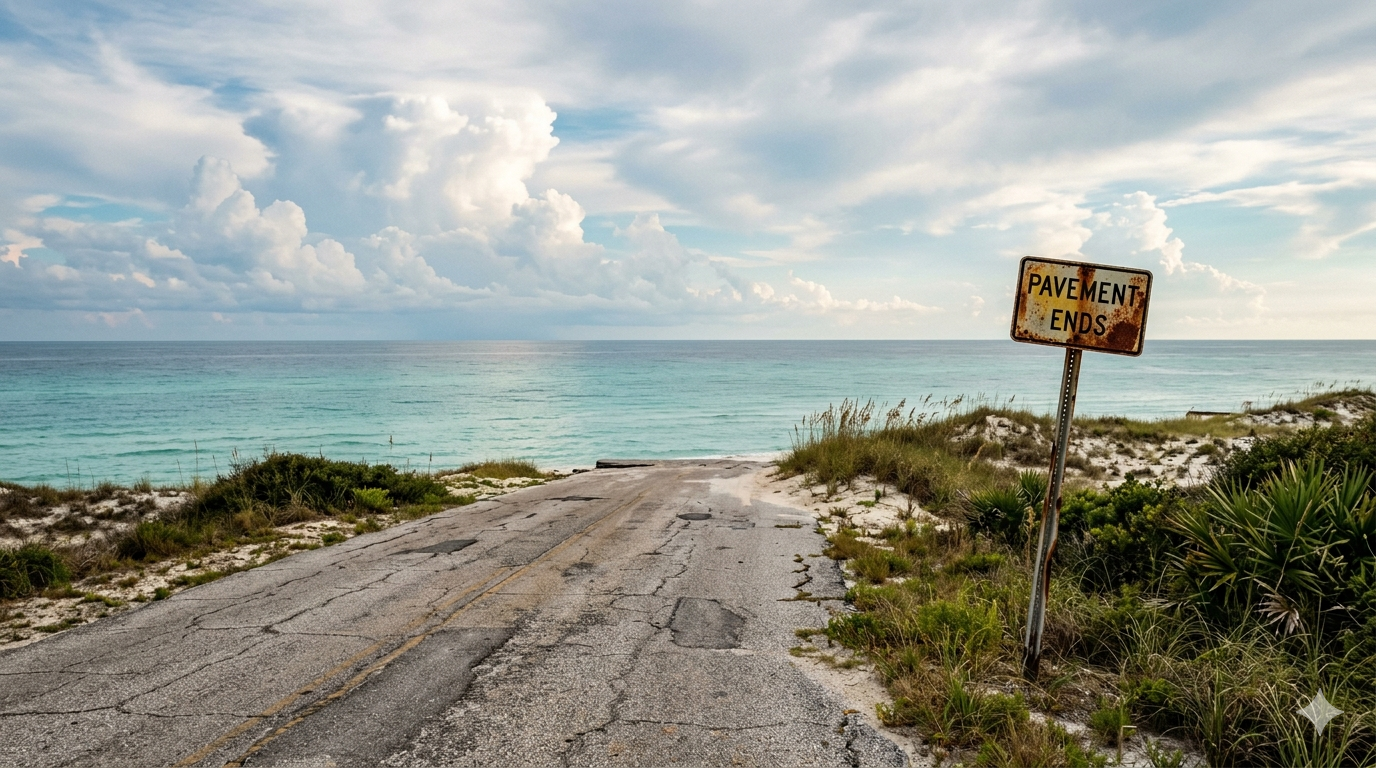
cracked asphalt road ending abruptly at the edge of a vast, calm turquoise ocean in the Florida Panhandle.
There is a specific, nervous frequency that a GPS emits when it realizes it has led you into a trap.
It usually starts with a frantic "Recalculating," followed by a series of increasingly desperate suggestions to make a U-turn.
But eventually, even the satellite-guided voice of modern certainty grows quiet, surrendering to the reality of the Florida coastline.
I was somewhere on the edge of the Big Bend—that vast, marshy curve where the Florida peninsula bows to the Panhandle—when my dashboard went silent.
The road I was on, a two-lane stretch of gray asphalt that had been narrowing for miles, finally gave up.
The white lines had long since flaked away, replaced by the lime-green fingers of salt marsh and the silver skeletons of cedar trees.
Then, the pavement simply stopped.
There was no grand finale. No guardrail. No "End of the World" gift shop selling overpriced magnets.
Just a rusted "Pavement Ends" sign pockmarked by salt-air corrosion and a transition into crushed oyster shells that crunched like broken glass under my tires.
Beyond that?
Nothing but the Gulf of Mexico, flat and gray-blue, stretching out to meet a horizon that looked like it had been painted with a wet brush.
We spend our lives being told that roads are meant to take us somewhere.
But in Florida, some of the most profound stories are found on the roads that take you nowhere.
These are the "Dead Ends" of the Sunshine State—monuments to a time when our ambition was bigger than our engineering, and the swamp had the final say.
The Architecture of Interrupted Dreams
To understand the highway that ends in the ocean, you have to understand the Florida Land Boom of the 1920s.
It was a decade of feverish, sun-drenched insanity. Developers stood on the backs of flatbed trucks,
selling dreams of "Venice in the Everglades" and "The Paris of the Panhandle."
They drew lines on maps with bold, black ink, promising highways that would skip across the keys and bridges that would tame the mangroves.
But Florida has a way of humoring our blueprints until the first hurricane season arrives.
These dead-end roads are the scars of those interrupted dreams. You find them all over the state—on the edges of the Ocala National Forest,
at the bottom of the Everglades, and tucked behind the luxury condos of the Keys.
They are the "Old Florida" grit that refused to be paved over. When you stand at the end of one of these roads,
you aren’t just looking at the water; you’re looking at the exact spot where a surveyor in 1925 threw up his hands and said, "
The mud is too deep, boys. Let’s go get a drink."
There is a profound, quiet dignity in that failure. In a state that is currently being paved over at a rate of acres per hour, a road that stops is a rare and beautiful thing
. It represents a boundary. It represents a place where the wild won.
The Monarch of the Cul-de-sac
The most curious thing about these dead ends is that they are never truly empty.
When I stepped out of my car at the end of the asphalt, I felt like a trespasser in a very quiet kingdom.
To my left, a Great Blue Heron stood perched on a "No Parking" sign with an air of absolute authority.
He didn't fly away. He simply turned his prehistoric neck and looked at me with a golden eye that seemed to say,
“You’re late. The pavement ended forty years ago. What took you so long?”
In Florida,
Nature doesn't just reclaim the road; it incorporates it. Small blue crabs scuttled across the last few feet of hot asphalt, seeking the shade of my wheel wells.
Sea oats pushed through the cracks in the tar, waving like tiny flags of surrender.
There is a specific soundtrack to these places. It’s not the roar of the interstate or the thrum of the city. It’s the "gholp" of a bullfrog,
the liquid slap of the tide against the limestone, and the wind whistling through the cabbage palms.
It’s a silence that is surprisingly loud.
It forces you to stop moving, which is perhaps why we find these places so unsettling at first. We aren't used to being forced into stillness by a dead-end sign.
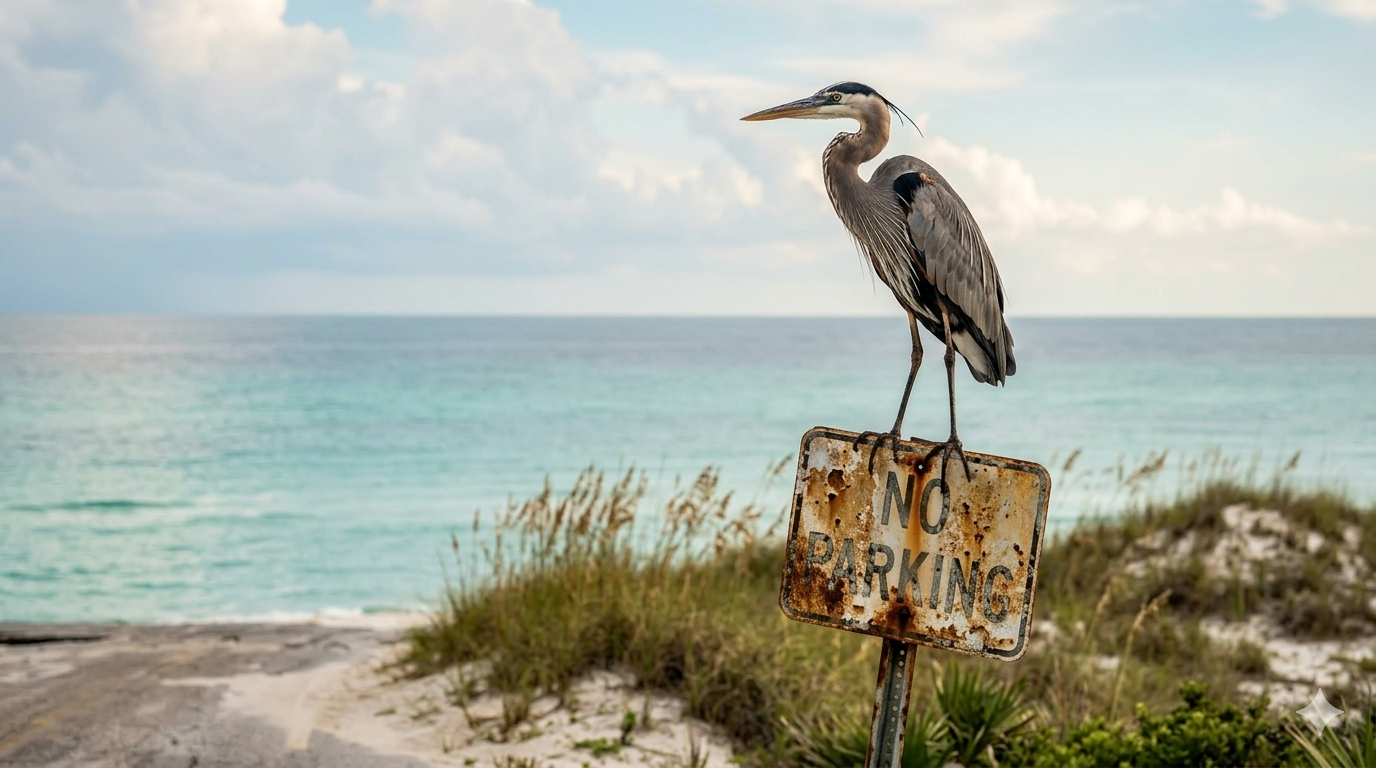
A Great Blue Heron perched on top of a faded, salt-corroded "No Parking" sign
The Beauty of the U-Turn
We are a culture obsessed with the "Scenic Viewpoint"—the designated spot with the wooden boardwalk and the trash can where you are supposed to take the photo.
But the highway that ends in the ocean offers something better: the unscripted view.
When you reach the end of the road, you are forced into a U-turn. And it is in that U-turn that the magic of Florida Unwritten really happens.
On the way in, you were rushing. You were looking at the GPS, checking the clock, wondering how much further the road went.
But on the way back, your perspective has shifted. You notice the small, weathered house tucked behind the sea grapes that you missed before.
You see the hand-painted sign for "Tupelo Honey - $10" leaning against a pine tree.
You notice how the light filters through the Spanish moss, creating a cathedral-like feel.
The dead end isn't a failure of the journey; it’s the climax. It’s the moment the world stops asking you to go and starts asking you to be.
The Unwritten Wisdom
As I drove back away from the Gulf, the asphalt slowly smoothed out beneath me,
I realized that these roads are the "Theme Song" for everything we’re trying to achieve here.
Florida isn't just the theme parks and the high-rises; it’s the stubborn, salty, beautiful places that refuse to be tamed.
It’s the places where the tide comes in, and the road goes out.
Next time your GPS tells you to turn around, maybe keep going for another mile or two. Look for the place where the white lines fade.
Look for the sign pockmarked by salt. When the road ends, and the ocean begins, you’ll know you’ve finally arrived.
Florida Unwritten is a weekly letter about the quieter side of the state.
Springs that stay cold in July.
Earl Lee
Florida Unwritten
