The Dirty History of Florida Mudding and Off-Road Racing
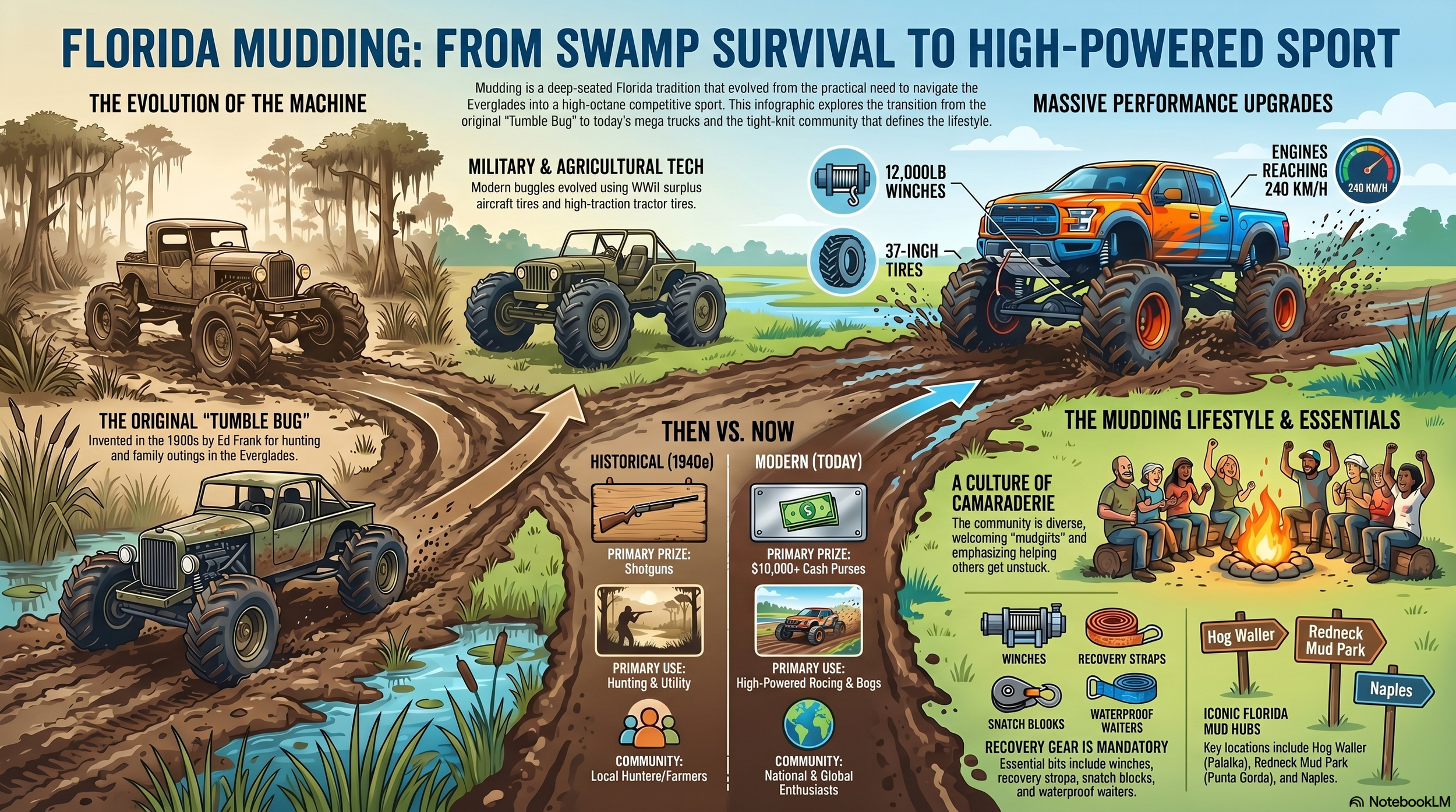
Infographic Evolution
If you think Florida is just white-sand beaches,
overpriced mouse-themed parks, and retired folks driving golf carts at five miles per hour, you’ve clearly never been knee-deep in a cypress head at 3:00 AM, wondering if your driveshaft is about to become a permanent resident of the swamp.
Welcome to the real Florida—the one they don’t put on the postcards. This is Florida Unwritten, and today we’re diving (literally) into the deep ruts, high-octane history, and "gumbo clay" that defines Florida’s off-road racing and mudding culture.
A History Written in Peat and Piston Oil
Before there were lifted Silverados with tires the size of studio apartments, there was a man named Ed Frank.
Back in the 1930s and 40s, the Everglades weren't exactly "commuter-friendly."
Navigating the murky bogs and thick woods of Southwest Florida required rafts or small boats until Frank decided he’d rather drive. He invented what we now call the swamp buggy, originally a strange-looking, tall contraption he dubbed the "Tumble Bug".
In the beginning, these weren't for sport; they were family vehicles for Sunday outings or hunting expeditions.
But, because Floridians have an innate need to see whose "buggy" is faster, it didn't take long for hunters and farmers to start challenging each other to races in the "biggest holes" they could find. By 1943, informal races were happening on Raymond Bennett’s potato farm in Naples.
The first "official" race kicked off on November 12, 1949, where 50 competitors battled for the ultimate Florida trophy: a shotgun.
Today, those Naples races have traded the shotguns for thousands of dollars in prize money, and the vehicles have become too fast, too loud, and far too modified for actual hunting—but they’re perfect for some "good old racing".
The Rigs: Engineering for the Apocalypse
You can’t just take your grandma’s Camry out to Richloam Wildlife Management Area and expect to make it home for dinner. Florida mud trucks are purpose-built beasts.
We’re talking about vehicles lifted "sky-high" with massive, aggressive tires and engines designed to churn through mud thick enough to stop a tank.

New Story Every Friday
The variety is part of the charm:
The Classics: You’ll see plenty of square-body Chevys and Ford F-series trucks dominating the pits.
The Specialists: Mega Mud Trucks are the heavy hitters, often featuring reinforced suspensions and massive tractor tires originally used in agriculture.
The Unexpected: Surprisingly, the Ford Excursion and even the Crown Victoria have become cult favorites. A lifted Crown Vic on mud tires is a sight to behold—a former police interceptor now spending its retirement climbing sand hills and traversing ruts.
👉 More stories live at https://surl.lu/uilyob
For the true "Grappaholics," it’s all about the modifications. You need Mud Grapplers (mud tires) with deep, widely spaced lugs to "self-clean" the muck, or else you’re just spinning your wheels on slick donuts.
And let’s not forget the winch—the holy grail of swamp survival. In a group ride, if you don't have a 12,000-lb winch, you better be riding with someone who does.
Speaking 'Mud': A Florida Lexicon
If you want to sound like you know what you’re doing (even while you’re being pulled out by a Jeep on 37s), you need to learn the lingo:
"Giving it the beans": This is the technical term for flooring the accelerator and hoping for the best when you feel your axle dragging.
"Boogered": When a trail or a truck is in a state of absolute mess/failure.
"Gumbo Clay": A particularly sticky, soul-crushing type of Florida mud that is much more difficult to navigate than standard wet dirt.
"The Student Driver Magnet": At some Florida parks, this is the "shame" award—a magnet passed to whoever gets stuck most spectacularly.
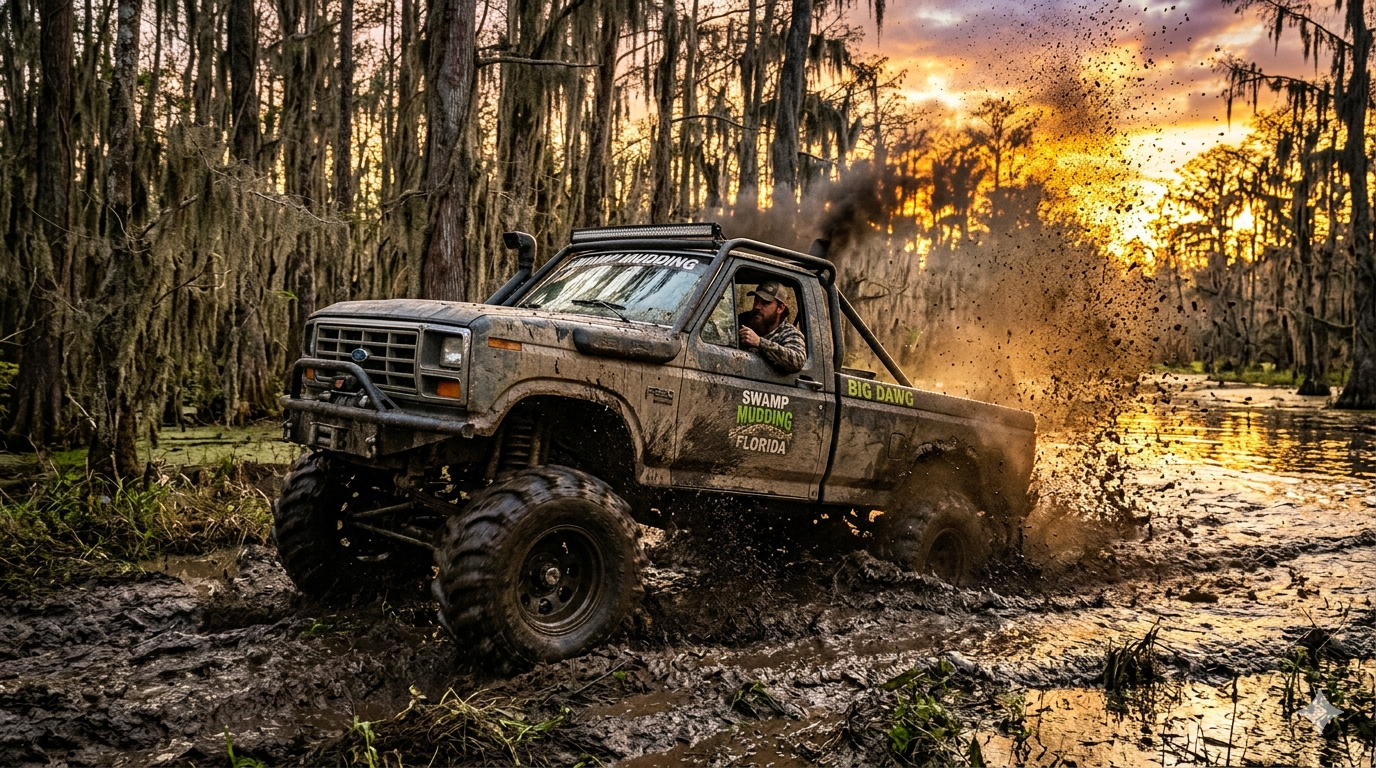
A massive lifted mud truck blasting through deep Florida swamp mud
The Hotspots: Where to Get Dirty
If you’re looking to ruin a perfectly good pair of boots, Florida has some world-class destinations:
1. Hog Waller Mud Bog (Palatka)
Located on the 6,300-acre Rodman Plantation, Hog Waller sits on about 1,200 acres of diverse terrain, ranging from "high sand hills to deep swamps".
Originally opened because the county needed a legal place for people to ride instead of roadside ditches, it’s now one of the biggest ATV and mud parks in the Southeast.
Their "King of the Deep" events and mega-truck races in a five-acre mud pit draw thousands of spectators and offer $10,000 in prize money.
2. Redneck Mud Park (Punta Gorda)
Home of the famous "Gator Hole" and RPM Alley, this park is open every weekend for those who want to experience "Mega Truck" racing and all-night riding. It’s a community-driven atmosphere where "Trucks Gone Wild" is more of a mission statement than a name.
3. Richloam Wildlife Management Area
For the more adventurous (and those with high ground clearance), Richloam is known as one of the wettest areas in its part of Florida.
If it rains once in two months, it stays wet forever. Here, you’ll find deep ruts, fallen trees, and water that can easily become "waist-deep," requiring you to break out the waders just to scout the path ahead.

More Than Just Mud: The Community
The most surprising thing about Florida’s off-road culture isn't the size of the tires—it’s the size of the hearts.
There is a deep sense of camaraderie in the mud. When someone gets stuck (and someone always gets stuck), the "victim" isn't left behind. Instead, the community rallies, often using a kinetic rope or a double line pool with a snatch block to winch them out.
It’s also an incredibly diverse scene. You’ll find:
Mudgirls: Female enthusiasts who build, drive, and dominate the pits, often sharing their builds under the #mudgirl hashtag.
Family Vibes: These events are often family affairs, with kids learning motor skills through "mudplay" and families camping out for the weekend.
The "Moto Doggo": It’s not uncommon to see the family dog decked out in gear, enjoying the roar of the engines.
Pro-Tips for the Mud-Curious
👉 More stories live at https://surl.lu/uilyob
Before you head out to the bogs, keep these "Florida Unwritten" rules in mind:
Check the Depth: Don't just "send it." If you’re at Richloam, you might want to walk the hole first—assuming you don't mind getting stuck in "waist-deep" water yourself.
Momentum is King: Sudden stops in deep mud are a one-way ticket to a "broken driveshaft" or a "blown hole" in your engine block. Maintain a steady speed and avoid sudden braking.
Prepare for the "Saplings": Navigating deep water often means rubbing up against submerged debris and trees.
If you hear a weird noise, it might just be a branch—or it might be your CV axle screaming for mercy.
The Aftermath: All that mud acts as a "protector" for your truck until you get home, but you’ll want to hose it off before the "gumbo" turns into concrete.
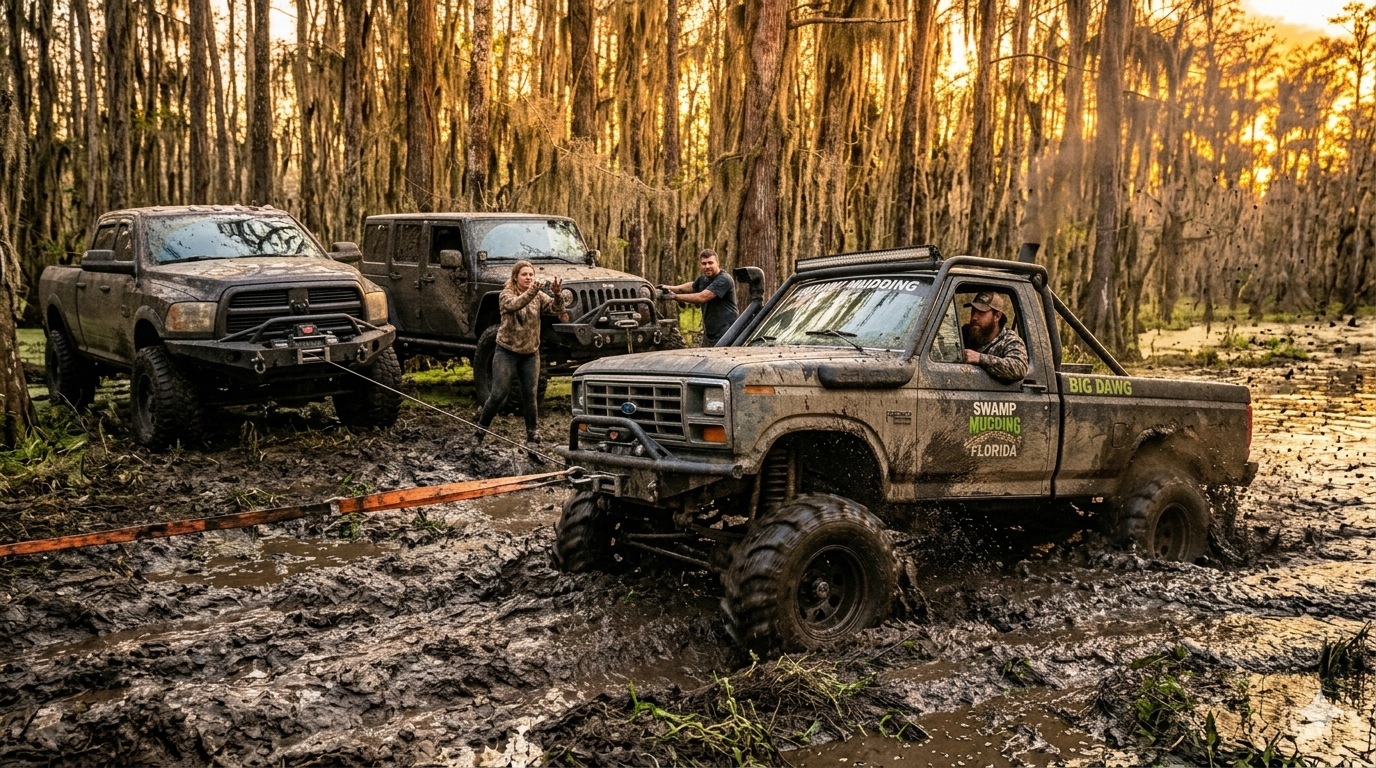
Two lifted trucks using recovery straps and a winch to pull a stuck mud truck from deep Florida gumbo clay
Conclusion: Embrace the Mess
Whether you’re watching a high-powered El Greengo mud truck hit speeds of 240 km/h, or you're just enjoying a cold drink at the "rancho" while watching your friends get boogered in a pit,
mudding is a quintessential Florida experience. It’s a lifestyle that combines engineering, skill, and a healthy disrespect for "clean" clothes.
So, next time you see a truck lifted so high it needs its own zip code, give 'em a wave.
They aren't just driving; they’re participating in a 77-year-old Florida tradition of conquering the swamp, one deep rut at a time.
Ready to get muddy? Grab your recovery straps, "give it the beans," and we’ll see you at the Gator Hole!

Click above to join the Circle
Thanks for spending part of your day with Florida Unwritten.
If this story felt familiar, salty, strange, or a little too Florida to explain at dinner, share it with someone who’d understand.
👉 More stories live at https://surl.lu/uilyob
Florida Unwritten is a labor of love dedicated to the places the brochures forget.
Earl lee
Florida Unwritten
