The Mason Jar Sweet Tea Ritual: A Backroads Liturgy
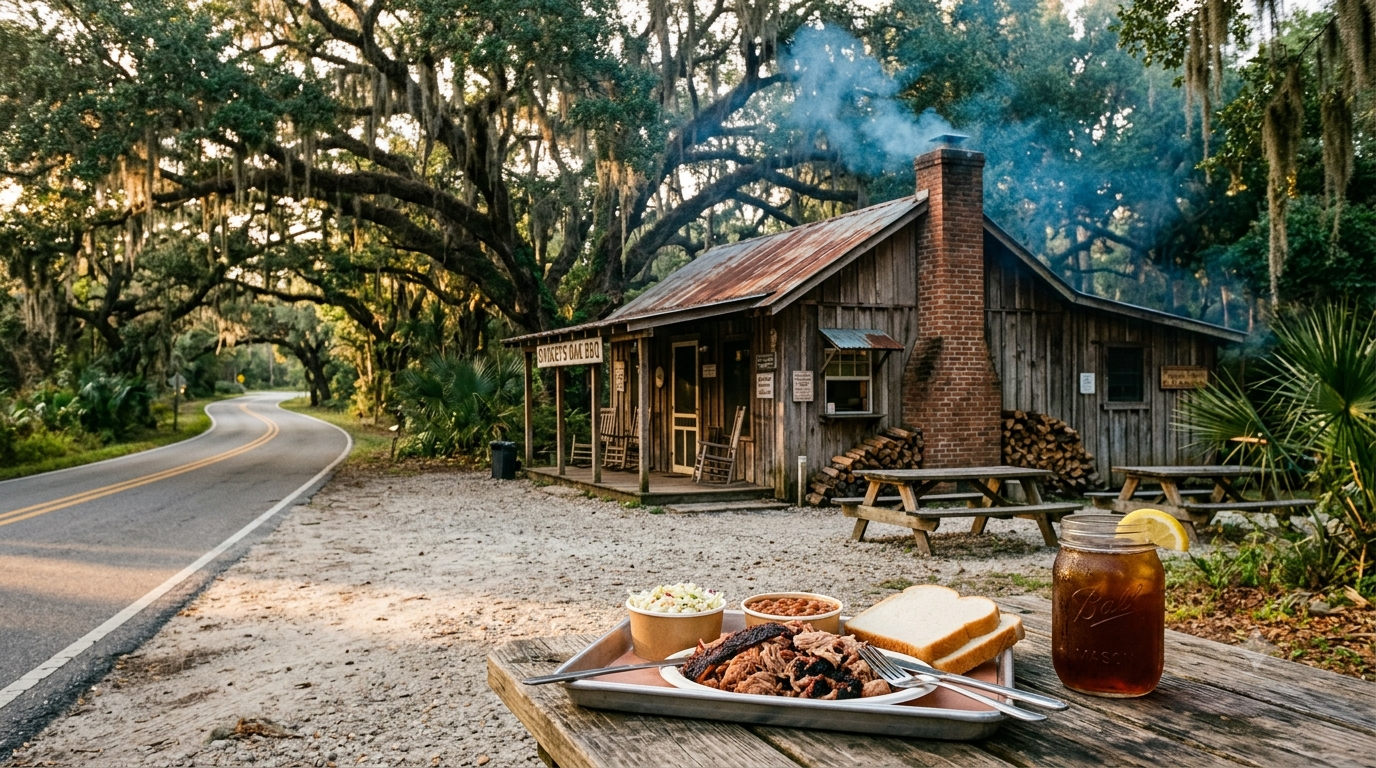
Old Florida roadside barbecue restaurant along a quiet two-lane highway beneath sprawling live oak trees
To understand the Mason Jar Sweet Tea Ritual, you have to first accept a certain kind of surrender. You have to be willing to leave the "neon-lit coastal strips," the "overpriced mouse-themed parks," and the "aggressive indifference" of interstate traffic in your rearview mirror.
To find the real Florida—the one that exists in "the places the brochures forget"—you have to intentionally take the exit you didn't mean to and turn onto a two-lane highway where the cell service begins to flicker.
This isn't a trip you can map out with a blue dot on a screen. In the Florida interior, "the real Florida doesn’t live on Google Maps".
It lives in a landscape that feels less like a state and more like a "fading memory," where the "Architecture of Appetite" is defined by hand-painted plywood signs and quirky local landmarks.
Navigation by "Grudge Trees" and Rusted Iron
The first step of the ritual is the navigation. When the "GPS on your dashboard starts having a midlife crisis," you have to learn to speak the language of the backroads. You’ll likely find yourself at a dusty crossroads, asking an old-timer in a faded cap for directions,
only to be told to "drive until you see the oak tree that looks like it’s holding a serious grudge".
This "Grudge Tree"—a massive, lightning-struck live oak draped in Spanish moss—isn't just a plant; it’s a "botanical character" that has served as a gateway for fifty years.
You’ll be told to look for the "mailbox shaped like a manatee" or the "rusted tractor sinking into the palmettos" that has been there since the Carter administration.
These "heavy metal markers" are the true anchors of our geography. They represent a time when the pace of life was dictated by the "speed of a harvest rather than the speed of a fiber-optic cable".
The Anatomy of the Smoke
You will almost always "smell the destination before you see it". As the "pine flatwoods and palmetto prairies" blur past, the "sweet, heavy, intoxicating scent of slow-burning live oak and hickory" will hit your vents. This is the perfume of the interior.
When the building finally appears, it won't have a glossy marketing strategy or matching uniforms.
It will be a "low-slung building with a corrugated tin roof," smoke billowing lazily from a "blackened metal pit out back". The parking lot will be a "chaotic mix of mud-splattered farm trucks, local police cruisers, and utility vehicles".
The acoustic signal that you’ve arrived is the "Screen Door Slam"—the "rhythmic slap-slam of a wooden screen door" closing behind hungry locals. Inside, the walls are seasoned with a "literal patina of grease and smoke," and the floors might be covered in sawdust to soak up the day’s stories.
You won’t find a digital menu; you’ll find a "hand-lettered chalkboard" and a "counter sticky with sweet sauce".
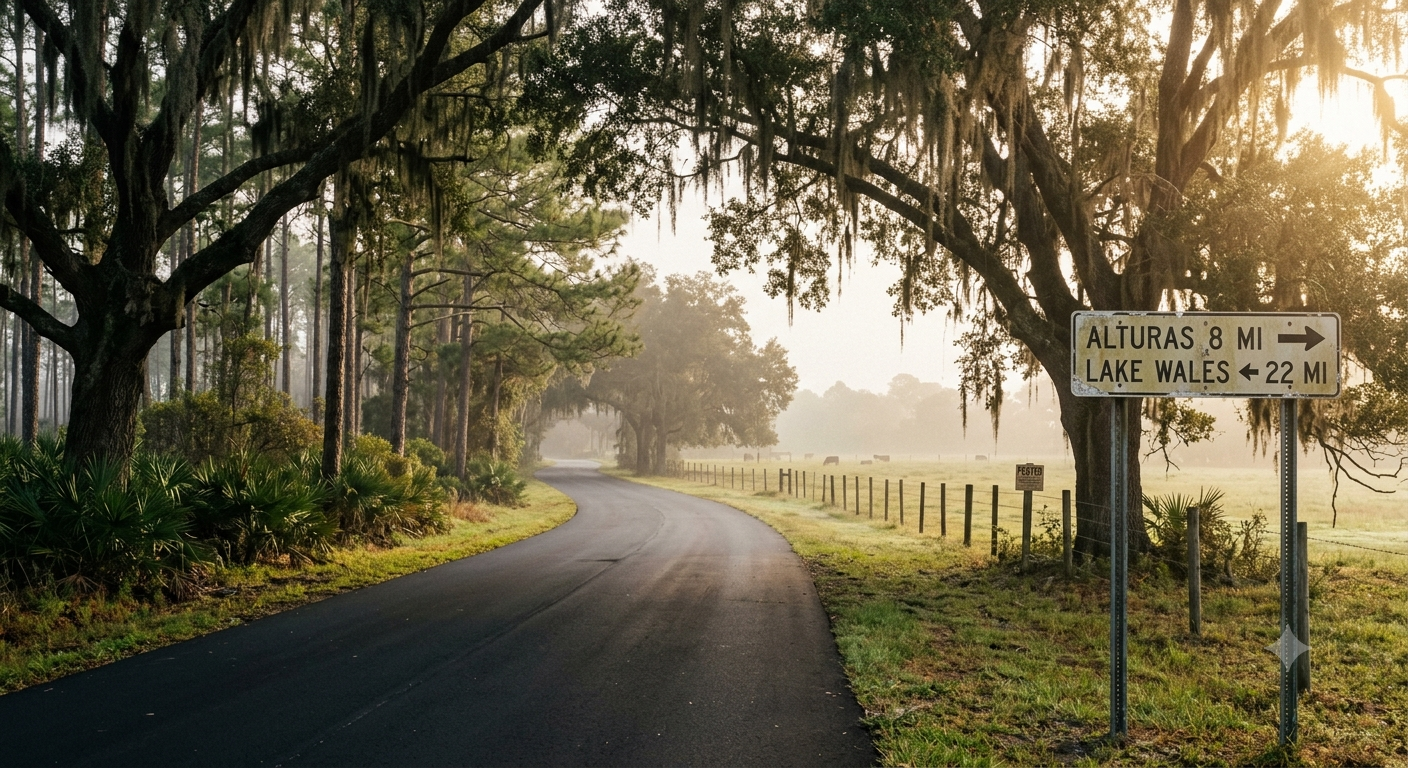
A lonely two-lane blacktop winding through rural Central Florida
The Liturgy of the Sweating Jar
Now we reach the heart of the matter: the sweating mason jar of sweet tea. In the "oppressive humidity" of a Florida summer, this jar is a sensory masterpiece.
The "sweat" on the outside of the glass isn't just condensation; it’s a physical manifestation of the environment, a cold rebellion against the shimmering heat that makes the horizon look like a mirage.
There is a nostalgia to this cold glass that connects us to a "different kind of childhood". For many of us, that first icy sip evokes the "neighborhood water fountain"—the green garden hose.
Back then, drinking from a stranger’s hose was a "forgotten superpower". The water might have tasted a little like rubber, but it was the "finest water any of us ever drank". The mason jar tea carries that same spirit.
It is brewed with enough sugar to be "salty, strange, or a little too Florida to explain at dinner," and it is served with an unspoken trust that you’re exactly where you’re supposed to be.
The "Cracker" BBQ Covenant
Etiquette at a backroad smokehouse demands you "pull up a chair" at a "mismatched picnic table where strangers sit shoulder-to-shoulder". The meal is a "culinary crossroads," stealing the best secrets from our neighbors to create something "entirely unique".
Your paper plate will be a "massive, messy mountain" of pulled pork, likely turned over split live oak, which burns hot and imparts a "rugged, earthy flavor". If you’re lucky, you might find smoked mullet, a "local, oily fish" that is a regional anomaly of the coastal backwaters.
The sauce will be a "sweet, tangy, tomato-and-mustard-based concoction," often "kicked up with a dash of local datil pepper heat".
But "never skip the sides". The baked beans usually sit in a pan "directly beneath the dripping meat in the smoker," and the collard greens are "simmered for hours with ham hocks". As you eat, you aren't just consuming calories; you’re "tasting the history of the state".
The Soundtrack of the Scrub
The ritual isn't complete until you "turn off the radio," roll the windows down, and "let the world back in". While you sit under the shade of an ancient live oak, the "hidden soundtrack of Florida" takes over.
It is a "textured silence" built from:
The "rhythmic, dry rattling of saw palmetto fronds" that sounds like "stiff parchment being shuffled".
The "sudden, sharp whirr of a cicada"—a sound that defines the "heavy, humid soundtrack" of a backroads summer.
The "distant, mournful whistle of a freight train" cutting through the orange groves.
This soundtrack is a "language of wind, of dry leaves, of heat," and of a life lived "outside the reach of the highway". It reminds us that "the world is much larger and much more resilient than the stress of our daily inboxes".
Join the Circle:Subscribe for weeklyFlorida stories, coastlines, wildlife, weirdness, and the kind of local moments tourists usually miss.
The Mental Reset
As you finish your tea and hear that screen door slam one last time, you’ll realize that this was never just about barbecue. It was a "profound mental reset". It was about "finding true solitude" in the "blank spots" on the map—the patches of green that aren't labeled as attractions.
We "thought we were simply riding bikes" or grabbing lunch, but we were really learning "independence, problem solving, and friendship". We were "embracing the quirkiness" and the "beauty in the bizarre".
So, before you head back to the "neon hum" of the city, "stash your flip-flops in your bag" and keep them handy. You never know when a "spontaneous trip to a forgotten historic town" or another "red dirt road" will call your name.
Thanks for spending part of your day with Florida Unwritten. If this story felt familiar, salty, strange, or a little too Florida to explain at dinner, share it with someone who'd understand.
Join the Circle: Subscribe for weekly Florida stories, coastlines, wildlife, weirdness, and the kind of local moments tourists usually miss.
Florida Unwritten is a labor of love dedicated to the places the brochures forget.
See Ya Friday, Earl Lee
